Measuring a band saw blade may sound simple, but it’s a task that can puzzle even experienced woodworkers and metalworkers. The right measurement is not just about length—it affects how well your machine works, the safety of your project, and the quality of your cuts.
Using the wrong size blade can cause poor tracking, blade breakage, or even damage to your band saw. If you’ve ever bought a new blade, installed it, and found out it doesn’t fit, you know the frustration.
In this guide, you’ll learn exactly how to measure a band saw blade, why each measurement matters, and practical methods that work both with and without the blade installed. We’ll cover the main measurements—length, width, and thickness—plus tips for accuracy and common mistakes. By the end, you’ll be able to measure any band saw blade confidently, whether for replacement, custom ordering, or troubleshooting.
Why Band Saw Blade Measurement Matters
Choosing the right size blade is not a minor detail. Every band saw is built for a certain range of blade lengths and widths. Using a blade that’s too long or too short means it won’t tension properly—either the blade will be too loose to cut straight, or it won’t fit onto the wheels at all.
A blade that’s too wide won’t track correctly around tight curves; a blade that’s too thin can wander and break.
Incorrect blade size can also damage your saw’s tires, bearings, or even the motor. For safe, smooth cuts and a longer-lasting machine, precise measurement is essential. This is especially true if your saw’s manual is missing, the existing blade is worn out, or you need a custom blade.
Key Measurements For Band Saw Blades
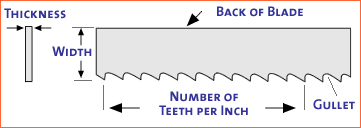
When measuring a band saw blade, you need three main numbers:
- Length (circumference)
- Width
- Thickness (gauge)
Let’s look at each in detail.
Band Saw Blade Length
This is the total distance around the blade, forming a complete loop. Manufacturers list blade length in inches. Common sizes are 72”, 93”, 105”, and 131. 5”, but every saw can vary.
Band Saw Blade Width
Width means the distance from the tip of the teeth to the back edge of the blade. This affects the smallest curve your saw can cut—wider blades are better for straight cuts, narrower blades for tighter curves.
Band Saw Blade Thickness (gauge)
Thickness is measured in thousandths of an inch (e. g. ,. 014”,. 020”,. 025”). Thicker blades are stronger but need a larger saw and more power. Too thin, and the blade might break or twist; too thick, and it might not fit your saw.
Tools And Supplies You’ll Need
Before you start measuring, gather these items:
- Flexible tape measure (tailor’s tape or a construction tape measure that can wrap around the blade)
- Caliper (digital or manual, for measuring width and thickness)
- Marker or chalk (optional, for marking the blade)
- Pen and paper (to write down measurements)
- Safety gloves (band saw blades are sharp!)
If you don’t have all these, don’t worry. You can still get accurate results with just a tape measure, but calipers are helpful for small differences.
How To Measure Band Saw Blade Length
There are three main methods, depending on whether the blade is installed, removed, or if you only have the saw itself.
1. Measuring A Removed (loose) Band Saw Blade
This is the most accurate and popular method. Here’s how to do it:
Step-by-step:
- Lay the blade flat on the floor or a workbench, forming a straight line (not a circle).
- Pull the blade tight so it is not twisted or kinked.
- Mark a starting point on the blade with chalk or a marker.
- Using your tape measure, start at the mark and follow the blade’s edge all the way around until you return to your mark. Make sure the tape stays tight against the blade.
- Read the measurement in inches—this is your blade’s length.
Practical tip: If your tape is not long enough, measure half the blade’s circumference, mark it, then double the result.
Example:
If your tape measure reads 70 inches when you make a full loop, your blade length is 70”.
2. Measuring With The Blade Installed On The Saw
If you can’t remove the blade, use this method. It’s less precise but good for a quick check.
Step-by-step:
- Lower the blade guard so you can see as much blade as possible.
- Mark the blade at the front of the upper wheel with chalk.
- Rotate the upper wheel by hand (unplug the saw first!) Until the mark completes one full revolution and returns to the starting point.
- Measure the distance traveled by the mark using a flexible tape. This is your blade’s length.
Pro Insight: On older saws, the blade might have stretched over time, so the measured length could be a bit longer than the original size. Always check your saw’s manual if possible.
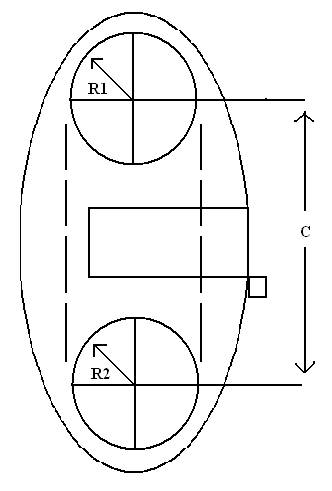
3. Calculating Blade Length From Saw Dimensions
If you don’t have the blade, you can estimate length using the distance between the saw’s wheels and their diameter.
Formula:
Blade Length = (2 × Center Distance) + (π × Wheel Diameter)
Where:
- Center Distance is the distance between the centers of the upper and lower wheels.
- Wheel Diameter is the diameter of the saw’s wheels (in inches).
- Π (pi) is about 3.14.
Step-by-step:
- Measure the wheel diameter (edge to edge across the center).
- Measure the center-to-center distance between the wheels with the saw tensioned for a normal blade.
- Plug the numbers into the formula.
Example:
- Wheel diameter: 14 inches
- Center distance: 17 inches
Blade Length = (2 × 17) + (3.14 × 14)
Blade Length = 34 + 43. 96 = 77. 96 inches (round to 78 inches)
This gives you a good estimate, though actual length may vary slightly depending on blade tension and saw design.
4. Measuring A Broken Band Saw Blade
If your blade snapped and you want to replace it, you can still measure the length.
Step-by-step:
- Lay both pieces end-to-end on a flat surface.
- Align the teeth or back edges to get the true full length.
- Use your tape measure to measure from one end to the other.
Beginner’s Miss: Don’t forget to add the thickness of the blade material at the break point. Some users lose 1/8″ to 1/4″ if the broken ends are uneven.
Measuring Band Saw Blade Width And Thickness
These two measurements are much easier.
How To Measure Width
Lay the blade flat and use a caliper (or a ruler if you don’t have a caliper). Place the caliper jaws at a right angle to the blade, from the tip of the tooth to the back edge. Read the measurement.
- Common widths: 1/8”, 1/4”, 3/8”, 1/2”, 5/8”, 3/4”, 1”.
Pro Tip: If your blade is heavily worn, measure a less-used area for a more accurate reading.
How To Measure Thickness
Place the caliper jaws on the flat part of the blade, avoiding the teeth. This will give you the gauge in thousandths of an inch.
- Common thicknesses: .014”, .018”, .020”, .025”, .035”.
If you only have a ruler, thickness is harder to measure accurately; a caliper is best.
How To Choose The Right Band Saw Blade Size
After you have your measurements, you need to select the best blade for your needs. Here’s what to consider:
Minimum And Maximum Blade Length
Check your saw’s manual for the accepted blade length range. Most band saws can tension a range (e. g. , 92-1/2” to 93-1/2”). Using a blade outside this range can prevent proper tension.
Blade Width For Your Project
- Wide blades (3/4″ to 1″): Best for straight, resawing cuts.
- Narrow blades (1/8″ to 1/4″): Best for tight curves and scrollwork.
- Medium widths (3/8″ to 1/2″): Good general-purpose cutting.
Blade Thickness (gauge)
- Thicker blades: For heavy work, straight cuts, or resawing thick material.
- Thinner blades: For fine, tight curves or when using smaller wheels (less than 14”).
Non-Obvious Insight: Using too thick a blade on small wheels can cause metal fatigue and early breakage because the blade is forced to bend too sharply.
Common Mistakes When Measuring Band Saw Blades
Even experienced users can make errors. Avoid these:
- Measuring a stretched or worn blade. Old blades can be longer due to stretching. Always measure a new or lightly used blade for best results.
- Ignoring blade set. The teeth often stick out wider than the blade body. Measure only the blade body, not the teeth.
- Not accounting for blade breakage. When measuring a broken blade, align the ends carefully to avoid underestimating length.
- Using the wrong units. Always use inches, as most blades are sized in the US that way.
- Guessing based on old packaging. Blade boxes can be mislabeled or reused—always measure yourself.
- Assuming all saws use the same sizes. Even two 14” saws can use different blade lengths.
Understanding Band Saw Blade Tooth Configurations
While not part of the measurement, tooth shape and spacing affect how your blade performs.
- Skip tooth: Widely spaced for fast, rough cuts.
- Hook tooth: Aggressive, for hard materials.
- Regular tooth: Fine, for clean cuts in wood or plastic.
You’ll often see TPI (teeth per inch) listed. More TPI means a smoother cut, but slower feed rate.
Example Data: Typical Band Saw Blade Sizes By Saw Type
Here’s a comparison of common band saw types and their standard blade sizes.
| Band Saw Type | Blade Length (inches) | Blade Width Range (inches) | Blade Thickness (inches) |
|---|---|---|---|
| Bench-top 9″ | 62 | 1/8 – 3/8 | .014 – .018 |
| 14″ Floor Model | 93-1/2 | 1/8 – 3/4 | .018 – .025 |
| 18″ Industrial | 133 | 1/4 – 1 | .025 – .035 |
Note: Always check your saw’s specifications, as actual sizes may differ.
Practical Tips For Accurate Band Saw Blade Measurement
- Use a flexible tape. Steel measuring tapes can be stiff and give inaccurate results.
- Double-check your numbers. Measure twice, order once.
- Order slightly shorter if uncertain. A blade that’s 1/4” short can usually be tensioned; a blade that’s too long cannot.
- Label your blades. Write the length on new blades so you don’t have to measure again.
- Keep a measurement log. Record the correct size for each saw you own for future reference.

Credit: www.youtube.com
When To Replace Or Resize Your Band Saw Blade
Sometimes, measuring is not enough—knowing when to replace or resize is just as important.
Replace Your Blade If:
- It’s cracked, missing teeth, or heavily worn.
- It’s stretched and won’t tension properly.
- The weld joint is separating.
Resize Your Blade If:
- You’ve changed the wheel size or configuration.
- You need a special length for custom cutting.
Advanced Note: Some shops have blade-welding machines and can custom-make blades to any length.
Understanding The Relationship Between Wheel Size And Blade Thickness
A common mistake is to use a blade that’s too thick for your band saw’s wheel diameter. Here’s a handy chart:
| Wheel Diameter (inches) | Max Blade Thickness (inches) |
|---|---|
| 6 – 10 | .014 |
| 12 – 14 | .018 |
| 16 – 20 | .025 |
| 24+ | .032+ |
Using a blade thicker than recommended can break the blade or damage your machine.
Measuring Band Saw Blades For Custom Or Specialty Saws
Some band saws, especially European or industrial models, use metric blades or custom lengths. If you’re ordering from a specialty supplier:
- Provide all three measurements: Length, width, and thickness.
- Mention tooth configuration and TPI if required.
- Specify application: Wood, metal, plastic, or composite.
Non-Obvious Insight: Specialty saws sometimes use “odd” lengths to ensure you buy blades from the original manufacturer. Measuring yourself can save money by allowing you to order generic blades.
Troubleshooting: What If The Blade Doesn’t Fit?
If your new blade is too short or too long:
- Too short: Try loosening the tension all the way and gently prying the blade onto the wheels. Never force it. If it’s still too short, return it.
- Too long: The blade will be loose and won’t tension. Do not attempt to cut it and reweld unless you have the proper equipment.
- Wrong width: If the blade rubs the guides or doesn’t track on the wheels, check your measurement. Order the correct width.
- Wrong thickness: If the blade won’t fit in the guides or on the tires, you may need a thinner blade.
Beginner’s Miss: Don’t try to “make do” with a blade that’s close but not right. Poor fit can be dangerous.
Credit: dev.detroitbandsaw.com
Quick Reference: Band Saw Blade Measurement Checklist
- Remove or access the blade.
- Lay flat and measure length (or use calculation method).
- Use a caliper to check width and thickness.
- Record all numbers in inches.
- Double-check against your saw’s manual.
- Order or install the correct blade.
Extra tip: Always unplug your band saw before working with the blade.
Real-world Example: Measuring And Replacing A Band Saw Blade
Let’s walk through an example with a typical 14” band saw.
- Remove the old blade.
- Lay it flat and measure around: 93.5 inches.
- Use a caliper: Width is 1/2″, thickness is .025″.
- Check manual: Accepts 93-1/2″ blades, width 1/8″ to 3/4″.
- Choose a 1/2″ wide, .025″ thick, 93-1/2″ long blade for general cutting.
- Order the blade, install it, tension properly, and check tracking.
Result: The saw cuts smoothly with no blade drift or excessive noise.
Credit: ellissaw.com
Other Factors To Consider When Measuring Band Saw Blades
- Kerf size: How much material the blade removes. Not directly related to measurement, but affects cut width.
- Blade set: Teeth are bent left and right for chip clearance; measure only the blade body, not the tooth set.
- Blade weld location: Some blades have a slight lump at the weld; avoid measuring here.
Safety Precautions When Measuring Band Saw Blades
- Always wear gloves to prevent cuts.
- Unplug the saw before touching the blade.
- Handle broken blades carefully—sharp edges can be dangerous.
Where To Find More Information
For more technical details and advanced tips, the Bandsaw Wikipedia page offers a thorough overview of band saw operation and blade types.
Frequently Asked Questions
How Do I Know What Size Band Saw Blade My Saw Needs?
Check your saw’s manual or the sticker inside the upper wheel cover. If missing, measure the old blade or use the calculation method with wheel diameter and center distance for a good estimate.
Can I Use A Blade That’s Slightly Longer Or Shorter Than My Saw’s Recommended Size?
A blade up to 1/4” shorter can usually be tensioned; longer blades will be loose and won’t work properly. Always aim for the correct length for best performance.
What Is The Most Accurate Tool For Measuring Blade Width And Thickness?
A caliper (digital or manual) is best for both width and thickness. Rulers are less precise, especially for thickness, and can lead to errors.
Why Does My New Blade Not Fit Even Though I Measured Carefully?
Possible reasons include blade stretch, saw wheel wear, or a mislabeled blade. Double-check your measurements and compare with the saw’s manual; contact the supplier if the blade is still incorrect.
Can I Make My Own Custom-length Band Saw Blades?
If you have access to a blade-welding tool and the right materials, yes. However, for most users, it’s safer and more practical to order blades to your measured length from a reputable supplier.
Measuring your band saw blade correctly is a skill that saves time, money, and frustration. Once you master these simple steps, you’ll always get the right fit—and enjoy smoother, safer cutting on every project.