
The best chop saw table saw combination balances clean crosscuts, safe handling, strong power, and useful workshop space.
Picture a Saturday project with long boards, trim, and sheet stock spread across your garage. A chop-style miter saw makes fast crosscuts, while a table saw handles rips and larger panels. The right setup saves trips, reduces guesswork, and helps you work with less strain. I reviewed these saws and blades with that real-world problem in mind. Some are compact and light, while others offer more reach or better finish cuts. This guide will help you choose the best chop saw table saw combination for your tools, budget, and cutting style.

Metabo HPT 10-Inch Single Bevel…
POWERFUL AND PRECISE: This 10-inch single bevel compound miter saw features a 15-Amp motor delivering high power for effortless cuts. The power saw generates a no-load speed up to 5,000…

SKIL 10″ Dual Bevel Sliding…
POWERFUL 15 AMP MOTOR – Delivers 4,800 RPM for quick, detailed cuts DUAL BEVEL – Perform cuts in four positive stop positions at 48° & 45° left, 0°, and 45°…

DOVAMAN Updated 10-Inch Sliding Miter…
Multi-Material Cutting with Dual-Speed: Includes two 40-tooth and one 48-tooth TCT 10-Inch blades for versatile cutting. The dual-speed setting (5000RPM and 3200RPM) allows precise cuts in wood, PVC, and soft…
Metabo HPT 10-Inch Compound Miter Saw

The Metabo HPT C10FCG2 is a compact 10-inch compound miter saw for trim, framing stock, and routine crosscuts. Its 15-amp motor gives it the power most home users need for common wood jobs. The single-bevel design keeps the controls simple and easy to learn. I also like the built-in Xact Cut shadow line because it shows the cut path without relying on a thin laser beam.
This saw uses positive miter stops to help repeat common angles with less setup time. The 40-tooth carbide blade is a sensible starting blade for general wood work. Its lighter body is useful when I need to move the saw between a bench and a portable stand. It does not replace a table saw for long rips, but it can pair well with one in a small shop.
Pros:
- Powerful 15-amp motor for common wood cuts
- Clear shadow-line cut guide
- Lightweight body for easy transport
- Useful 0–45-degree bevel range
- Positive stops make angle work faster
- 10-inch blade size is easy to find
Cons:
- Single bevel needs more repositioning for some cuts
- Not designed for long rip cuts
- Included blade may not suit fine finish work
SKIL 10-Inch Dual-Bevel Sliding Miter Saw

The SKIL MS6305-00 adds sliding reach and dual-bevel control to a familiar 10-inch format. That combination helps when I cut wide boards, baseboard, casing, or framing lumber. The 15-amp motor gives this saw a confident feel during normal crosscuts. Its dual-bevel head lets me tilt left or right without turning the workpiece around.
For a homeowner, remodeler, or new woodworker, this model offers a lot of useful range at a reasonable size. The sliding rails need room behind the saw, so I would measure the bench before buying. A good support table also matters because long stock can pull the cut out of square. As part of the best chop saw table saw combination, this is a strong choice when crosscut capacity matters more than table-saw work.
Pros:
- Sliding action increases crosscut capacity
- Dual-bevel head saves setup time
- Strong 15-amp motor
- 10-inch blades are widely available
- Good fit for trim and renovation work
- Useful choice for beginners who want room to grow
Cons:
- Rear slide rails require extra clearance
- Not a substitute for a table saw fence
- Dust collection may need shop-vac support
DOVAMAN 10-Inch Sliding Miter Saw

The updated DOVAMAN sliding miter saw focuses on flexibility. It includes three TCT blades, ambidextrous controls, a laser guide, and nine positive stops. The listed speed settings support both wood work and selected multi-material tasks, but I would always match the blade to the material first. Its 0–45-degree bevel range covers many home repair and craft cuts.
The large stated cutting capacity is useful for shelves, deck boards, flooring pieces, and wide trim. The laser can help with quick layout, though I still prefer to confirm the blade path with a test cut. Ambidextrous operation is helpful in a busy shop where the saw position may change. For shoppers seeking the best chop saw table saw combination on a budget, this model offers many accessories in one package.
Pros:
- Includes three carbide-tipped blades
- Sliding design handles wider stock
- Ambidextrous controls suit left- and right-handed users
- Laser guide supports quick alignment
- Nine positive stops speed repeated cuts
- Useful for several household materials when the correct blade is used
Cons:
- Laser accuracy should be checked before precise work
- Extra features can make setup feel less simple
- Material limits must be followed carefully
Virutex TM33W Tiltable Miter Saw

The Virutex TM33W stands apart because it combines a tiltable miter saw with an upper table. That upper table gives the tool a second work position for certain table-style cuts. It can be a smart answer for a small workshop where every square foot matters. The integral safety system and precision laser add confidence during setup and operation.
This tool is best viewed as a specialized combination saw, not as a direct replacement for a full-size cabinet table saw. Its portable design makes it easier to carry to a job site or store after work. The upper table may help with smaller stock, but I would check the manual for approved materials, depth, and fence use. If compact versatility is your top goal, this is one of the more literal choices for the best chop saw table saw combination.
Pros:
- Combines miter functions with an upper table
- Portable design suits mobile work
- Precision laser helps mark the cut path
- Integral safety features support controlled use
- Useful option for small work areas
- Tiltable design adds cutting flexibility
Cons:
- Higher cost than basic miter saws
- Upper table capacity is not the same as a full table saw
- Less common format may need a careful learning period
Diablo 12-Inch 60-Tooth Combination Blade
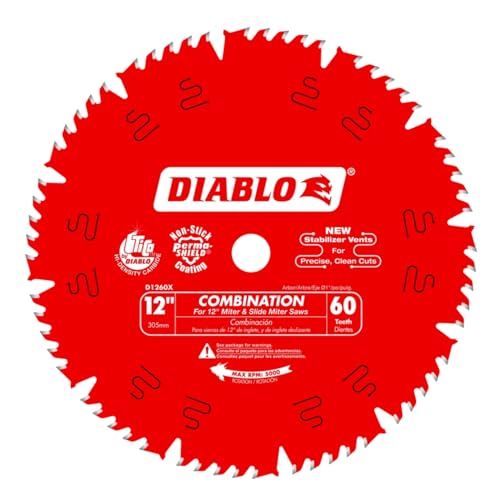
A saw is only as useful as the blade installed in it. This Diablo D1260X is a 12-inch, 60-tooth combination blade made for wood cutting. Its tooth count aims to balance a clean finish with a reasonable feed rate. The 1-inch arbor and 6,000-rpm maximum rating must match the saw before installation.
I would choose this blade for users who move between crosscuts and moderate rip cuts. It can improve the finish over a coarse framing blade, especially on trim and visible edges. Still, a combination blade cannot perform every task perfectly; a dedicated ripping or fine-finish blade may work better for specialized jobs. As an add-on, it can improve the best chop saw table saw combination without taking up much storage space.
Pros:
- 60 teeth offer a useful balance of speed and finish
- 12-inch size suits compatible miter and table saws
- Carbide teeth support longer working life
- Combination pattern handles more than one wood task
- Thin kerf can help reduce waste on compatible saws
- Good upgrade for a basic factory blade
Cons:
- Only fits saws with the correct arbor and diameter
- Not the best choice for thick, fast ripping
- Requires careful rpm and material checks
DEWALT 12-Inch Single-Bevel Miter Saw

The DEWALT DWS715 is a straightforward 12-inch compound miter saw for users who want reach and familiar controls. Its 15-amp motor is suited to framing, trim, and general crosscut work. The larger blade can handle substantial stock when the material is positioned and supported correctly. A single-bevel head keeps the price and operation simpler than a dual-bevel model.
This saw makes sense for a contractor, serious DIY user, or homeowner who often cuts large boards. Its size also means it deserves a sturdy stand and good side support. I would not buy it for a tiny bench unless I had a clear storage plan. In a two-saw shop, it pairs well with a portable table saw and becomes a dependable half of the best chop saw table saw combination.
Pros:
- 12-inch blade provides generous crosscut potential
- 15-amp motor handles common job-site lumber
- Compound cuts support trim and framing work
- Well suited to repeated construction cuts
- Large format offers room for thicker stock
- Simple controls are easy to learn
Cons:
- Single bevel requires workpiece repositioning
- Larger body takes more bench and storage space
- Support stands are important for long boards
WEN 10-Inch 80-Tooth Finish Blade

The WEN BL1080 uses 80 carbide-tipped teeth to target smooth finish cuts. It fits compatible 10-inch miter saws and table saws, making it useful for a shared workshop setup. The higher tooth count can reduce rough edges on trim, plywood, and other suitable wood stock. I see it as a finish blade rather than a fast production blade.
Fine teeth reward a steady feed and a clean, well-aligned saw. They are not ideal for forcing thick lumber through a cut. I would keep a general-purpose blade nearby and install this one when the edge will remain visible. For a woodworker building the best chop saw table saw combination around clean results, this blade is a practical upgrade.
Pros:
- 80 teeth support smooth visible cuts
- Works with compatible 10-inch miter and table saws
- Carbide tips improve durability
- Useful for trim and cabinet-style projects
- Can reduce splintering with proper setup
- Good value for finish-focused users
Cons:
- Slower than a coarse blade on thick stock
- Needs the correct arbor and blade guard clearance
- Not intended for aggressive ripping
SKIL 10-Inch Portable Jobsite Table Saw
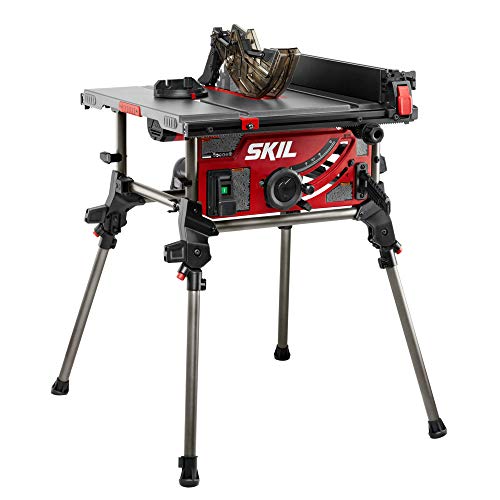
The SKIL TS6307-00 supplies the table-saw side of this buying guide. It uses a 15-amp motor, a 10-inch blade, and a folding stand for job-site mobility. The stand is valuable because a stable working height can make long boards easier to control. Its portable format also suits garages where a permanent cabinet saw would take too much room.
A table saw performs the rip cuts that a chop or miter saw cannot do safely or efficiently. I would use the fence for long, straight cuts and use outfeed support for large panels. Before work, check that the blade, riving knife, guard, and fence align correctly. If I had to choose one table saw partner for the best chop saw table saw combination, this SKIL model would be a practical starting point for many DIY users.
Pros:
- 15-amp motor supports common ripping tasks
- 10-inch blade size is widely supported
- Folding stand improves portability
- Useful for boards, trim stock, and sheet goods
- Provides the rip-cut function a miter saw lacks
- Good fit for garages and mobile workshops
Cons:
- Portable tables offer less mass than cabinet saws
- Large panels still need careful support
- Users must verify fence and blade alignment
Yumark 8-1/4-Inch Compound Miter Saw

The Yumark 8-1/4-inch saw targets shoppers who want a compact tool for light wood work. Its listed 5,000-rpm speed and corded design suit small boards, trim, and simple project parts. The smaller blade can make the unit easier to store than a 10- or 12-inch saw. Its compound miter format adds angle options for basic home projects.
I would consider this model for a beginner, apartment workshop, or occasional repair kit. The reduced blade size also means I would not expect the same capacity as a larger sliding saw. Always check the cutting depth and material limits before tackling thick stock. As a compact part of the best chop saw table saw combination, it is most appealing when storage space matters more than maximum reach.
Pros:
- Compact 8-1/4-inch format saves storage space
- Lightweight style suits occasional users
- High listed speed supports clean wood cuts
- Compound miter function adds angle flexibility
- Corded power avoids battery charging
- Accessible option for small household projects
Cons:
- Smaller blade limits cutting capacity
- Less suited to thick construction lumber
- Brand-specific support and parts should be checked
WEN 10-Inch 60-Tooth Finish Blade
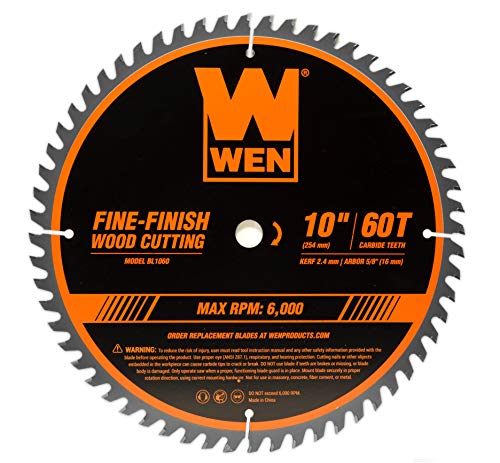
The WEN BL1060 is a 10-inch, 60-tooth blade for users who want a smoother edge than a basic coarse blade can provide. It works with compatible miter saws and table saws. The 60-tooth count offers a middle ground between fast cutting and fine finish work. That makes it a useful blade for general furniture parts, trim, and clean crosscuts.
I like this type of blade for a two-saw setup because I can move it between tools when the arbor and guard requirements match. I would inspect the blade for pitch buildup and keep the work firmly against the fence. A clean blade and slow, even feed often matter as much as tooth count. For buyers building the best chop saw table saw combination on a modest budget, this blade adds useful flexibility.
Pros:
- 60 teeth balance finish and cutting speed
- Fits compatible 10-inch miter and table saws
- Carbide teeth are suited to repeated wood cuts
- Useful for trim and basic furniture work
- Affordable way to improve cut quality
- Good general-purpose companion blade
Cons:
- Not as fine as an 80-tooth finish blade
- Not ideal for heavy ripping through thick lumber
- Compatibility must be confirmed before installation
My Recommendation
After comparing the saws and blades, I would build a combination around the SKIL portable table saw and the SKIL sliding miter saw for most home workshops. The table saw handles rips, while the sliding miter saw handles crosscuts and bevels. That pairing covers furniture, shelving, trim, flooring, and many repair jobs without demanding a large permanent shop. If you want the most compact true combination, the Virutex deserves attention because its upper table adds a second cutting position.
For large construction stock, the DEWALT 12-inch model gives more reach. For a low-cost and light setup, the Metabo HPT or Yumark may be easier to carry. I would add the WEN BL1060 for general cuts or the WEN BL1080 for smoother finish work. Always match the blade diameter, arbor, rpm rating, guard, and material to the saw manual. Tool value is not only the purchase price; it also includes safe setup, reliable support, blade cost, and the time saved on each project.
| Best for | Why |
|---|---|
| Best overall two-saw setup | SKIL table saw plus SKIL sliding miter saw covers rips, crosscuts, bevels, and wide stock. |
| Best compact combination | Virutex offers an upper table and miter functions for shops with limited floor space. |
| Best finish-focused setup | A compatible 10-inch saw paired with the WEN BL1080 can produce smoother visible edges. |
How I Evaluated These Saw Combinations
I do not judge a chop saw by motor power alone. A strong motor means little if the fence moves, the table flexes, or the blade does not track well. I look at cutting role, setup time, support needs, blade access, portability, and user safety. Those details decide whether a tool feels helpful or becomes another dusty box in the corner.
I also separate miter work from table-saw work. A miter saw pushes the blade down through a supported workpiece. A table saw moves the workpiece across a rising blade. Their jobs overlap for some cuts, but their strengths differ. That is why the best chop saw table saw combination is usually a pair of compatible tools, not one machine forced to do every task.
Chop Saw or Miter Saw: What Is the Difference?
People often use “chop saw” and “miter saw” as if they mean the same tool. A chop saw usually describes a machine made for straight, fast cuts, often in metal or heavy construction work. A miter saw adds a pivoting table and sometimes a bevel head for angled wood cuts. The products in this guide are mainly miter saws, though many shoppers use “chop saw” as a broad search term.
A sliding miter saw adds rails so the blade can travel through wider stock. A compound model tilts for bevel cuts. A dual-bevel model tilts in both directions. These features help with crown molding, picture frames, door trim, and angled joints. The best chop saw table saw combination should match the cuts you make most often, not just the largest number printed on the box.
Why Add a Table Saw?
A table saw is the better tool for ripping a board lengthwise. It also helps cut sheet goods when you use proper infeed and outfeed support. The fence guides the work in a straight line, while the miter gauge can assist with some crosscuts. I still prefer a miter saw for repeated short crosscuts because it is fast and easy to reset.
Safety matters more with a table saw because the user feeds material toward the blade. Keep the guard and riving knife installed when the cut allows it. Do not freehand a rip, and do not stand directly behind the board. Current workshop guidance also supports eye and hearing protection, dust control, and a clear work area.
Key Buying Factors for 2026
Blade size and cutting capacity
Common miter saw sizes include 8-1/4, 10, and 12 inches. A larger blade may cut thicker stock, but it also adds weight and cost. A 10-inch model often offers the best balance for homeowners. A 12-inch saw makes sense when you work with larger trim or framing lumber often.
Sliding or non-sliding design
A non-sliding saw takes less space and usually has fewer parts to adjust. A sliding model cuts wider boards but needs rear clearance. Measure the saw footprint with the rails extended, not only the folded body. If your bench sits close to a wall, a front-rail or compact design may fit better.
Bevel range
A single-bevel saw tilts one way. A dual-bevel saw tilts both ways. Dual bevel saves time when you cut matching trim on both sides of a room. Single bevel can still deliver accurate results, but you may need to flip or reposition the workpiece.
Fence and table support
A square fence helps the blade meet the work at the angle shown on the scale. Test it before a large project. Long boards need side extensions or a separate support stand. Without support, the board can tip and pinch the blade. Good support often improves results more than a small increase in motor power.
Dust control
Sawdust can hide the cut line and irritate your eyes and lungs. Use the dust port with a suitable shop vacuum when possible. A vacuum will not capture every chip, especially on a miter saw, but it can reduce the cloud. Wear eye protection and use respiratory protection suitable for the dust and workspace.
Blade choice
Tooth count affects cut speed and surface quality. A lower tooth count often cuts faster through framing lumber. A higher count usually leaves a cleaner edge in trim and plywood. Check kerf width, arbor size, blade diameter, tooth type, and maximum rpm. Never install a blade simply because it looks like it will fit.
Portability and storage
A portable saw helps if you work in more than one room or carry tools to a job site. A folding stand can save time and reduce back strain. A heavy saw may feel more stable, but it is harder to move. Think about your actual routine. A tool that takes five minutes to set up may get used more than one that needs a permanent bench.
Safety Tips for a Chop Saw Table Saw Setup
Read the manual before the first cut. Inspect the blade, guard, cord, switch, and work supports. Keep your hands outside the marked danger zone. Let the blade reach full speed before entering the material, and wait until it stops before lifting the head or reaching near the cut.
Secure small pieces with a clamp when the manual allows it. Do not hold a short piece close to the blade with your fingers. Support long stock on both sides of a miter saw. On a table saw, use a push stick or push block when your hands would approach the blade.
Use the correct blade for wood, plastic, or another approved material. A wood blade is not automatically safe for metal or composite stock. Check for nails and screws before cutting used lumber. Disconnect power before changing a blade or clearing a jam. These simple habits protect your hands and help the saw last longer.
Common Mistakes to Avoid
The first mistake is expecting one saw to perform every cut. A miter saw does not replace a table saw fence for long rips. A table saw does not offer the same quick angle control for trim. Buying the right pair is often more useful than buying one oversized machine.
The second mistake is skipping calibration. Factory scales can shift during shipping or use. Check the fence with a reliable square and make a test cut before visible work. The third mistake is using a dull blade. A dull blade needs more force, creates more heat, and can leave a poor edge.
Another common issue is poor material support. Long stock acts like a lever and can lift from the table. Use level supports that match the saw surface. Finally, do not ignore the room around the saw. Give yourself space to stand, move, and safely guide the workpiece.
FAQs Of best chop saw table saw combination
Can one saw replace both a chop saw and a table saw?
Usually, no. A miter or chop saw excels at short crosscuts and angled cuts. A table saw excels at long rips and sheet goods. A combination-style tool may cover light work, but two dedicated tools provide better control and capacity.
What size miter saw works best with a portable table saw?
A 10-inch miter saw is often the best match. It offers useful capacity, common blade availability, and manageable weight. Choose a 12-inch model if you regularly cut large trim or thick stock.
Are the same blades usable on a miter saw and table saw?
Some blades are labeled for both tools, but compatibility is not automatic. Confirm the diameter, arbor, kerf, tooth design, and rpm rating. Follow the saw and blade maker’s instructions before installation.
Is a sliding miter saw worth the extra cost?
It is worth it if you cut wide boards, shelves, or large trim. A sliding model adds reach. A non-sliding saw may be better for small trim work or a tight bench because it needs less space.
What should I buy first for a small workshop?
Buy the tool that matches your most common cut. Choose a table saw first for long rips and sheet goods. Choose a miter saw first for framing, trim, and repeated crosscuts. Add the second tool when your projects require it.
Final Verdict: Which Should You Buy?
For most DIY users, the SKIL sliding miter saw paired with the SKIL portable table saw is the best chop saw table saw combination. It covers wide crosscuts, bevels, rips, and sheet goods at a useful price and size.
Choose the DEWALT for larger stock, Virutex for compact versatility, or WEN blades for cleaner edges. Match every blade and cut to the manual for safe, reliable results.