
The best saw table accessories improve safety, dust control, accuracy, and comfort without forcing you to replace your table saw.
A table saw can cut with great speed, but small problems quickly become frustrating. A narrow strip may drift, dust may cover your work, or your hand may get too close to the blade. I have found that the right accessories act like extra hands around the saw. Push blocks protect your fingers, featherboards steady the wood, and sleds help make clean crosscuts. This guide reviews the best saw table accessories for safer cuts, better control, and a cleaner workshop. I also explain who each tool suits best, so you can spend money with confidence.
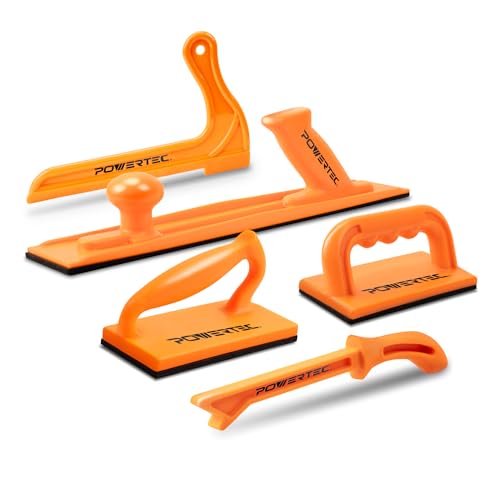
POWERTEC Push Block and Push…
INCLUDES: (1) Long Hold Down Push Block (1) Safe V Stick and (1) Straight Push Stick (2) Short Hold Down Push Blocks. BLOCK FUNCTION: Provides added hand safety while guiding…

Table Saw Dust Collector Bag…
【Compatible With】The table saw dust bag is compatible with a wide range of table saws including Bosch 4000, 4100, GTS1031, and GTS1041A, as well as Dewalt/Ryobi/Craftsman/Porter Cable/RIGID/Metabo/Kobalt/Skilsaw/Delta/10″ table saws, that…

21P Table Saw Sled Kit,…
Table Saw Sled Kit: You will receive 2 UHMW miter bars for table saw (17 in), 2 universal T-tracks (12 in), 1 star knob and bolt, 1 round washer, and…
POWERTEC Push Block and Stick Set

The POWERTEC 71009V set gives you several ways to guide stock through a table saw. Its mix of push blocks and push sticks works well for sheet goods, narrow boards, and smaller parts. The handles feel more natural than a short scrap-wood stick, especially during long cuts. I also like that the set can serve a router table, band saw, or jointer.
The broad gripping surfaces help keep the workpiece under control as it passes the blade. That added control can reduce sudden movement, which is one of the main causes of poor cuts and unsafe hand positions. The set does not replace a blade guard, riving knife, or careful technique. Still, it offers a practical safety upgrade for both new woodworkers and busy home shops.
Pros:
- Includes several push tools for different cuts
- Works with table saws, router tables, band saws, and jointers
- Ergonomic handles provide a firm, comfortable grip
- Helps keep hands away from the blade
- Useful for both wide boards and narrow stock
- Good starter value for a small workshop
Cons:
- Takes some storage space compared with one push stick
- Plastic parts may show wear with heavy daily use
- Large hands may prefer a wider custom handle
My Recommendation
I recommend this set for beginners, weekend woodworkers, and anyone who wants a complete hand-safety kit in one purchase. It is also a smart choice for a shared shop because different users can select the push tool that feels most natural. Among the best saw table accessories, this set stands out for its broad use and easy learning curve. It offers strong everyday value without the cost of several premium tools.
| Best for | Why |
|---|---|
| New table saw users | Provides several easy-to-use push options |
| Small workshops | One set covers several woodworking machines |
| General safety | Helps maintain hand distance from the blade |
Table Saw Dust Collector Bag

This dust collection bag is made for many 10-inch table saws that use a 2.5-inch dust port. It is listed as compatible with brands such as Bosch, DeWalt, Ryobi, Craftsman, RIDGID, Metabo, Kobalt, Skilsaw, and Delta. A bag like this catches chips close to the source instead of allowing them to spread across the floor. That can make cleanup much faster after a long cutting session.
I see this accessory as a simple option for shops that do not have room for a full dust collector. It is light, easy to remove, and useful for quick jobs. You must confirm your saw model and port size before ordering, because brand names alone do not guarantee a perfect fit. Also, a collection bag should not replace a dust mask or proper workshop ventilation.
Pros:
- Helps collect sawdust at the table saw
- Useful for shops without a large dust collector
- Supports many common 10-inch table saw brands
- Lightweight and simple to install
- Can reduce floor cleanup after cuts
- Works with a common 2.5-inch dust-port size
Cons:
- Compatibility depends on the exact saw and port
- Needs regular emptying during heavy work
- May not capture fine dust as well as a powered collector
My Recommendation
This bag suits apartment garages, small basements, and mobile job sites where a full dust system is not practical. It is one of the best saw table accessories for basic chip control and quick cleanup. I would choose it for occasional cutting, not as the only dust solution for daily production work. Check the port measurement first, then use hearing, eye, and respiratory protection as well.
| Best for | Why |
|---|---|
| Small shops | Needs little space and adds simple dust control |
| Quick projects | Removes chips without setting up a large collector |
| Portable work | Light design is easier to move and store |
21-Piece Table Saw Sled Kit

This 21-piece kit is aimed at woodworkers who want to build or improve a crosscut sled. The parts can help create runners, stops, and other guides for controlled crosscuts. A well-made sled supports the workpiece on both sides of the blade and can reduce tear-out. It also gives you a stable platform for repeat cuts.
The value here comes from flexibility rather than a ready-made sled. You still need a flat sled base, careful measuring, and time for setup. I would check the dimensions of your table slots before using the runners, since slot sizes vary between saws. When fitted and tuned well, this kit can turn a basic table saw into a more accurate crosscut station.
Pros:
- Offers many parts for a custom crosscut sled
- Can improve repeat-cut accuracy
- Helps support work on both sides of the blade
- May reduce tear-out with a proper sled base
- Useful for advanced DIY woodworking projects
- Lets users design around their own table saw
Cons:
- Requires building and tuning before use
- May not fit every table slot without adjustment
- Not the best choice for users wanting instant setup
My Recommendation
I recommend this kit for makers who enjoy building shop fixtures and want more control over crosscuts. It is especially useful for furniture work, picture frames, boxes, and repeated parts. The kit earns a place among the best saw table accessories because it can improve accuracy at a low project cost. However, measure first and take time to make the sled flat, square, and free from play.
| Best for | Why |
|---|---|
| DIY fixture builders | Includes parts for a custom sled design |
| Repeat crosscuts | Supports stops and a stable cutting platform |
| Furniture makers | Can improve square, clean crosscut work |
GOINGMAKE Thin Rip Jig

The GOINGMAKE thin rip jig helps make narrow, repeatable strips on a table saw. It can also suit a band saw or router table when the track size matches the stated 3/8-inch by 3/4-inch T-slot. This type of jig moves with the cut and helps maintain a steady offset from the fence. That is useful when you need several strips with the same width.
Thin ripping can feel awkward because a small gap is hard to measure and control by eye. A jig gives that task a fixed reference, much like a ruler that stays in place. I would test the setup with scrap wood and confirm that the fence is parallel to the blade. This tool improves repeatability, but it cannot correct a misaligned saw or a poorly set fence.
Pros:
- Helps make repeated narrow strips
- Useful for edging, splines, and small craft parts
- Can work with several woodworking machines
- Provides a consistent offset from the fence
- May save time on repeated measurements
- Compact compared with a large shop jig
Cons:
- Requires a matching T-slot size
- Needs careful setup for safe, accurate results
- Less useful for wide or irregular stock
My Recommendation
This jig is best for trim builders, box makers, and woodworkers who often cut thin strips. It is one of the best saw table accessories for repeat work because it turns a tricky hand measurement into a guided process. I would not buy it for occasional rough cuts alone. If your saw has the correct slot and you value repeat width, it can quickly earn its space beside the fence.
| Best for | Why |
|---|---|
| Thin strip cutting | Maintains a repeatable distance from the fence |
| Box and trim work | Helps create uniform small parts |
| Multi-tool shops | Can suit a saw, band saw, or router table |
Dual-Port Table Saw Dust Adapter

This dual-port adapter is made to connect two 2.5-inch dust hoses to a table saw setup. It can help collect dust from more than one outlet, such as a cabinet port and an upper blade-guard port. Better airflow at both points may reduce the cloud of fine dust that often rises above the blade. The compact form also helps keep hoses organized.
Dust collection depends on the entire system, not only the adapter. Your collector must have enough airflow, and the hoses should stay short and clear of sharp bends. I would inspect each connection for leaks before cutting. This adapter is most helpful for a shop that already owns a suitable collector and wants to improve its saw connection.
Pros:
- Connects two 2.5-inch dust hoses
- Can support lower and upper dust collection
- May reduce airborne chips around the saw
- Helps organize a multi-hose setup
- Small design uses little bench or floor space
- Useful for cabinet and portable saw systems
Cons:
- Needs a dust collector with suitable airflow
- Two hoses may reduce suction if the system is weak
- Connections may need clamps or extra fittings
My Recommendation
I recommend this adapter for experienced woodworkers who already use a shop vacuum or dust collector. It is among the best saw table accessories for improving a two-point collection system, especially when fine dust escapes near the blade guard. It is not a complete dust solution by itself. Match the hose size, seal leaks, and use a suitable filter for fine particles.
| Best for | Why |
|---|---|
| Two-hose systems | Joins two 2.5-inch dust connections |
| Cabinet saw owners | Can support upper and lower dust pickup |
| Cleaner workshops | May reduce chips and dust near the blade |
The Hedgehog Table Saw Featherboard
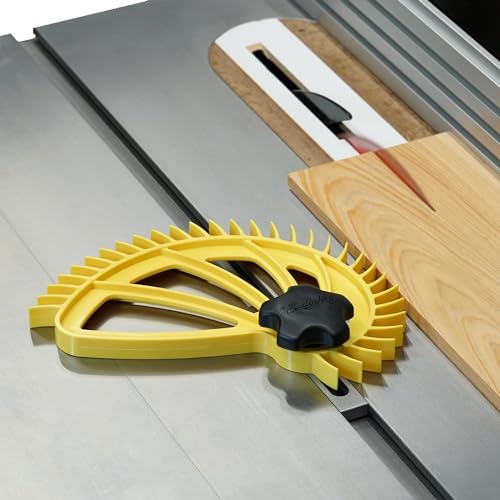
The Hedgehog featherboard helps hold wood against the fence as you make a cut. Its flexible fingers apply steady side pressure without stopping the board from moving forward. That pressure can reduce wandering, burning, and uneven edges. It is useful for table saws and may also work with compatible router-table setups.
I find featherboards most valuable when cutting long boards or making repeated rips. They act like a calm second hand, keeping the stock close to the fence while you guide it with the push tool. Correct placement matters because too much pressure can make feeding hard. Install it before the blade, keep it clear of the cut path, and follow the saw maker’s safety instructions.
Pros:
- Helps keep stock tight against the fence
- Can improve rip-cut consistency
- Reduces side-to-side board movement
- Useful for long boards and repeated cuts
- Supports a smoother feeding motion
- Compact and easy to store
Cons:
- Must be positioned with care before each setup
- Too much pressure can make feeding difficult
- May require a compatible track or hardware
My Recommendation
The Hedgehog is a strong pick for woodworkers who want steadier rip cuts without building a featherboard from scrap. I consider it one of the best saw table accessories for improving fence control and repeat work. It is especially helpful for new users who are still learning smooth feed pressure. Pair it with a push block, and never use it in a way that traps material between the fence and blade.
| Best for | Why |
|---|---|
| Long rip cuts | Applies steady pressure toward the fence |
| Repeat work | Helps maintain a consistent board path |
| New woodworkers | Adds control while learning feed technique |
Comfylichi 14-Piece Setup Block Set

The Comfylichi setup block set provides aluminum reference bars for table saw and router-table adjustments. The pieces can help check fence spacing, blade height, depth, and angle. Instead of relying on a tape measure for every small change, you can use a known block as a quick guide. The included case also keeps the pieces together when they are not in use.
Precision blocks are not exciting tools, but they can prevent a long chain of small errors. A fence that sits slightly out of line may cause burning or an uneven cut, while a wrong blade height can affect the finish. I would use these blocks with a reliable square and the instructions for your saw. They are best for careful setup, not for forcing a part into place.
Pros:
- Includes several reference sizes and shapes
- Useful for blade height and fence adjustments
- Can support router-table setup tasks
- Aluminum construction feels solid in the hand
- Storage case helps prevent lost pieces
- Can reduce repeated measuring during setup
Cons:
- Requires users to understand each measurement
- Blocks do not replace a quality square or gauge
- Extra pieces may feel unnecessary for simple work
My Recommendation
This set suits detail-focused woodworkers, cabinet makers, and anyone who tunes more than one machine. It belongs on a list of the best saw table accessories because accurate setup often matters as much as the blade itself. I would buy it for repeatable shop work, not for rough construction cuts. The case and range of blocks add value for users who want a more measured workflow.
| Best for | Why |
|---|---|
| Precision setup | Offers fixed references for common adjustments |
| Cabinet work | Helps repeat fence, depth, and height settings |
| Multi-tool shops | Can help tune saws and router tables |
Zebekk Push Block for Table Saws

The Zebekk push block gives you a focused tool for guiding stock through a table saw. Its design also targets router tables, band saws, and jointers, so it can earn a place in a multi-tool shop. The grip helps you apply downward and forward pressure at the same time. That can make thin or narrow boards feel less twitchy during a cut.
A single push block is easier to grab than a large set when you need to make a quick adjustment. I would still keep a second push tool nearby for long stock or special cuts. Assembly may be needed, so inspect the parts and make sure the contact surface sits firmly before use. Like every push tool, it works best when the blade guard and riving knife remain in place whenever possible.
Pros:
- Provides forward and downward control
- Works across several woodworking machines
- Useful for narrow and smaller workpieces
- Compact design stores easily
- Can help keep hands farther from the blade
- Good choice for users who prefer one main push block
Cons:
- May need assembly before use
- One block cannot cover every cutting situation
- Small contact areas may not suit very wide stock
My Recommendation
I recommend the Zebekk for hobbyists who want one versatile push block at a reasonable cost. It is one of the best saw table accessories for basic control across several machines. It may also work well as a backup tool in a busy shop. If you often cut large sheets or long boards, add a second push device and use proper outfeed support.
| Best for | Why |
|---|---|
| One-tool buyers | Provides a simple, multi-use push solution |
| Small projects | Compact shape suits narrow and short stock |
| Multi-tool users | Can work with saws, routers, and jointers |
MICROJIG GRR-RIPPER GR-100 Pushblock
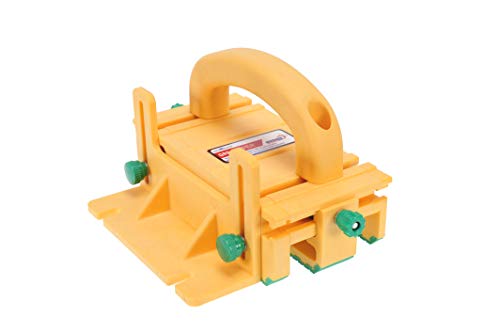
The MICROJIG GRR-RIPPER GR-100 is a well-known 3D pushblock for controlled table saw work. Its design lets you guide the workpiece with downward, forward, and sideways pressure. That three-way control can help stabilize narrow stock and improve the feel of a rip cut. The bright yellow body is also easy to spot on a crowded workbench.
I value this style of pushblock because it gives the hand a firm, balanced position while keeping it away from the blade. It is especially useful when the cut is narrow or the board needs steady pressure against the fence. The price may seem higher than a simple push stick, but the control feels more refined. Always set the tool correctly for the stock width and keep the blade path clear.
Pros:
- Provides three-direction control during a cut
- Strong grip on many common workpieces
- Helps guide narrow stock with confidence
- Bright color is easy to see in the shop
- Can improve hand position and feed control
- Build quality suits frequent woodworking use
Cons:
- Costs more than a basic push stick
- Needs correct setup for different stock widths
- May feel large for very small projects
My Recommendation
The GRR-RIPPER is best for serious hobbyists, cabinet makers, and users who make frequent narrow rip cuts. In my view, it is one of the best saw table accessories when control and hand placement matter more than the lowest price. It feels like a small driving wheel for the workpiece, giving the operator a steady grip. Buy it if you want a durable, proven pushblock for regular use.
| Best for | Why |
|---|---|
| Narrow rip cuts | Offers balanced three-direction control |
| Frequent users | Durable design suits regular shop work |
| Safety-minded makers | Supports a stable hand position away from the blade |
How I Evaluate the Best Saw Table Accessories
I do not judge a saw accessory by its product photo alone. I look at fit, control, build quality, ease of setup, and the kind of work it can improve. A tool that looks useful but does not match your miter slot or dust port can waste both time and money. I also consider whether a new user can understand it without a long learning curve.
Safety comes first in every review. Push blocks, featherboards, sleds, and dust fittings can support safer work, but none can make a table saw risk-free. The Occupational Safety and Health Administration and major saw manufacturers stress the importance of guards, riving knives, correct operation, and training. I recommend reading your saw manual before adding any jig or accessory.
Fit is often the hidden issue. Measure the miter slot, T-track, dust port, fence space, and available table area. Check whether an accessory can sit clear of the blade and still allow the workpiece to move freely. These simple checks help you choose the best saw table accessories for your actual machine rather than for a similar model shown online.
What Accessories Does a Table Saw Need?
The first accessory most users need is a good push tool. It helps you control the board while keeping your hands away from the blade. A featherboard is next if you make long rip cuts or repeat the same cut many times. It holds the stock against the fence, but you must position it so the board does not bind.
Dust collection is also important. Wood dust can affect air quality, cover your cut line, and make cleanup harder. A bag may suit a small shop, while a dual-port adapter may suit a stronger collector. For better crosscuts, a sled kit can add support and repeatable stops.
Precision blocks are useful when you adjust several machines or need repeat settings. They do not replace basic tools such as a square, tape measure, caliper, and reliable angle gauge. Think of accessories as parts of a system. The best result comes from a tuned saw, a sharp blade, good support, and the right accessory working together.
Safety Tips for Using Saw Table Accessories
Before each cut, check the blade, guard, riving knife, fence, and accessory position. Make sure no push block, featherboard, or sled can touch the blade. Stand slightly to the side of the cut line, not directly behind the board. This position gives you more room if the stock moves unexpectedly.
Use push tools before your hand reaches the danger zone. Do not use a featherboard to hold wood against the fence after the blade if that setup could trap the cut-off piece. Use outfeed support for long boards and get help with large sheets. A table saw works best when the material stays flat and moves at a steady pace.
Wear eye protection and hearing protection. Use dust control and suitable respiratory protection when fine dust remains in the air. Keep loose clothing, jewelry, and cords away from the blade. Never reach over a moving blade to remove offcuts, and disconnect power before clearing a jam or changing an accessory.
How to Choose the Best Saw Table Accessories
Start with the job you do most. If you rip narrow boards, choose a strong pushblock and a thin rip jig. If you cut large panels, focus on featherboards, outfeed support, and dust control. If you build boxes or furniture, a crosscut sled kit and setup blocks may offer more value.
Next, confirm compatibility. A 2.5-inch dust hose is not the same as a 2.25-inch port. A 3/8-inch by 3/4-inch T-slot may not match your saw table. Miter bars can also vary in width and height. Read the listing details, measure your machine, and look for clear information about the included hardware.
Then consider your work style. A beginner may prefer a complete push set with simple handles. An experienced maker may prefer a modular jig that can be tuned to a custom sled. Portability, storage, and replacement parts also matter. The best saw table accessories are the ones you will use often, not the ones with the longest feature list.
Common Buying Mistakes to Avoid
One common mistake is buying a jig before measuring the saw. A product can fit one table saw and fail on another. I also see users choose a dust adapter without checking collector power. More ports do not always mean more suction; a weak vacuum may perform better with one sealed hose.
Another mistake is treating a safety accessory as permission to rush. A pushblock helps with hand placement, but it cannot stop kickback caused by a bad fence setting or pinched stock. A featherboard improves control, but it must not create a trap point. Learn the correct use of each accessory before making a real cut.
Finally, avoid buying too many tools at once. Start with a push tool, then add dust control or a featherboard based on your needs. Build a sled only when your projects justify it. This approach keeps your bench clear and makes it easier to learn how each tool affects the cut.
FAQs Of best saw table accessories
What are the most important table saw accessories?
A push block or push stick is the best first purchase for most users. Dust collection, a featherboard, and outfeed support are also very useful. Your project type should guide the next accessory.
Are table saw push blocks safer than push sticks?
Both can help keep your hands away from the blade. A push block often gives more downward and side control, while a push stick can work well for simple rip cuts. Use the tool that matches the stock and keeps your hand position safe.
Do I need a featherboard for a table saw?
You may not need one for every cut, but it helps with long boards and repeated rips. It keeps the workpiece closer to the fence. Place it before the blade and make sure it does not cause binding.
How do I know if a table saw accessory will fit?
Measure your miter slot, T-track, dust port, and available clearance. Compare those measurements with the product details. Do not rely on the saw brand alone because models from the same brand can use different parts.
Can a dust bag replace a shop vacuum?
A dust bag can collect chips on some saws, but it may not capture all fine dust. A suitable vacuum or dust collector usually provides better airflow. Use ventilation and respiratory protection when dust remains in the work area.
Final Verdict: Which Should You Buy?
The MICROJIG GRR-RIPPER is my top pick for control, while the POWERTEC set offers the best all-around value. Add the Hedgehog for steady rips and a dust bag or adapter for cleaner work. These are among the best saw table accessories for most home shops.
Choose by fit and task, not hype. The right best saw table accessories can make each cut safer, cleaner, and more precise while helping your table saw work like a better tool.