
The best table saw gripper gives you firm control, safer cuts, and less hand strain during demanding woodworking tasks.
A narrow board can twist, slide, or kick back just as your hand reaches the blade. That moment feels stressful, especially when a project matters to you. The right table saw gripper keeps pressure close to the workpiece while your hands stay farther from danger. I compared grip, control, adjustability, cut quality, and value across popular push blocks and push sticks. My goal is simple: help you choose a tool that feels steady, works with your saw, and earns a place beside your favorite measuring tools.

GRR-RIPPER+ by Microjig. Includes SafeRip…
Table Saw Pushblock: Protect hands and prevent kickback like never before Enhanced SafeRip Kit: With the New SafeRip Kit, GRR-RIPPER+ guarantees precise material handling, preventing accidental blade contact for faster…

MICROJIG GRR-RIPPER GR-100 3D Table…
Protect hands and prevent kickback like never before Powerful high-friction durable grip for extreme hold Precision cutting and control down to 1/4″ Ripping Fully adjustable for easy handling Work with…

MICROJIG GRR-RIPPER 2GO Push Block…
STRONG GRIP AND CONTROL: Designed in the USA, the MICROJIG GRR-RIPPER 2GO Push Block has a Green GRIP non-slip surface for strong gripping power, making it a dependable table saw…
Microjig GRR-RIPPER+ SafeRip Push Block

The Microjig GRR-RIPPER+ is a highly adjustable table saw gripper for woodworkers who want control over both narrow and wide cuts. Its 3D design lets you push down, sideways, and forward at the same time. That action helps keep a board flat against the table and tight to the fence. The bright yellow and green body also stays easy to spot in a busy shop.
The included SafeRip kit adds a useful layer of protection when a cut brings the tool close to the blade. I like the way the center leg can be set to match the cut width, because it reduces guesswork on thin stock. The rubber feet create strong contact on smooth boards and plywood. It also works beyond a table saw, including router tables, band saws, and jointers.
Pros:
- Adjustable design handles many board widths
- 3D pressure improves forward, downward, and side control
- Rubber grip pads resist slipping during cuts
- SafeRip kit adds protection near the blade
- Works with several woodworking machines
- Bright colors make it easy to find
Cons:
- Costs more than a basic push stick
- Requires setup before some narrow cuts
- Its larger shape may feel bulky on very small workpieces
My Recommendation
This is my top pick for a serious hobbyist, cabinetmaker, or frequent table saw user. The GRR-RIPPER+ gives the most complete mix of grip, precision, and safety features in this group. It suits users who often switch between sheet goods, trim, narrow strips, and other stock sizes. If you want the best table saw gripper for long-term use and do not mind paying for better adjustment, this model offers excellent value. Always follow your saw manual and accepted shop safety rules; no push block replaces careful setup.
Microjig GRR-RIPPER GR-100 3D Pushblock
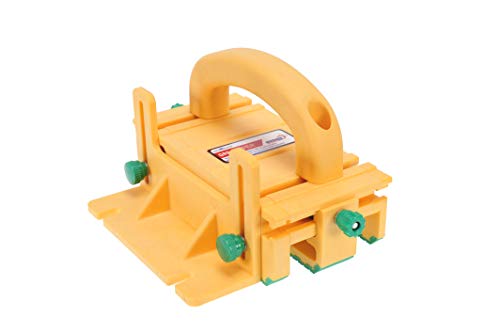
The original Microjig GR-100 remains one of the best-known 3D push blocks for table saw work. Its compact body gives you a strong handle and a stable base in one tool. Instead of pressing only from behind, you can guide the stock down onto the table and toward the fence. That makes the GR-100 feel more controlled than a simple wooden push stick.
The rubber feet hold well on common lumber, plywood, and sheet stock. I find this style helpful when a board feels light or wants to lift as it passes the blade. The center leg can also support narrow cuts while keeping your hand in a safer position. It is a practical choice for a home shop that needs one table saw gripper for several daily tasks.
Pros:
- Proven 3D control system
- Strong grip on many wood surfaces
- Compact shape fits most small shops
- Adjustable center leg supports narrow stock
- Useful for table saws, routers, and jointers
- Easy-to-see yellow body
Cons:
- Basic package lacks some newer add-ons
- Not ideal for every extra-wide or unusual cut
- Replacement grip parts may add to ownership cost
My Recommendation
I recommend the GR-100 to beginners who want a well-established design without moving into the most advanced kit. It also suits experienced woodworkers who need a second table saw gripper for a helper station or another machine. The compact body gives better control than many low-cost push sticks, yet it does not take much room in a tool drawer. For many users, this is the simplest way to gain the main benefits of a 3D push block at a reasonable price.
Microjig GRR-RIPPER 2GO Compact Push Block

The GRR-RIPPER 2GO is built for woodworkers who value a small, ready-to-grab table saw gripper. Its compact format is easy to carry from a workbench to a portable saw. The tool provides a firm handhold while its grip surface helps keep the workpiece from sliding. It is especially handy when a full-size push block feels too large for the task.
This model can serve on table saws, routers, jointers, and band saws. I see it as a useful choice for quick cuts, small shops, and mobile woodworking setups. Its size makes storage simple, and the yellow-green color helps prevent it from getting buried under scraps. Still, users should match its contact area to the stock and avoid forcing it beyond its intended control range.
Pros:
- Compact and easy to transport
- Fast to grab for short cutting tasks
- Good grip for improved workpiece control
- Fits well in a crowded portable shop
- Works across several woodworking tools
- Simple storage in a small tool box
Cons:
- Small body offers less support on wide sheets
- May not replace a full-size push block
- Less useful when you need a long guiding surface
My Recommendation
Choose the 2GO if you cut in a garage, jobsite, or compact apartment workshop. It is also a good backup tool for experienced users who already own a larger block. This table saw gripper makes sense for short stock, quick trimming, and situations where portability matters more than maximum coverage. Its value comes from convenience: the best safety tool is often the one you can reach and use without delay.
Anti-Kickback Table Saw Push Block

This anti-kickback push block focuses on a straightforward goal: help keep your hand away from the blade while you guide wood through the cut. Its broad contact area can give a steadier feel than a thin stick. The design is useful for common rip cuts and general woodworking tasks. For a new woodworker, that simple approach can make safe habits easier to build.
A push block cannot stop every form of kickback, so correct fence alignment, blade height, and stock support still matter. I would pair this table saw gripper with a properly adjusted riving knife and suitable eye protection. The tool is best used with controlled pressure rather than a hard shove. Its simple format may appeal to people who want a low-cost safety aid without a complex adjustment system.
Pros:
- Simple design is easy for beginners to understand
- Broad base can support common boards
- Helps place distance between hands and blade
- Useful for everyday rip cuts
- Usually easier to store than a large jig
- Accessible option for a starter shop
Cons:
- May offer fewer adjustment options
- Not a complete solution for kickback prevention
- Contact pads can wear with regular use
My Recommendation
This push block is best for beginners, occasional DIY users, and anyone building a basic safety kit. It can help you learn to keep steady pressure on the workpiece without reaching toward the blade. I would not choose it over an adjustable 3D block for complex cuts, but it can provide good everyday value at a lower entry cost. Inspect the grip surface often, and replace the tool if damage affects control.
Zebekk Multi-Tool Push Block

The Zebekk push block is designed as a flexible safety tool for table saws, router tables, band saws, and jointers. Its shape gives the user a raised handhold and a broad base for better contact. The assembly process is intended to be approachable, which helps users get started without a long setup session. It can act like a bridge between a basic push stick and a premium adjustable gripper.
I like the multi-machine focus for a small shop where each tool must earn its storage space. The block can help guide stock with more control than bare hands, especially during routine straight cuts. Its grip depends on clean, flat contact, so sawdust under the pads can reduce performance. As with any table saw gripper, I would test the tool with the machine off before making a live cut.
Pros:
- Designed for several woodworking machines
- Raised handle keeps the hand more secure
- Broad base supports many routine cuts
- Assembly is approachable for home users
- Useful choice for a shared tool station
- Can reduce the need for several separate push tools
Cons:
- Assembly takes more time than a ready-made stick
- May feel less refined than premium Microjig models
- Large contact areas need regular cleaning
My Recommendation
The Zebekk is a good fit for a budget-minded hobbyist who wants one tool for several machines. It offers more hand protection and stability than a basic narrow stick, while keeping the cost and learning curve manageable. I would choose it for general shop work, not for highly specialized production cuts. If you want a practical table saw gripper for occasional use, this model deserves a look when its price is competitive.
Milescraft GrabberPRO 3406 Push Block

The Milescraft GrabberPRO is a sturdy push block for users who want a broad, confident grip. Its handle and base help spread pressure across the workpiece instead of concentrating it in one small spot. That can make long rip cuts feel calmer and more controlled. It is made for use with table saws, router tables, band saws, and jointers.
The design gives the hand a clear place to rest while the base contacts the material. I find that useful when a board has a rough surface or when fatigue starts to affect hand control. The GrabberPRO is not a magic shield, but it encourages a better habit: guide the wood with steady pressure and let the machine do the cutting. Its larger profile may be reassuring for users who prefer a substantial tool in the hand.
Pros:
- Solid feel for demanding workshop tasks
- Broad base helps spread downward pressure
- Comfortable handle supports longer cuts
- Works on four common woodworking machines
- Useful for users who dislike thin push sticks
- Can improve confidence during repetitive work
Cons:
- Bulkier than compact push blocks
- May need more clearance around unusual setups
- Less convenient to carry in a small portable kit
My Recommendation
I recommend the GrabberPRO for makers who value a substantial, stable grip. It is well suited to furniture builders, home renovators, and users who make repeated rip cuts in a full-size shop. The tool feels like a firm handshake with the board, which can reduce hesitation during a long cut. If the best table saw gripper for you must feel robust and comfortable, Milescraft is a strong mid-range choice.
POWERTEC 5-Piece Push Block Set

The POWERTEC 71009V set gives you several push tools instead of one single table saw gripper. The package includes push blocks and push sticks with ergonomic handles for different cutting situations. That variety helps when one tool does not fit beside the fence or over a narrow strip. It is a sensible way to equip a new shop without buying each piece separately.
The dual-handle approach can give you a better grip when pushing larger boards. A push stick is also useful when a block would interfere with a tight fence setting or small workpiece. I appreciate having spare tools available because a helper can work safely without borrowing the only gripper. The set does take more drawer space, but that trade-off may be worthwhile for families, classes, and busy workshops.
Pros:
- Includes multiple tools for different cuts
- Ergonomic handles improve hand comfort
- Good starter package for a new shop
- Spare tools help when working with a partner
- Push sticks fit tasks that need a slim profile
- Useful across saws, routers, jointers, and bandsaws
Cons:
- Quality and grip vary by tool in the set
- Needs more storage space than a single block
- May include pieces you rarely use
My Recommendation
The POWERTEC set is best for beginners, school shops, and woodworkers who want broad coverage for a modest cost. It may be the smarter buy than one premium table saw gripper if you need different shapes for different operations. I would keep the slim sticks for tight cuts and use the larger block for wider stock. This set offers strong practical value, especially when several people share the same workshop.
BOW Products Expandable Push Shoe

The BOW Products Expandable Push Shoe takes a different approach to table saw control. It adjusts from about two to six inches wide, so the contact area can match the workpiece. That range helps users support narrow boards without losing the option to handle wider stock. The shoe-style form also gives you a clear pushing surface for steady feed pressure.
An adjustable width can be helpful when your projects change from small trim to larger panels. It may also reduce the need to keep several fixed-size push blocks nearby. I would take time to set the width before turning on the saw and confirm that the shoe clears the blade and fence. For users who care about fit and flexibility, this table saw gripper offers a useful middle ground between a stick and a large block.
Pros:
- Expandable width handles varied stock sizes
- One tool can replace several fixed shoes
- Broad support improves control on wider boards
- Useful for changing project needs
- Clear push surface encourages steady feeding
- Good option for organized, careful users
Cons:
- Width adjustment adds setup time
- Needs careful clearance checks near the blade
- May feel less natural to users who prefer a simple stick
My Recommendation
The BOW Expandable Push Shoe is best for woodworkers who cut many board widths and want one adaptable tool. It suits a project shop where storage is limited but flexibility matters. I especially like it for users who plan cuts in advance and do not mind a short setup step. If your search for the best table saw gripper centers on adjustable coverage, this push shoe is one of the most interesting options in the group.
POWERTEC Deluxe Push Stick Two-Pack

The POWERTEC Deluxe two-pack is aimed at woodworkers who prefer slim push sticks with comfortable handles. The narrow profile helps you reach the end of a board while keeping your hand away from the cutting area. Two matching sticks also provide a useful spare or allow a second person to work safely. They can serve table saws, router tables, band saws, and jointers.
This style does not provide the same downward hold as a full 3D push block. However, it can fit spaces where a larger table saw gripper cannot. I would use these sticks for narrow rips, final feed stages, and setups with limited room between the fence and blade. Their simple design makes them quick to pick up, though users should keep the shoe in firm contact with the stock.
Pros:
- Slim profile fits tight cutting spaces
- Two-piece package provides a spare
- Comfortable handle supports controlled pressure
- Easy to store beside a portable saw
- Useful for narrow rips and final board feed
- Simple design needs little adjustment
Cons:
- Offers less downward force than a 3D block
- Requires careful contact on the workpiece
- Not the best choice for very wide stock
My Recommendation
Choose this two-pack if you want a reliable, low-fuss push stick for narrow cuts. It is ideal for beginners who need a simple starting tool and for experienced users who want backup equipment. I would not call it the strongest all-around table saw gripper, but its slim shape solves a real problem. For the price, two comfortable sticks can add useful protection to nearly any small workshop.
Microjig GRR-RIPPER Pro 3D Pushblock
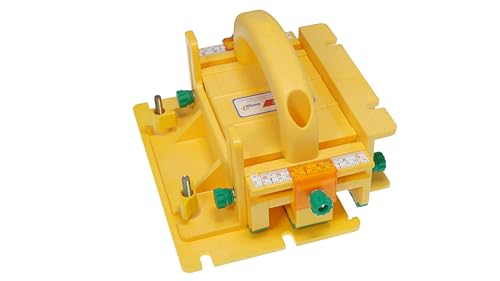
The GRR-RIPPER Pro is made for users who want advanced control, safety, and precision from one table saw gripper. Its 3D force system helps apply pressure in three directions as you guide stock through the blade. The included SafeRip kit supports work near the blade while helping maintain a controlled feed. This design is especially appealing to professionals and serious hobbyists who expect more from their push block.
The Pro model gives you a stable base, a secure hand position, and useful adjustment potential. Those features can help reduce sideways drift, which matters when a clean edge or exact width is important. It also works with router tables and other machines, so the tool can earn its keep across the shop. The trade-off is a higher price and a short learning period, but the control feels worthwhile for frequent users.
Pros:
- Advanced 3D force system improves control
- SafeRip kit supports safer close work
- Strong grip helps reduce sideways movement
- Designed for precision-minded woodworkers
- Useful on table saws and other shop tools
- Premium construction supports frequent use
Cons:
- Higher price than basic push tools
- New users may need time to learn adjustments
- May be more tool than an occasional DIY user needs
My Recommendation
The GRR-RIPPER Pro is my premium choice for professionals, cabinet shops, and serious makers. It is best suited to people who make frequent, precise cuts and want a durable table saw gripper with advanced control. The SafeRip kit and 3D pressure system make it a strong safety-focused upgrade. If you use your saw often, the higher initial cost may pay back through better control, less frustration, and a more consistent workflow.
How I Evaluated These Table Saw Grippers
I judged each product by the things that matter beside a spinning blade: grip, control, clearance, comfort, adjustment, and value. A good table saw gripper should keep the workpiece stable without forcing you to lean over the cut. It should also feel natural in the hand, because an awkward tool may stay on the shelf when you need it most.
I also looked at the tool’s contact surface. Rubber or high-friction pads can help resist sliding, but sawdust, resin, and rough wood can reduce grip. Clean the pads often and inspect them for cracks or wear. A damaged push block is like a worn tire: it may look fine until it loses contact at the wrong time.
Safety guidance from the Occupational Safety and Health Administration emphasizes guarding, proper machine setup, training, and keeping hands away from blades. The Consumer Product Safety Commission also warns that table saw injuries can be severe. These products support safer work, but they do not replace a riving knife, blade guard, eye protection, dust control, a stable fence, or careful feed technique.
Before each cut, I recommend checking four points. First, make sure the fence is parallel to the blade. Second, confirm that the riving knife or splitter is installed when appropriate. Third, support long or wide stock so it cannot fall or twist. Finally, test the push tool with the saw turned off to confirm its path and clearance.
Best Table Saw Gripper Buying Guide
Choose the right grip style
A 3D push block gives downward, forward, and sideways pressure. That makes it a strong choice for rip cuts where the board must stay flat and close to the fence. A push stick gives more clearance in tight spaces. Many woodworkers keep both styles because no single table saw gripper fits every cut.
Check the contact area
The base should touch enough of the board to stay stable. A small base may work well on narrow strips but feel weak on a wide panel. A wide shoe may offer more control but need extra clearance. Think about the stock you cut most often, not only the product photo.
Think about blade clearance
The tool should guide the board without entering the blade’s path. Many push blocks include replaceable or sacrificial parts for close cuts, but you still need to understand the setup. Turn off and unplug the saw before making adjustments. Then move the tool through the planned path by hand.
Look for comfortable handling
A smooth handle can reduce wrist strain during long cuts. A secure grip also helps you avoid pressing too hard. I prefer a handle that lets me keep my wrist straight and my elbow relaxed. Comfort is not just a luxury; fatigue can lead to rushed movements.
Consider more than the table saw
A multi-tool table saw gripper can also help with a router table, band saw, or jointer. That makes one purchase more useful in a small shop. Still, each machine has different hazards and operating rules. Read the manual for every tool and confirm that the push block fits its table and cutting path.
Do not judge safety by color alone
Bright yellow, green, or red plastic makes a tool easy to see, but color does not create protection. The important features are stable contact, a secure handle, good clearance, and correct technique. Replace any tool with a cracked body, loose part, or worn grip pad. Store push tools where you can reach them before starting the saw.
Best For Comparison
| Best for | Why |
|---|---|
| Best overall control | Microjig GRR-RIPPER+ combines adjustable 3D pressure, strong grip, and the SafeRip kit. |
| Best premium precision | Microjig GRR-RIPPER Pro suits frequent users who want advanced control for accurate cuts. |
| Best starter value | POWERTEC sets provide several push tools for beginners, shared shops, and varied tasks. |
Tips for Using a Table Saw Gripper Safely
Keep your body out of the kickback path
Stand slightly to the side of the blade, not directly behind the workpiece. If the board moves backward, your body should not be in its likely path. This small change can make the cutting position feel much safer.
Use steady pressure
Do not shove the board through the blade. Let the teeth cut at a controlled pace. Press down and forward only as much as needed to keep the stock moving. A good table saw gripper should guide the work, not become a lever for force.
Support long stock
Long boards can sag, lift, or twist when they extend beyond the table. Use an outfeed table, roller stand, or another stable support. Ask for help with large sheets rather than trying to balance them alone.
Inspect the blade and setup
A dull or dirty blade can increase resistance and make the workpiece harder to control. Check that the blade height suits the material and that the fence locks firmly. Remove loose scraps from the table before you begin.
Keep both hands purposeful
Use one hand to guide the stock and the other to control the push tool when the cut permits. Never reach over the blade or place fingers in line with the teeth. When the board clears the blade, use an appropriate push tool until the cut is complete.
Clean the grip pads
Dust acts like tiny ball bearings under a rubber pad. Wipe the contact surfaces and the saw table before demanding cuts. Avoid oily cleaners because they can reduce traction. Replace pads when they become smooth, torn, or loose.
FAQs Of best table saw gripper
What is a table saw gripper?
A table saw gripper is a push block or push shoe that helps move wood through a table saw while keeping your hands farther from the blade. Many models also press the stock down and against the fence. This can improve control during rip cuts.
Is a 3D push block safer than a push stick?
A 3D push block can offer more downward and sideways control, while a push stick can fit tighter spaces. Neither tool makes a cut risk-free. The best choice depends on the stock, fence position, blade path, and machine setup.
Can I use one gripper for other woodworking machines?
Many listed models work with router tables, band saws, and jointers. However, each machine has different hazards and clearance needs. Confirm compatibility in the product instructions and your machine manual before use.
How do I choose the best table saw gripper for narrow cuts?
Look for a slim push stick, adjustable center leg, or compact block. The tool must fit between the fence and the blade without touching either one. Test the full path with the saw off before making the cut.
When should I replace a push block?
Replace it if the body cracks, the handle loosens, or the grip pads become damaged or slick. Also replace sacrificial parts after the blade contacts them. A table saw gripper should feel solid every time you hold it.
Final Verdict: Which Should You Buy?
The Microjig GRR-RIPPER+ is the best table saw gripper for most serious users. It combines strong grip, adjustable control, and the SafeRip kit in one versatile tool.
For premium precision, choose the GRR-RIPPER Pro. For beginners on a budget, the POWERTEC set offers useful variety and strong overall value. Always pair your gripper with careful setup and safe saw habits.