
Finding the best carbide jigsaw blade depends on material, TPI, and build.
You pull the jigsaw out for a quick cut and it binds, chips, or burns. Most times, the blade is the problem. The right carbide blade turns a pain into a clean, fast cut that looks pro. I’ve cut laminate, stainless, porcelain, and composite decking in real homes and shops. In this guide, I break down what makes the best carbide jigsaw blade for each job, based on real-world use, manufacturer specs, and how blades hold up under heat and side pressure. If you want cleaner cuts, longer life, and fewer blade swaps, this is for you.

Bosch T128BHM3 3 pc. 3-5/8…
CARBIDE BRAZING TECHNOLOGY: Delivers 10x life versus standard bi-metal blades ADVANCED TOOTH DESIGN: Provides clean cuts in difficult-to-cut, brittle materials on both sides of the cutting surface THIN BLADE KERF:…
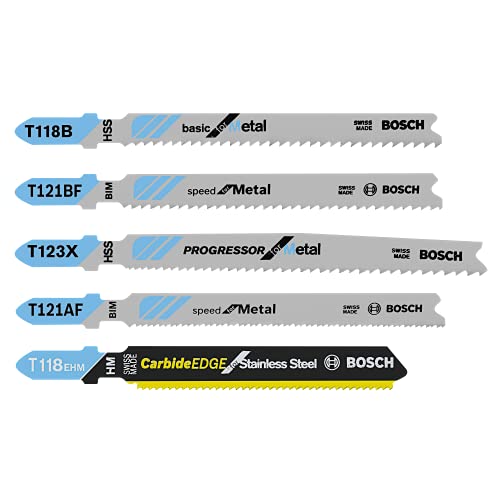
Bosch TPM005 5 pc. Pro-Metal…
Multiple blade types – designed for cutting stainless steel and metal, including high-performance blades for optimal results Carbide Edge for stainless steel – designed to provide outstanding cutting solutions for…

Bosch T118AHM3 3 pc. 3-1/4…
Power Tools and Accessories Country of manufacture: Switzerland Manufacturer: Bosch Carbide strip offers long life
Bosch T128BHM3 Carbide Laminates, 3-Pack

This Bosch T128BHM3 set is built for laminates and melamine. The carbide strip rides a 14 TPI profile that stays sharp on abrasive surfaces. It resists heat and keeps edges clean on both sides. If you hate chip-out, this blade is a game-changer.
I use it on countertop laminate, veneer plywood, and pre-finished panels. It tracks straight with light pressure. The kerf is narrow and leaves a paint-ready edge. It is a top pick if you want the best carbide jigsaw blade for laminate sheets.
Pros:
- Carbide strip holds an edge on abrasive laminates
- 14 TPI gives smooth cuts with less tear-out
- Excellent heat resistance on long rips
- T-shank fits modern jigsaws from major brands
- Short length reduces deflection on thin sheets
Cons:
- Not ideal for thick hardwoods
- Slower in softwood compared to coarse teeth
- Pricey compared to HCS blades
My Recommendation
If you cut laminate counters, melamine cabinets, or veneered panels, start here. The edge stays clean, so you sand less and finish faster. It makes sense for pros who need repeatable cuts and for DIYers who want to avoid costly chips. For this niche, it deserves a spot in any “best carbide jigsaw blade” lineup.
| Best for | Why |
|---|---|
| Laminates and melamine | Carbide strip resists abrasive wear, reduces chip-out |
| Veneered plywood | 14 TPI leaves a smooth, splinter-light edge |
| Cabinet scribing | Short blade improves control and accuracy |
Bosch TPM005 Pro-Metal Jig Saw Set, 5-Pack

The TPM005 set targets metal work with pro-grade blades. You get a mix of tooth counts for steel, aluminum, and thin sheet. They are robust, with improved heat resistance and tooth hardness. The set gives you options when you do mixed metal cuts in one day.
These are excellent for HVAC openings, bracket trimming, and conduit notches. With a steady feed and low orbital action, they cut without binding. Use cutting fluid for best life. If metal is your main task, this set pairs well with a dedicated carbide for stainless work.
Pros:
- Assorted profiles for thin and thick metals
- Good heat resistance for long cuts
- Clear markings help pick the right TPI fast
- T-shank fits most modern jigsaws
- Strong value for mixed metal projects
Cons:
- Not all blades are carbide-tipped
- Slower in stainless compared to carbide edge blades
- Needs fluid and slower SPM to avoid heat
My Recommendation
Grab this if you switch between aluminum, mild steel, and perforated sheet. It is a flexible metal kit. For heavy stainless, add a dedicated carbide blade. This set still belongs in a pro’s drawer, and it supports your search for the best carbide jigsaw blade by covering the metals carbide does not always need to handle alone.
| Best for | Why |
|---|---|
| Mixed metal jobs | Assorted TPIs match thin and thick stock |
| HVAC and electrical | Makes clean openings with low burrs |
| Shop standby | Reliable set that fills gaps in a kit |
Bosch T118AHM3 Carbide for Stainless, 3-Pack

This T118AHM3 is the stainless specialist. The 24 TPI carbide edge is built for hard alloys. It resists galling and dulling that ruin cheaper blades. When I cut sink openings or stainless trim, this blade pays for itself in one job.
Run your jigsaw slow with low orbital action. Use cutting fluid to keep it cool. The blade tracks true and leaves less burr. If your work touches stainless, this is among the best carbide jigsaw blade choices you can make.
Pros:
- Carbide edge for stainless and hard alloys
- 24 TPI reduces snagging in thin sheet
- Excellent heat and wear resistance
- Clean edges with minimal deburring
- Compact length for tight spaces
Cons:
- Slow in thick plate without fluid
- Not ideal for wood or plastic
- Higher cost than bi-metal
My Recommendation
If you handle sinks, restaurant fixtures, or outdoor stainless, get this. It delivers consistent cuts and survives where others fail. It is a must-have alongside your general-use kit. For stainless, this is the best carbide jigsaw blade I trust to finish clean and fast.
| Best for | Why |
|---|---|
| Stainless steel | Hard carbide edge resists dulling and heat |
| Thin sheet metals | 24 TPI prevents grabbing and distortion |
| Precision metal cuts | Short blade limits flex for accurate lines |
Bosch T367XHM3 Carbide All-Purpose, 3-Pack

The T367XHM3 is a workhorse. With a 5-7 TPI carbide edge and 5-1/4″ length, it chews through nail-embedded wood, PVC, and composites. It runs fast yet stays steady in curves. If you remodel and hit surprises behind walls, this blade saves time.
I like it for demolition and rough carpentry. It handles deck boards and plastics without melting or clogging fast. The longer body adds reach for thicker material. It is a strong best carbide jigsaw blade candidate for mixed-material cuts.
Pros:
- Carbide edge shreds through tough materials
- Variable 5-7 TPI balances speed and control
- Longer blade for deeper cuts
- Good curve cutting without excess wander
- Resists nail damage better than HCS
Cons:
- Rougher finish than fine-tooth blades
- Overkill for delicate work
- Heavier feed can cause tear-out in thin veneers
My Recommendation
Pick this blade if your to-do list spans studs, deck boards, PVC, and the odd nail. It takes abuse and keeps cutting. Pros and DIYers who value speed will love it. For all-around jobs, it ranks as the best carbide jigsaw blade when you want one blade to do most tasks.
| Best for | Why |
|---|---|
| Remodeling and demo | Carbide edge survives nails and screws |
| Composite decking | Fast cuts with less heat glazing |
| PVC and plastics | Tooth geometry clears chips well |
Bosch T130RF1 Carbide Grit for Ceramics

This T130RF1 uses a 30-grit carbide edge to grind tile and ceramic. There are no teeth. It files its way through brittle materials with low chip-out. Use steady speed and water for the best finish.
It is great for outlet cutouts in tile and custom curves. It is also helpful on low-density ceramic panels. The cut is slower than a tile saw, but the control is excellent. If you need accuracy, this earns a place among the best carbide jigsaw blade picks for tile tasks.
Pros:
- Carbide grit grinds rather than chips
- Reduces cracking in brittle tile
- Good control on curves and cutouts
- T-shank for easy changes
- Works with water to keep dust down
Cons:
- Slow compared to a wet saw
- Not for thick porcelain or stone
- Grit wears faster on hard tile
My Recommendation
Use this for detail tile work where a saw cannot reach. It makes clean openings without breaking the piece. For DIYers and tile pros, it is a smart backup tool. If your goal is the best carbide jigsaw blade for ceramic cutouts, this is it.
| Best for | Why |
|---|---|
| Tile outlets and notches | Grinds cleanly with reduced cracking |
| Curved cuts in ceramic | No teeth to catch and chip |
| Drywall-to-tile transitions | Controlled, low-vibration progress |
50-Pc Contractor T‑Shank Jigsaw Blade Set
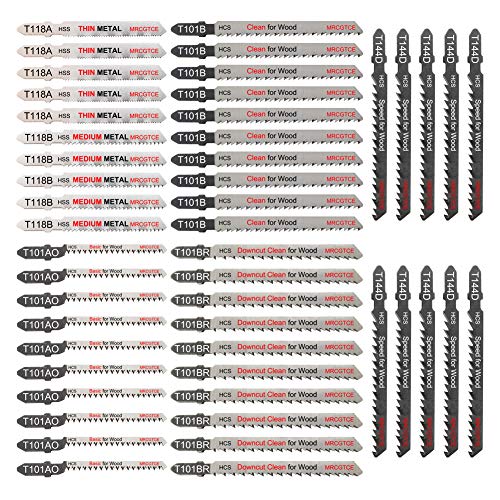
This 50-piece set covers wood, plastic, and thin metals. You get common profiles like T118A, T118B, T101AO, T101B, T101BR, and T144D. The blades are not all carbide, but the variety is hard to beat for the price. It is a good filler kit to keep in the truck.
I use large assortments like this for rough cuts and backups. They handle quick jobs and save my premium carbide for when it matters. The included case keeps sizes sorted. Pair it with a few carbide specialists for a complete, budget-friendly setup.
Pros:
- Huge variety for many materials
- Great value per blade
- Handy storage case
- Works with most T-shank saws
- Good for learning tooth profiles
Cons:
- Not a dedicated carbide set
- Shorter life on abrasive materials
- Finish quality varies by profile
My Recommendation
Buy this as your general stock. Then add a few carbide blades for the tough stuff. It is perfect for new users and for pros who need spares. It supports your search for the best carbide jigsaw blade by covering everyday cuts without draining the budget.
| Best for | Why |
|---|---|
| General cutting | Assortment handles many jobs |
| Backup blades | Affordable and easy to replace |
| Learning profiles | Try different TPIs and tooth shapes |
Bosch T11C Laminate/Wood/Metal, 11-Piece

The Bosch T11C packs a curated mix for laminate, wood, and metal. It is a smarter, smaller assortment than big contractor kits. The profiles are proven performers. You can cover most home and shop tasks with one compact case.
I like this as a starter or travel kit. The quality is consistent across the set. Add a few carbide specialists for stainless or tile. With that, you have the best carbide jigsaw blade coverage for almost any project.
Pros:
- Balanced set for common materials
- Quality you can count on
- Compact storage case
- Clear labeling for quick picks
- Great value for curated profiles
Cons:
- Limited deep-cut options
- Few carbide edges included
- May need extras for heavy metals
My Recommendation
Choose this if you want one case that works on most jobs. It travels well and covers wood to light metal. Add a stainless carbide and a tile grit blade to round it out. It is a fast path toward owning the best carbide jigsaw blade setup for daily use.
| Best for | Why |
|---|---|
| Starter kits | Curated mix for common cuts |
| Mobile work | Compact case and quick ID |
| Home projects | Covers wood, laminate, and light metal |
Diablo DJT144DHM Carbide for Decking
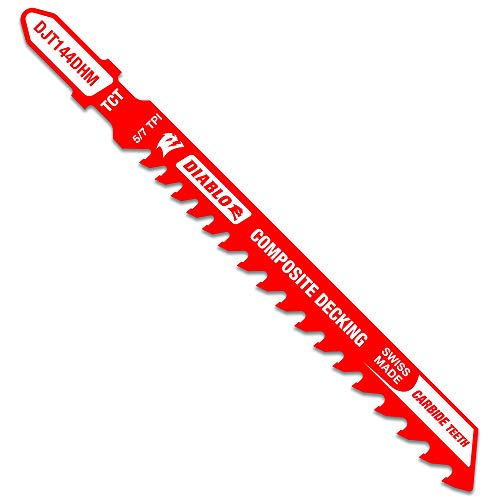
Diablo’s DJT144DHM targets composite decking, wood, and PVC. The carbide teeth and 5/7 TPI design move fast with control. It keeps its edge on the abrasive fillers found in many deck boards. If you cut decking curves around posts, this is a joy to use.
I get fewer melted edges on PVC trim with this one. It ejects chips well and resists heat. The cut is fast and fairly clean for a coarse tooth. For decking and exterior trim, it is among the best carbide jigsaw blade options you can buy.
Pros:
- Carbide teeth for long life in composites
- Fast cut rate in decking and wood
- Good chip ejection reduces heat
- Holds edge on PVC without melting
- T-shank for quick changes
Cons:
- Rougher finish than fine TPI blades
- Not ideal for thin veneers
- Curve radius is limited in thick boards
My Recommendation
If your job list includes composite deck boards, PVC trim, or treated lumber, run this blade. It is fast and tough. The longevity on abrasive composites stands out. For outdoor work, this deserves the “best carbide jigsaw blade” label in my book.
| Best for | Why |
|---|---|
| Composite decking | Carbide teeth handle abrasive fillers |
| PVC trim | Stays cool with clean edges |
| Exterior carpentry | Fast cuts with strong durability |
Diablo DJT308BFP5 Bi‑Metal Fine Wood, 5‑Pk

This Diablo pack is bi-metal and tuned for ultra-fine finish. It has 12 TPI and cuts from top and bottom for clean faces. On plywood and veneered panels, it leaves minimal splinters. If you want paint-ready edges, it delivers.
Though not carbide, it earns a slot for fine wood results. I keep it for trim and furniture-grade work. It is smooth, quiet, and accurate with low orbital action. Combine this with a carbide laminate blade, and you cover almost all fine cutting needs.
Pros:
- Ultra-fine finish on both sides
- Excellent control in curves
- Bi-metal durability for wood use
- Ideal for veneered panels
- Cleaner edges reduce sanding
Cons:
- Not carbide, shorter life on abrasives
- Slower than coarse blades
- Not for metals or tile
My Recommendation
Pick this for clean, show-side cuts in finished wood. It reduces rework and touch-up. I suggest pairing it with a carbide laminate blade in your kit. With that duo, your best carbide jigsaw blade setup stays versatile and finish-ready.
| Best for | Why |
|---|---|
| Fine finish wood | 12 TPI leaves smooth edges |
| Veneered plywood | Top-and-bottom cutting reduces tear-out |
| Trim work | Accurate curves with low vibration |
U‑Shank Carbide Grit Set for Fiber Cement

This U-shank carbide grit set is built for fiber cement, Hardie siding, fiberglass, and low-density tile. The grit edge grinds without snagging. It shines when you need notches and curves that a shear cannot make. It is a niche kit that solves tough siding layouts.
Check your jigsaw: this is U-shank, not T-shank. If it fits, you get solid value for fiber cement detailing. Cuts are slower but controlled. For siding crews, it complements shears and saws and earns a mention in any best carbide jigsaw blade discussion.
Pros:
- Carbide grit handles abrasive fiber cement
- Great for notches and curves
- Reduces edge blowout
- Useful on fiberglass panels
- Affordable way to add specialty cuts
Cons:
- U-shank limits saw compatibility
- Slow cutting progress
- Dusty work, use proper PPE
My Recommendation
If you install Hardie or cut cement board details, this earns its keep. It is not fast, but it is controlled. Use a vac and mask for dust. For fiber cement detail work, it serves as the best carbide jigsaw blade style when other tools cannot make the shape you need.
| Best for | Why |
|---|---|
| Hardie siding notches | Grit edge grinds without cracking |
| Fiberglass panels | Reduces chipping and delamination |
| Tile cutouts | Controlled curves where saws cannot reach |
FAQs Of best carbide jigsaw blade
How do I choose the best carbide jigsaw blade for my job?
Match blade type to material. Use carbide teeth for wood and composites, carbide edge for stainless, and carbide grit for tile or fiber cement. Pick TPI based on thickness and finish needed.
What speed and settings work best with carbide blades?
Use lower orbital action for metals and brittle materials. Run medium speed for wood and composites. Go slow with stainless and use cutting fluid to reduce heat.
Can I use a carbide jigsaw blade on tile?
Yes, use a carbide grit blade. It grinds, not cuts. Add water to reduce dust and improve finish. Avoid thick porcelain or stone.
Are T-shank and U-shank blades interchangeable?
No. Check your jigsaw. Most modern saws use T-shank. Some older or specialty saws use U-shank.
Why is my carbide blade burning the wood?
Feed rate may be too slow, or the speed too high. Reduce SPM, increase feed slightly, and clear chips. Check for dullness and resin buildup.
Final Verdict: Which Should You Buy?
If you cut laminates or panels, the Bosch T128BHM3 is a standout for clean edges. For stainless and hard alloys, the Bosch T118AHM3 is the best carbide jigsaw blade I rely on.
For all-purpose demolition and decking, the Bosch T367XHM3 or Diablo DJT144DHM deliver speed and life. Add the T130RF1 for tile cutouts. With these, you own the best carbide jigsaw blade setup for 2026 projects.