
The best general table saw balances power, accuracy, portability, safety, and value for everyday wood projects.
You know the feeling: a board shifts, the fence drifts, and a simple cut turns into a long repair job. A good table saw removes much of that stress. I tested the key features that matter most, including motor power, rip width, fence control, stand design, bevel range, and ease of setup. This guide covers the best general table saw options for home shops, job sites, and serious weekend work. I also include useful blade choices, because even a great saw needs the right teeth for a clean cut.

SKIL 15 Amp 10 Inch…
RACK AND PINION FENCE RAILS – Ensures fence stays parallel to blade for fast smooth, and accurate cuts INTEGRATED FOLDING STAND – Legs quickly fold in to provide portability and…

DEWALT Table Saw 10 Inch…
Rack & Pinion Telescoping Fence System Make fence adjustments fast, smooth and accurate Patented material support, can be used for narrow rip cuts. 32-1/2″ rip capacity easily cuts a variety…

DEWALT 15 Amp 8-1/4 in….
24.5 in. of rip capacity for ripping 4×8 plywood or OSB sheets Compact size for easy transportation and storage Rack & pinion telescoping fence rails make fence adjustments fast, smooth,…
SKIL 10-Inch Portable Table Saw
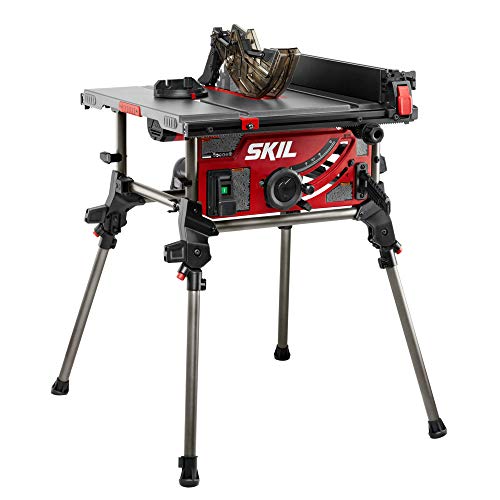
The SKIL TS6307-00 gives home woodworkers a strong mix of size, power, and price. Its 15-amp motor and 10-inch blade handle common cuts in plywood, pine, framing lumber, and hardwood boards. The folding stand adds useful height without making the saw feel like a permanent shop machine. I also like the rack-and-pinion fence adjustment, which makes small fence changes easier to control.
This saw works well when you need one tool for many tasks. The 4-by-4 cutting capacity at 90 degrees is useful for posts and thick stock, while the bevel range supports angled cuts for trim and basic furniture work. Its rolling stand folds for storage, so it suits a garage where every square foot matters. The best general table saw should feel approachable, and this SKIL model does that for new users without leaving experienced users short on useful features.
Pros:
- Powerful 15-amp motor for common wood cuts
- 10-inch blade handles larger stock than compact saws
- Folding stand saves storage space
- Rack-and-pinion fence helps with fast adjustments
- Good 4-by-4 cutting capacity at 90 degrees
- Useful choice for home shops and weekend projects
Cons:
- Stand may feel less rigid than a heavy shop base
- Dust collection can improve with a shop vacuum
- Large sheets still need an outfeed or side support
My Recommendation
I recommend the SKIL TS6307-00 for homeowners, new woodworkers, and DIY users who want a full-size blade without paying for a cabinet saw. It gives you enough power for shelves, benches, cabinets, and repair work. The folding stand is especially helpful if you must move the saw after each project. For many buyers, this is the best general table saw because it offers broad ability at a friendly price.
DEWALT 10-Inch Rolling Table Saw
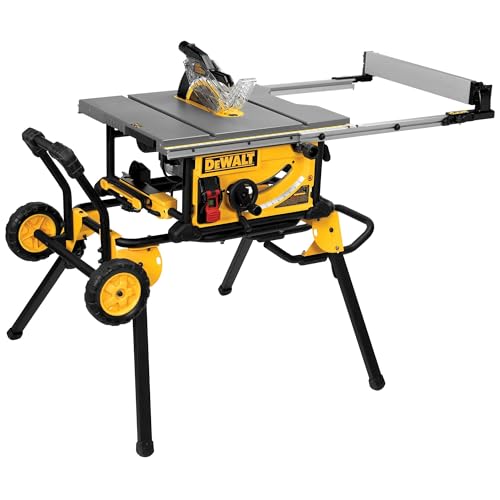
The DEWALT DWE7491RS is a jobsite table saw built for users who need more rip width and a firm fence. Its 15-amp motor reaches up to 4,800 RPM, and the 10-inch blade gives it strong capacity for plywood and dimensional lumber. The standout feature is the 32-1/2-inch rip capacity, which helps when cutting wide panels. Its rolling stand also makes transport far easier than lifting a saw and stand separately.
In daily use, the fence system is the main reason to consider this model. The telescoping rails let you open the rip area when needed and pull them back to reduce the footprint during storage. The rolling stand has a broad base and feels more stable than many small folding stands. I would choose this saw for renovation work, deck projects, built-ins, and repeated sheet-good cuts where a narrow table can slow you down.
Pros:
- Large 32-1/2-inch rip capacity
- Accurate rack-and-pinion fence adjustment
- Rolling stand improves jobsite mobility
- Strong 15-amp motor for demanding cuts
- 10-inch blade supports deep cuts
- Good table support for wide panels
Cons:
- Heavier and larger than compact jobsite saws
- Costs more than many entry-level models
- Needs extra support for very large sheet goods
My Recommendation
The DWE7491RS is my top pick for contractors and serious DIY users who value rip capacity above compact storage. It is also a smart choice for anyone who often cuts plywood or wide boards. The rolling base saves your back, while the fence helps keep long cuts straight. If your work demands the best general table saw for wide cuts and regular transport, this DEWALT model is a strong fit.
DEWALT 8-1/4-Inch Compact Table Saw

The DEWALT DWE7485 takes the jobsite table saw idea and makes it smaller. Its 15-amp motor and 8-1/4-inch blade offer enough power for trim, flooring, shelves, framing parts, and many plywood cuts. The compact body is easier to carry up stairs or place on a small workbench. Its rack-and-pinion fence also gives it a more precise feel than many basic portable saws.
This model makes the most sense when space and weight matter. It has a 24-1/2-inch rip capacity, which covers many everyday cuts but does not match the larger DWE7491RS. The metal roll cage helps protect the saw from bumps during transport. I find it appealing for apartment garages, mobile repair work, and woodworkers who want a dependable saw that does not dominate the room.
Pros:
- Compact design is easy to carry
- 15-amp motor provides useful cutting power
- Rack-and-pinion fence supports accurate setup
- Metal roll cage helps protect the housing
- Good fit for small shops and mobile work
- Quick to place on a bench or portable stand
Cons:
- Smaller blade limits maximum cut depth
- Rip capacity is less than larger 10-inch saws
- Stand is not included with every package
My Recommendation
I recommend the DWE7485 for users who carry tools often or work in a tight space. It is a practical option for punch-list jobs, home repairs, and small furniture projects. Choose it over a larger saw when portability matters more than wide-panel capacity. Among compact models, it can be the best general table saw for clean setup, easy transport, and dependable power.
Evolution R10TS 10-Inch Jobsite Table Saw

The Evolution R10TS brings several useful features to a portable 10-inch saw. It uses a 15-amp motor, offers a 26-inch rip capacity, and includes a zero-clearance throat plate for cleaner support around the blade. The listed 3-3/8-inch cut depth is suitable for many common boards and sheet goods. A precision fence and 0-to-45-degree bevel range give this saw flexibility for general woodworking.
A notable benefit is the included dado plate, although users should always confirm the manual and local rules before fitting a dado setup. The zero-clearance design can help reduce small offcuts dropping near the blade and may improve support for narrow pieces. This saw is a good middle ground for people who want a larger blade but do not need a large contractor base. It deserves attention from buyers comparing the best general table saw options outside the most familiar brands.
Pros:
- 10-inch blade offers useful cutting depth
- Zero-clearance throat plate supports narrow cuts
- Dado plate is included with the package
- 26-inch rip capacity suits many home projects
- 0-to-45-degree bevel range supports angled work
- Precision fence helps guide long cuts
Cons:
- Accessory compatibility should be checked first
- May have less local service support than major brands
- Large panels still need added side support
My Recommendation
The Evolution R10TS suits DIY woodworkers who want useful features at a portable size. It is a good match for shelves, cabinets, garden projects, and light framing work. I especially like it for users who want a zero-clearance setup and may explore dado work after checking the instructions. As a best general table saw, it offers a thoughtful feature set for buyers who want something different from the usual jobsite choices.
DEWALT 10-Inch 24-Tooth General-Purpose Blade

The DEWALT DWA11024 is a 10-inch, 24-tooth carbide blade made for fast general wood cutting. Its lower tooth count lets it remove material quickly, which can help when ripping boards or making repeated construction cuts. The carbide teeth are designed for longer working life than plain steel teeth. This blade is a useful first upgrade when the stock blade on a table saw feels slow or dull.
A 24-tooth blade favors speed over a fine, furniture-grade finish. It works well for framing lumber, rough stock, and cuts where the edge will later be covered, sanded, or joined. I would not choose it as the only blade for delicate crosscuts or visible cabinet parts. Used on the right material and kept clean, it can make the best general table saw more productive during heavy rough-cut work.
Pros:
- Fast cutting for ripping wood
- 10-inch size fits many table saws
- Carbide teeth support longer use
- Useful for construction and rough stock
- Helps reduce cutting time on repeated rips
- Backed by a well-known tool brand
Cons:
- Not the best choice for fine finish cuts
- May leave more visible tooth marks than a 40-tooth blade
- Users must confirm arbor size and saw clearance
My Recommendation
I recommend this DEWALT blade for framing, rough ripping, and fast shop preparation. It is ideal for users who value speed and do not need a polished edge straight from the saw. Keep a finer blade nearby for cabinet parts and trim. If your best general table saw spends much of its time breaking down lumber, this 24-tooth blade is a practical partner.
FOXBC 10-Inch 40-Tooth General-Purpose Blade

The FOXBC 10-inch, 40-tooth blade aims to cover the broad middle ground between fast ripping and smooth finishing. Its tooth count is useful for plywood, solid wood, shelves, and general shop cuts. The 5/8-inch arbor is common on many table saws, but I always advise checking the saw manual before installation. A general-purpose blade like this can save time because you do not need to change blades for every small task.
This blade is best for budget-minded woodworkers who want a spare or everyday blade. A 40-tooth pattern usually leaves a cleaner edge than a 24-tooth construction blade, though feed speed and wood type still affect the result. It may not match a premium blade in noise control, coating, or tooth life. Still, it gives the best general table saw a flexible cutting option for routine home projects.
Pros:
- Versatile 40-tooth design for common wood cuts
- Works well for plywood and solid lumber
- 5/8-inch arbor suits many standard saws
- Useful balance of speed and finish quality
- Good option as a spare shop blade
- Can reduce frequent blade changes
Cons:
- Premium blades may last longer
- Not designed for the finest crosscut finish
- Compatibility must be confirmed before use
My Recommendation
The FOXBC blade is a sensible choice for beginners and casual DIY users who want one blade for many jobs. It fits the needs of people making shelves, boxes, workbenches, and basic furniture. I would pair it with a clean, well-aligned fence for the best result. For a budget setup built around the best general table saw, this blade offers useful flexibility without a high replacement cost.
Luckyway 10-Inch 40-Tooth Blade 2-Pack

The Luckyway two-pack gives you two 10-inch, 40-tooth carbide-tipped blades for the cost of one higher-priced blade in some cases. This setup is helpful when you want one blade in service and another ready after a dulling event or accidental damage. The general-purpose tooth pattern suits wood cutting on compatible miter and table saws. Its 5/8-inch arbor matches many common machines, but compatibility still deserves a careful check.
Two blades can also support a simple workflow: keep one for cleaner plywood and one for rougher stock. The 40-tooth count offers a reasonable balance of cutting speed and edge quality. These blades are not a replacement for specialty blades made for laminate, melamine, or very fine joinery. For a home shop using the best general table saw for several projects each month, the two-pack adds convenience and value.
Pros:
- Two blades provide useful backup
- 40-tooth pattern suits many wood projects
- Carbide tips support repeated use
- Good value for home workshops
- Useful for both table and miter saws when compatible
- Reduces downtime when one blade needs cleaning
Cons:
- May not equal premium blades in finish quality
- Two-pack can encourage mixing blades without labeling
- Always check kerf, arbor, and speed ratings
My Recommendation
I recommend the Luckyway pack for hobbyists who want a backup blade on hand. It is especially useful if you work with wood often and dislike stopping to buy a replacement. Mark each blade by use so you can reserve one for cleaner stock. When paired with the best general table saw, this two-pack gives a small shop a simple and affordable blade system.
DEWALT 10-Inch 40-Tooth Fine-Finish Blade

The DEWALT DWA11040 uses 40 carbide teeth to target smoother wood cuts. It is a good step up from a rough ripping blade when the cut edge will remain visible. This type of blade can help with shelves, face frames, trim, and plywood panels. The 10-inch format and common 5/8-inch arbor make it a likely match for many table saws, subject to the saw maker’s specifications.
Fine finish does not mean the blade can replace careful technique. I still use a stable fence, a sharp riving knife, proper support, and a steady feed rate. Clean teeth and correct blade height also matter because pitch buildup can make any blade cut poorly. If your best general table saw serves both construction and furniture work, this blade is a useful choice for the cleaner side of that workload.
Pros:
- 40 teeth support smoother visible cuts
- Carbide construction helps with durability
- Useful for trim, shelving, and furniture parts
- Good choice for plywood and solid wood
- Common 10-inch size fits many saws
- Well suited to a mixed home-shop workload
Cons:
- Slower than a lower-tooth ripping blade
- Not a specialty blade for laminate or metal
- Must match the saw’s arbor and maximum RPM
My Recommendation
This DEWALT blade is best for DIY builders and woodworkers who care about a cleaner edge. Choose it for cabinet parts, shelves, and projects where sanding should stay light. It offers a useful balance rather than an extreme finish or extreme speed. I would keep it as the everyday blade on a best general table saw used for both repairs and small furniture.
WORKPRO 10-Inch 40-Tooth Wood-Cutting Blade

The WORKPRO 10-inch, 40-tooth blade is made for general wood cutting across common home projects. Its tooth count gives a useful blend of speed and edge quality for boards, plywood, and basic trim. It can serve as a replacement for a worn stock blade or as a second blade for a small workshop. As with every table saw blade, the arbor, kerf, blade diameter, and RPM rating must match your saw.
This blade makes sense for users who want a simple, low-cost way to refresh an older saw. A new blade often makes a bigger difference than beginners expect, especially when the old blade has pitch, dull teeth, or heat marks. The result also depends on fence alignment and material support, so I would not blame the blade for a setup problem. For routine work with the best general table saw, the WORKPRO option offers a practical starting point.
Pros:
- Versatile 40-tooth design
- Useful for common wood and plywood cuts
- Good replacement for a worn stock blade
- 10-inch size suits many table saws
- Helpful option for budget-conscious users
- Supports a smoother edge than coarse blades
Cons:
- May require more sanding on premium furniture work
- Not intended for cutting metal or masonry
- Users must verify fit before installation
My Recommendation
I recommend the WORKPRO blade for light-to-medium home use and as a backup for a busy garage shop. It is a good fit for users who need a fresh general wood blade without spending heavily. Keep it clean and avoid forcing the stock through the cut. Used with a properly adjusted best general table saw, it can deliver a clear improvement over a tired factory blade.
How I Evaluate the Best General Table Saw
Choosing a table saw is not just about motor amperage. A saw can have plenty of power and still frustrate you if the fence slips or the stand wobbles. I look at the full work system: the saw, fence, stand, blade, dust control, and safety parts. This approach reflects how the tool behaves during real cuts, not just how impressive its box specifications look.
I also consider the type of woodworker who will use the saw. A contractor may need a rolling stand and wide rip capacity, while a homeowner may prefer a smaller saw that stores under a bench. A cabinet builder may care more about fence accuracy and low tear-out. The best general table saw is the one that matches your work instead of forcing you to work around its limits.
Power and Cutting Capacity
Most portable table saws in this guide use a 15-amp motor. That power level works well on a normal 120-volt circuit, but it does not mean every saw cuts at the same rate. Blade sharpness, tooth count, wood density, feed speed, and alignment all affect performance. A sharp 40-tooth blade may cut better than a dull blade with a larger motor.
Blade size also matters. A 10-inch saw usually offers more depth than an 8-1/4-inch compact saw. That extra capacity helps with thick boards and 4-by-4 stock. However, a smaller saw may be easier to carry and faster to set up. I suggest choosing cutting capacity based on your most common stock, not on the largest board you might cut once a year.
Fence Accuracy Matters Most
The fence guides the workpiece during a rip cut, so its behavior affects both accuracy and safety. I prefer a fence that locks firmly at the front and stays parallel to the blade. Rack-and-pinion systems help users make small changes without tapping the fence by hand. This feature is especially useful when a project calls for repeated narrow cuts.
Before cutting, check the fence against the miter slot and blade. A fence that is not parallel can pinch the wood and increase kickback risk. Even the best general table saw needs a careful setup. Take a few minutes to test the fence with a straight board, then make a small scrap cut before working on expensive material.
Stand Design and Portability
A good stand should support the saw without rocking. It should also fold or roll in a way that feels controlled. Rolling stands help on job sites, but wheels do not remove the need for a level surface. Lock the wheels before cutting and inspect the frame for loose bolts or damaged parts.
If you work in a garage, measure the storage area before buying. A large stand can take more room than expected when its rails extend. Compact saws fit smaller areas, but they often need extra support for wide plywood. I would rather see a small saw used with a solid outfeed table than a large saw used with an unsafe, crowded setup.
Choosing the Right Table Saw Blade
Tooth count gives you a simple starting point. Blades with fewer teeth, such as 24-tooth models, usually remove wood quickly and suit rough ripping. Blades with around 40 teeth offer a balance of speed and finish. Higher tooth counts can produce smoother cuts, though they may feed more slowly and place more load on the motor.
Use the blade for the material it lists. The blades in this guide are intended for wood, not steel, tile, or masonry. Check the arbor size, diameter, kerf, maximum RPM, and any restrictions in the saw manual. Never install a blade that does not fit the arbor correctly, and never use a damaged blade.
Safety Features I Want to See
A table saw can cut wood quickly because it uses a fast, exposed cutting edge. Use the blade guard, riving knife, and anti-kickback parts as directed. Wear eye and hearing protection, keep both hands away from the blade path, and use a push stick for narrow pieces. A dust mask or suitable respirator may also help when cutting wood, especially in a closed shop.
OSHA guidance emphasizes guarding, safe work practices, and control of kickback hazards. Manufacturer manuals also give important limits for blade setup, dado use, extension cords, and stand placement. I never remove a safety part simply to make a cut easier. If a cut feels awkward, stop and change the support or use another tool.
Dust Collection and Shop Cleanup
Portable saws often have a dust port, but their small housings can still release fine dust. Connect a compatible shop vacuum when possible and keep the port clear. Fine dust can collect around the motor and adjustment parts. Clean the saw after use, but disconnect the power before reaching near the blade or internal parts.
Good dust control also improves your view of the cut. You can see the line, fence, and workpiece more clearly when dust does not cover the table. It makes the shop more pleasant for anyone nearby. The best general table saw should fit into a clean work routine, not create a cloud every time you cut a board.
Common Mistakes New Users Make
One common mistake is cutting full sheets without support. A sheet can sag, twist, or push back against the blade. Use an outfeed table, roller support, or a helper who understands safe handling. Never let a helper pull the workpiece from behind the blade while the saw is running.
Another mistake is using the fence for crosscuts. For crosscuts, use a miter gauge or a properly built crosscut sled, while keeping the cutoff from binding between the blade and fence. Do not use both the miter gauge and fence as guides unless the setup specifically prevents the offcut from trapping. Small technique choices can make a large difference.
Many users also set the blade too high. Set it just above the workpiece, following the saw manual and safe cutting practice. A blade that rises far above the stock exposes more tooth area than needed. Finally, do not rush a cut because the project is almost done. Fatigue is when careful habits matter most.
Best For Comparison
| Best for | Why |
|---|---|
| Wide panels and contractors | DEWALT DWE7491RS offers a large rip capacity, strong fence control, and a rolling stand. |
| Small shops and mobile repairs | DEWALT DWE7485 is compact, easy to carry, and powerful for common cuts. |
| Budget home woodworking | SKIL TS6307-00 combines a 10-inch blade, folding stand, and useful everyday capacity. |
Buying Advice for 2026
Product packages can change, so check the current listing for included stands, blades, throat plates, and accessories before ordering. Confirm the return policy and warranty terms as well. I also suggest checking whether replacement parts and blades are easy to find in your area. A low purchase price matters less if a worn part is hard to replace.
Think about your power supply too. A 15-amp saw may need a suitable circuit, especially when cutting thick stock. Avoid long, light-duty extension cords that can cause voltage drop and heat. Follow the instructions for cord size and outlet use. These simple checks protect the motor and help the saw deliver steady power.
Which Size Table Saw Should You Choose?
An 8-1/4-inch saw is often enough for trim, plywood, shelves, and light framing. It is easier to lift and store, which can encourage you to use it more often. A 10-inch saw gives more depth and handles larger stock with less planning. The trade-off is more weight, more storage space, and often a higher price.
For a first saw, I usually favor a 10-inch portable model when the user has room for it. The extra capacity gives the tool more room to grow with your skills. If stairs, a small vehicle, or limited storage are major concerns, the compact DEWALT may be the wiser choice. The best general table saw is not always the biggest one; it is the one you can safely set up and use.
How to Get Cleaner Cuts
Start with a sharp blade that matches the task. Align the fence, set the blade height, and support the workpiece before switching on the saw. Push the stock at a steady pace without leaning into the fence. Let the teeth do the work instead of forcing the cut.
For plywood, place the better face up on a standard table saw because the blade enters from below and can create more tear-out on the top exit side. Use a fine blade when the edge will show. Painter’s tape and a zero-clearance insert may also help, but test the method on scrap first. Small tests protect your finished project.
Maintenance Tips
Unplug the saw before cleaning or making adjustments. Remove pitch from the blade with a cleaner approved for carbide blades, and dry it fully before reinstalling. Inspect the power cord, guard, riving knife, throat plate, and fence lock. Replace parts that crack, bind, or fail to lock.
Keep the table clean and lightly protected according to the manufacturer’s advice. Do not use a coating that makes the workpiece hard to control. Check that the blade raises, lowers, and bevels smoothly. A few minutes of care can keep the best general table saw accurate for years.
FAQs Of best general table saw
What is the best general table saw for most homeowners?
The SKIL TS6307-00 is a strong choice for most homeowners. It offers a 10-inch blade, 15-amp motor, folding stand, and useful cutting capacity. It handles common repair, shelf, and DIY projects without taking up the space of a cabinet saw.
Is a 10-inch table saw better than an 8-1/4-inch model?
Not always. A 10-inch saw cuts thicker stock, while an 8-1/4-inch model is lighter and easier to store. Choose 10 inches for broader capacity and 8-1/4 inches when portability matters most.
How many teeth should a general-purpose table saw blade have?
A 40-tooth blade offers a useful balance for many wood projects. A 24-tooth blade cuts faster during rough ripping, while a higher tooth count can produce a smoother finish. Match the blade to the material and the result you need.
Can I cut plywood with a portable table saw?
Yes, but support the sheet on both sides of the saw. Use a sharp blade, align the fence, and keep the sheet flat during the cut. Never let a large panel sag or twist near the blade.
Are portable table saws safe for beginners?
They can be safe when used correctly. Read the manual, keep the guard and riving knife in place, wear eye and hearing protection, and use push sticks for narrow cuts. Practice with scrap wood before making important cuts.
Final Verdict: Which Should You Buy?
For most users, I would choose the SKIL TS6307-00 as the best general table saw. Contractors who need wide rips should choose the DEWALT DWE7491RS, while space-limited users may prefer the DWE7485.
Pair the saw with a sharp 40-tooth blade for flexible woodwork. Set it up carefully, support large stock, and follow safe cutting habits for dependable results.