
The best jointing jig for table saws is the Aepiraza Taper/Straight Line Jig for steady, clean, edge-jointing cuts.
A rough board can turn a simple project into a fight. A table saw jointing jig helps you guide bowed, uneven, or angled stock with more control, even when you do not own a jointer. I know how frustrating it feels to glue boards that look aligned but open at the seam later. The right jig acts like a calm extra hand. It keeps the workpiece steady, supports repeat cuts, and helps improve safety when used with proper push tools, guards, and eye protection.

GOINGMAKE Thin Rip Jig Table…
【EASY TO USE】GOINGMAKE thin rip jig is easy to use. Just slide the guide into T-track miter slot of your table saw and lock it in front of the saw…

Aepiraza Taper/Straight Line Jig for…
Taper & Straight Line Jig: The taper drill jig allows you to make tapered cuts quickly, easily, and accurately at your table saw. With the miter bar removed, this wood…

Woodpeckers Taper Sled, Table Saw…
SPECS – You will receive a fully-equipped Taper Sled including 2 18.5″ miter bars, rigid powder-coated steel fence that won’t deflect, 2 knuckle hold-down clamps, 32″ honeycomb plywood sled, and…
Aepiraza Taper/Straight Line Jig

The Aepiraza Taper/Straight Line Jig is a strong choice for woodworkers who need one fixture for several table saw tasks. Its long 37-inch miter bar helps the jig track across the table with less twisting. The steel fence gives the board a firm reference edge while the hold-down clamps help keep stock from shifting during a cut.
This design can help with straight-line cuts, tapered legs, and edge jointing work. I like the long layout because it gives a rough board more support than a small sled. It is not a replacement for a jointer in every case, but it can bring useful control to a small shop where space and budget matter.
Pros:
- Long 37-inch miter bar supports smooth tracking
- Steel fence provides a firm guide surface
- Two hold-down clamps improve workpiece control
- Useful for straight cuts, tapers, and edge jointing
- Helpful for shops without a dedicated jointer
- Good support for long boards and furniture parts
Cons:
- May need careful setup before the first precise cut
- Its long size needs extra storage space
- Not ideal for very thick or unusually wide stock
My Recommendation
I recommend the Aepiraza jig for beginners, serious hobbyists, and small-shop users who want broad table saw coverage. It is especially useful for chair legs, table legs, rough board edges, and long straight-line cuts. The clamps and steel fence add confidence when a board feels awkward on the saw. If you want the best jointing jig for table saw work that also handles taper cuts, this is one of the most complete options in this group. Check the current Amazon listing for price, stock, and fit details before ordering.
Woodpeckers Taper Sled TSL-32

The Woodpeckers Taper Sled TSL-32 targets woodworkers who value a stable, polished jig for repeat work. Its 37-inch miter bar gives the sled a long path across the table saw. The steel fence creates a clear reference, and the two hold-down clamps help secure the part as it moves through the blade.
This sled suits tapered furniture parts and straight-line work, including some edge-jointing tasks. The long base can make a rough board feel less like a loose puzzle piece and more like a guided workpiece. I would choose it for repeat projects where consistent setup matters more than having the smallest jig in the shop.
Pros:
- Long miter bar helps reduce unwanted yaw
- Steel fence offers a durable registration edge
- Two clamps help hold parts in place
- Works well for tapered legs and straight cuts
- Good choice for repeat furniture work
- Long support area can improve control on larger parts
Cons:
- Costs more than many basic taper jigs
- Large footprint may challenge small workbenches
- Users must confirm table-slot compatibility
My Recommendation
The Woodpeckers TSL-32 is best for experienced woodworkers who want a robust taper sled with strong workpiece support. It makes the most sense for furniture builders, cabinet shops, and makers who repeat angled cuts often. As a jointing jig for table saw use, it offers stability, but its main strength is controlled taper and straight-line cutting. I see it as a premium option for people who prefer a purpose-built tool over a homemade plywood sled.
Rockler Taper Jig and Straight Line Jig
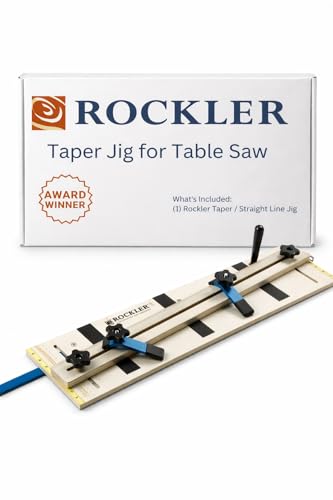
The Rockler Taper Jig and Straight Line Jig is a practical fixture for woodworkers who want a familiar, flexible layout. Its 36-inch miter bar gives the jig a long travel path and helps guide stock through the cut. It can support tapered parts and straight-line trimming when a board needs a clean reference edge.
I find this style of jig useful when a board is too rough to register safely against the normal fence. You attach or hold the board to the jig, establish a straight guide edge, and then make the cut with a more predictable path. The jig does not remove the need for careful blade height, push-block use, and stock inspection, but it can make difficult work less stressful.
Pros:
- 36-inch miter bar gives useful support
- Handles both taper cuts and straight-line cuts
- Useful for trimming rough board edges
- Simple concept is easy for many users to learn
- Suitable for furniture and cabinet projects
- Often easier to store than extra-large sled systems
Cons:
- May offer fewer hold-down features than premium sleds
- Setup can take time when switching between projects
- Fit must match the saw’s miter slot
My Recommendation
I recommend the Rockler model for hobbyists who want a proven, multi-use table saw guide without moving into a highly specialized system. It is a good fit for straightening rough stock, cutting tapers, and making furniture parts. If your main goal is a budget-friendly best jointing jig for table saw projects, this model deserves a close look. It offers useful reach without turning your whole workbench into a fixture.
POWERTEC 71395 Taper and Straight Line Jig

The POWERTEC 71395 is designed for taper and straight-line cuts on a table saw. Its stated 3/4-inch-wide by 3/8-inch-deep miter-slot fit matches a common table saw slot size, though I still suggest measuring your saw before purchase. The jig can help guide irregular boards and support angled cuts with a more repeatable motion.
This is a useful option for makers who need more than a basic miter gauge but do not need a full-size industrial sled. I would use it for tapered legs, furniture parts, and straightening one edge before later joinery. The best results come from checking the fence, miter bar, and workpiece for movement before turning on the saw.
Pros:
- Supports taper and straight-line operations
- Fits a commonly used 3/4-inch by 3/8-inch slot size
- Useful for furniture legs and angled parts
- Can help create a straight reference edge
- More versatile than a single-purpose taper guide
- Good match for general home-shop woodworking
Cons:
- Slot dimensions still require careful user verification
- May need extra clamping for unusual workpieces
- Not a complete substitute for a jointer or planer
My Recommendation
The POWERTEC 71395 is best for home woodworkers who want a versatile guide at a practical size. Choose it if you make tapered legs, trim rough edges, or need a straight-line jig for occasional projects. It can serve as a capable jointing jig for table saw work when your saw has the correct slot. Its value is strongest for users who want several functions from one compact tool.
MICROJIG GRR-RIPPER Microdial Tapering Jig

The MICROJIG GRR-RIPPER Microdial Tapering Jig is a more compact approach to taper work. It is made for table saw and band saw use, so it can fit makers who move between machines. The Microdial design aims to make taper adjustments easier to set and repeat than a rough block of scrap wood.
This jig is not the same as a long straight-line sled, and that difference matters. It is better suited to controlled tapering of smaller parts than to flattening a long, bowed board. I like it for users who already understand safe stock control and want a compact guide that does not dominate the saw table.
Pros:
- Compact design stores easily
- Works with both table saws and band saws
- Microdial adjustment can aid repeatable taper settings
- Useful for small furniture parts and angled pieces
- Bright color makes the jig easy to see
- Good option when shop space is limited
Cons:
- Not designed for long edge-jointing cuts
- Less support than a 36- or 37-inch sled
- Requires careful handling near the blade
My Recommendation
I recommend the Microdial for makers who mainly cut tapers and want a small jig for table saw or band saw work. It suits chair parts, narrow legs, and repeat angled components better than rough board jointing. If you need the best jointing jig for table saw use on long stock, choose a longer sled instead. For compact taper work, however, this MICROJIG tool is easy to store and quick to bring into service.
Rockler Deluxe Spline Jig

The Rockler Deluxe Spline Jig serves a different need from the taper sleds above. It focuses on splines, box joints, finger joints, and decorative joinery rather than straightening rough board edges. Its 45-degree miter sled layout can help cut splines in picture frames and similar mitered assemblies.
This tool is valuable when joint appearance and strength matter more than edge correction. A properly fitted spline can reinforce a miter and add a striking accent wood detail. I would not call it the best jointing jig for table saw edge jointing, but it is a strong choice for joinery-focused projects and anyone who wants more repeatable decorative cuts.
Pros:
- Designed for spline and decorative joinery work
- Useful for 45-degree mitered parts
- Can support box-joint and finger-joint tasks
- Expands table saw project options beyond basic ripping
- Helpful for picture frames and small boxes
- Good fit for detail-focused woodworking
Cons:
- Does not replace a straight-line jointing jig
- May be too specialized for a first table saw jig
- Joinery setup requires careful alignment and test cuts
My Recommendation
Choose the Rockler Deluxe Spline Jig if your work centers on frames, boxes, miters, and decorative joints. It is best for an intermediate or advanced woodworker who already has a basic table saw guide and wants to add more joinery options. For a rough-board edge, I would select a long taper or straight-line sled instead. For spline work, this specialized fixture can offer far more value than a general-purpose jig.
POWERTEC 71035V Tapering Jig

The POWERTEC 71035V is a lightweight tapering jig with 24-inch aluminum rails and a laser-engraved scale. It is made for angle cuts with taper settings up to 15 degrees. The scale can make common adjustments easier to repeat, which is useful when a project has several matching legs or braces.
Its shorter body makes it easier to handle than a full-length sled. That can be a benefit for small saws and crowded benches. I would use this jig for controlled taper cuts, not for jointing the edge of a long, bowed board, because it does not provide the same extended support as a straight-line fixture.
Pros:
- 24-inch rails keep the jig relatively easy to handle
- Laser-engraved scale aids angle setup
- Supports taper cuts up to 15 degrees
- Aluminum construction helps reduce bulk
- Useful for repeated legs and braces
- Good choice for smaller workshops
Cons:
- Shorter than many straight-line jointing sleds
- Limited to taper-focused work
- May not support long or wide boards as well
My Recommendation
The POWERTEC 71035V is best for a woodworker who wants a manageable taper jig with a visible scale. It works well for table legs, chair parts, and other components that need matching angles. I would not choose it as my main best jointing jig for table saw work, but I would consider it a smart secondary jig for a shop that already owns a straight-line guide. Its compact form is its main appeal.
Router Table Box Joint Jig
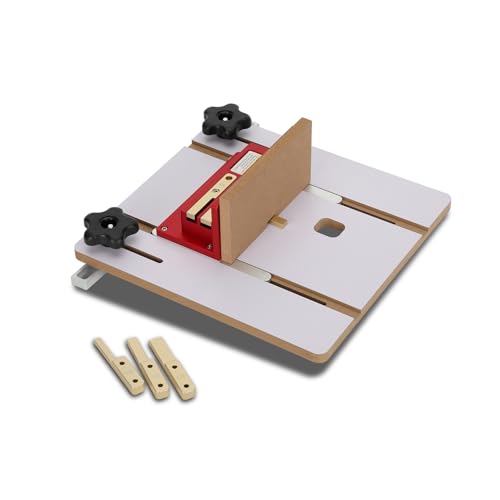
This router table box joint jig is built for indexed box joints rather than table saw edge jointing. It includes three interchangeable brass indexing keys in 1/4-, 3/8-, and 1/2-inch sizes. Those key sizes give the user several common spacing choices for boxes, trays, drawers, and small cases.
The jig belongs in a joinery section of a buying guide because many shoppers use “jointing jig” as a broad term. It will not straighten a rough board edge on a table saw. It can, however, help make clean, repeatable finger joints when paired with a suitable router table setup, sharp bit, and secure workholding.
Pros:
- Includes three useful indexing key sizes
- Brass keys can provide a durable indexing surface
- Useful for boxes, drawers, and small cases
- Supports repeatable box-joint spacing
- Expands router table joinery options
- Helpful for decorative and structural finger joints
Cons:
- Not a table saw edge-jointing jig
- Requires a compatible router table setup
- Test cuts are essential before valuable stock
My Recommendation
I recommend this jig only for users who specifically want box joints on a router table. It is not the best jointing jig for table saw edge work, tapering, or straight-line ripping. It is best for box makers, drawer builders, and hobbyists who want several indexing sizes in one tool. If your search began with edge jointing, select a long table saw sled instead.
GOINGMAKE Thin Rip Jig

The GOINGMAKE Thin Rip Jig is made for repetitive narrow strip cuts. It can fit a 3/8-inch by 3/4-inch T-slot and is marketed for use with a table saw, band saw, or router table. Its purpose is to keep the cut width consistent while the stock moves through the machine.
This tool is useful for edge banding, small trim, veneer support strips, and repeated craft parts. It does not flatten or straighten a rough board edge, so it should not be confused with a full straight-line jointing sled. I like it as a focused production aid because repeat thin cuts can become tiring and inconsistent when measured by hand each time.
Pros:
- Designed for repetitive narrow strip cuts
- Useful for edge banding and small trim
- Can support table saw, band saw, and router table tasks
- Helps reduce repeated manual measuring
- Compact design suits many small shops
- Useful for making matching strips for a project
Cons:
- Not intended for edge jointing rough boards
- Requires compatible slot dimensions
- Thin work needs careful safety control
My Recommendation
The GOINGMAKE Thin Rip Jig is best for woodworkers who often cut narrow, matching strips. Choose it for trim, banding, small rails, and repeat production work. Do not buy it as your only best jointing jig for table saw projects if you need to straighten board edges. As a specialty jig, it can save time and reduce guesswork when every strip must match.
Preciva Thin Rip Table Saw Jig

The Preciva Thin Rip Table Saw Jig uses three pulleys to guide repetitive narrow strip cuts. It supports both a 3/8-inch by 3/4-inch U-slot and a 1/4-inch by 3/8-inch T-slot, but measuring the actual saw slot remains important. The design aims to keep each strip at a similar width without moving the main table saw fence after every cut.
This can be helpful for making repeated strips from one board, especially when a project calls for many matching pieces. It is a thin-rip guide, not a board-flattening tool or traditional edge-jointing jig. I would pair it with a separate straight-line sled if I needed both accurate board preparation and narrow-strip production.
Pros:
- Three-pulley design supports repeat thin ripping
- Fits two listed slot formats
- Useful for repeated narrow stock
- Can improve consistency over hand measuring
- Helpful for trim, inlays, and edge banding
- Good specialty tool for project-based production
Cons:
- Does not joint or flatten rough board edges
- Slot compatibility must be checked before use
- Small strips demand careful hand placement and support
My Recommendation
I recommend the Preciva jig for makers who need repeated narrow cuts and want a guide with broad slot compatibility. It is a good partner to a table saw used for trim, inlays, and cabinet details. It is not the best jointing jig for table saw edge preparation, but it may be the best specialty thin-rip option for some users. Review the current listing and measure your slot before ordering.
What Is a Jointing Jig for a Table Saw?
A jointing jig for a table saw helps create one straight reference edge on a board. A normal table saw fence works best when the board already has one fairly straight edge. If the board has a bow, crook, or uneven side, it may rock, pinch, or wander as you push it forward.
A straight-line jig solves this problem by holding the rough board against a straight guide. The jig rides in the miter slot while the saw blade trims one edge. After that first pass, the new edge can rest against the table saw fence for later rip cuts.
This process is not the same as using a jointer. A jointer uses a cutter head and two tables to flatten one face and square an edge. A table saw jointing jig only trims an edge. It will not flatten a twisted face or correct every type of warp.
That difference is important when choosing the best jointing jig for table saw work. A long straight-line sled is usually the right tool for rough board edges. A taper jig is better for angled legs. A thin-rip jig is better for repeat strips. A spline or box-joint jig handles decorative joinery.
How I Evaluated These Table Saw Jigs
I looked at the job each jig is meant to perform first. A tool can be well made and still be the wrong choice for your project. I separated straight-line edge work from tapering, thin ripping, spline cutting, and box-joint work.
I also considered support length. Long boards need a long reference path. A short jig may work well for a small part but feel unstable on a long panel. A long bar can improve tracking, yet it also needs more storage space.
Slot fit is another key point. Table saw miter slots are common, but they are not universal. Some saws use a standard 3/4-inch slot, while others use a smaller slot, a T-track, or a nonstandard shape. Always measure width, depth, and any T-slot lip before buying.
I considered clamping as well. A hold-down clamp can stop a board from sliding on the jig. It does not replace your hands, push blocks, blade guard, riving knife, or safe feeding habits. The jig should support the cut, not encourage you to reach near the blade.
Finally, I checked versatility and storage. A multi-use jig may offer better value in a small shop. A focused jig may perform one task with less adjustment. I prefer a tool that matches the work rather than a fixture with features I will rarely use.
What to Look for Before You Buy
Choose the Correct Jig Type
Start with the cut you need. For rough board edges, look for a straight-line jig with a long guide. For table legs, look for a taper jig with a stable fence and clear adjustment marks. For narrow strips, choose a thin-rip guide.
A spline jig or box-joint jig belongs in a different group. These tools can produce excellent joinery, but they do not square a crooked board edge. Many poor buying decisions happen because the word “jointing” covers several different tasks.
Check the Miter Slot
Measure your saw before you order. Check the slot width and depth with a ruler or caliper. If the slot has a T shape, inspect the lower lip as well. A guide that feels loose can create poor cuts and a guide that binds can become unsafe.
The product listing may state a slot size, but your own saw remains the final test. Manufacturer descriptions can vary by model and production run. When in doubt, contact the seller or manufacturer before purchase.
Look for a Straight Fence
A jointing jig needs a reliable reference edge. If the fence bends, twists, or has gaps, the blade will copy those errors onto your board. A straight fence acts like a ruler beside the stock.
Steel can offer a rigid reference, while aluminum can reduce weight. A thick hardwood fence can also work well when it stays straight. The best material depends on the full design, not just one part.
Consider the Board Size
The jig should support the board before, during, and after the cut. A short sled may work for cabinet rails but struggle with an eight-foot board. A long sled gives more support but can be harder to store and control.
For very long or heavy boards, use outfeed support and infeed support. A helper can also reduce strain, but keep the work area clear. Never let a board tip as it leaves the saw.
Check Clamps and Hold-Downs
Clamps help keep the stock against the guide. They are especially useful when the board has an irregular edge or when you make repeated cuts. The clamp should hold the material firmly without blocking the blade path.
Before cutting, move the jig through the full travel path with the saw off. This simple dry run can reveal a clamp, screw, or board corner that might contact the blade.
Think About Adjustment
A good taper jig should make angle changes clear. A scale or index mark helps, but test cuts still matter. Wood movement, blade width, and setup errors can affect the final part.
For straight-line jointing, adjustment is often simpler. The main concern is keeping the guide straight and the board firmly attached. Simple tools can be excellent when they do one job without unwanted play.
Safe Use Tips for a Table Saw Jointing Jig
Read the table saw manual before using any accessory. Follow the saw maker’s instructions for the blade guard, riving knife, splitter, and miter slots. The U.S. Consumer Product Safety Commission and major tool makers stress the need for eye protection, proper guarding, and safe feeding practices.
Inspect the blade before work. A dull or damaged blade can burn the wood, increase force, and make the cut harder to control. Use a blade suited to the stock and cut.
Keep your hands away from the blade path. Use push sticks, push blocks, or the jig’s handles when appropriate. Stand to the side of the cut line rather than directly behind the stock.
Secure the board to the jig before switching on the saw. If the board can move, stop and fix the setup. Never hold a loose, warped board against a jig with one hand while pushing it through the blade.
Make a dry pass first. Turn off the saw and slide the jig from start to finish. Check clearance around the blade, fence, clamps, and throat plate. This small habit can prevent a large mistake.
Use light feed pressure. Let the blade do the work. If the saw slows, the board binds, or the cut feels forced, stop and inspect the setup. Do not push harder to solve a problem you have not identified.
Best For Comparison
| Best for | Why |
|---|---|
| Overall straight-line and edge jointing | Aepiraza offers a long 37-inch guide, steel fence, and two hold-down clamps. |
| Premium taper and furniture work | Woodpeckers TSL-32 provides long support and a sturdy setup for repeat angled cuts. |
| Repeated narrow strips | GOINGMAKE and Preciva focus on consistent thin-rip cuts for trim and edge banding. |
FAQs Of best jointing jig for table saw
Can a table saw jointing jig replace a jointer?
No. A straight-line jig can trim one edge straight, but it cannot flatten a twisted or cupped face. Use a jointer, planer sled, or another suitable method when the board face also needs correction.
What is the best jointing jig for table saw edge work?
The Aepiraza Taper/Straight Line Jig is the strongest overall choice in this group for edge-jointing tasks. Its long guide, steel fence, and hold-down clamps support rough boards and long straight cuts.
Will every jig fit my table saw?
No. Measure the miter slot before buying. Check the width, depth, and T-slot shape. A close fit with no binding is important for accurate and safe movement.
Are taper jigs and jointing jigs the same?
Not always. Some taper jigs also support straight-line edge cuts, but many focus only on angled cuts. Read the product purpose carefully before choosing one for board jointing.
Can I use a thin-rip jig for jointing?
A thin-rip jig is made for narrow, repeat strips. It does not normally straighten a rough board edge. Choose a long straight-line jig for edge preparation.
Final Verdict: Which Should You Buy?
For most woodworkers, the Aepiraza Taper/Straight Line Jig is the best jointing jig for table saw use because it combines long support, clamps, and a firm fence. Choose Woodpeckers for premium taper work, or GOINGMAKE and Preciva for thin strips.
Measure your miter slot and use safe feeding methods before cutting. The right table saw jig can make rough stock feel far more manageable.