For most woodworkers, the JET JWL-1221VS is the best lathe machine for wood turning control and power.
You may have a bowl blank, a rough branch, or a spindle project ready to turn, yet the wrong lathe can make the work shake, stall, or feel unsafe. I understand that choice can feel hard, especially when shop space and budget are limited. For this 2026 guide, I compared motor power, speed control, swing, bed length, build quality, ease of use, and value. These wood lathes cover beginners, home shops, serious hobbyists, and makers who need more room for larger work.
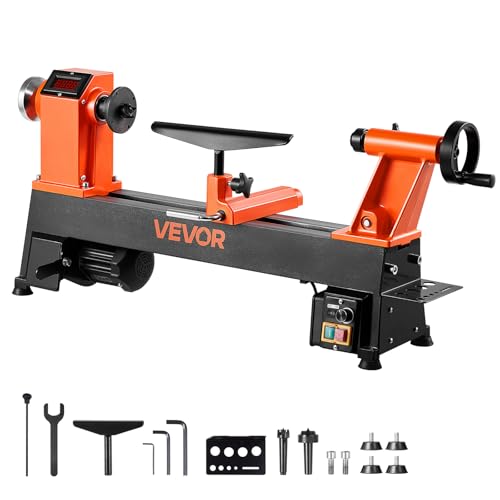
VEVOR Wood Lathe, 6Amp 1…
Powerful Performance: Equipped with 1 HP/750W power and a maximum speed of 3800 RPM, our woodworking lathe handles cutting and shaping with ease. Ideal for beginners, hobbyists, and classroom users…
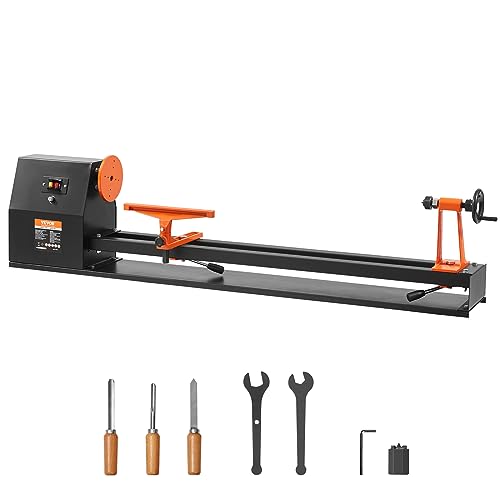
VEVOR Wood Lathe, 14 in…
Ideal for Crafting Various Small Wooden Items: Our benchtop wood lathe is designed with a 40-inch workbench and powerful capabilities, meeting the needs of professional woodworkers and providing a convenient…

JET 10″ x 15″ Variable…
Three variable-speed ranges (200-1050, 300-1750, 600-3600) allow you to match the speed to each workpiece Integrated 24-position indexing for precise workpiece alignment and repeatable results Wider bed ways for increased…
VEVOR 1 HP 12 x 18-Inch Wood Lathe

The VEVOR 12 x 18-inch lathe offers a strong mix of size, power, and speed for a home woodshop. Its listed 1 HP motor gives it more working force than many small starter lathes. The variable speed range runs from 150 to 3,800 RPM, so you can start slowly on an uneven blank and speed up for sanding. Its cast iron body also helps reduce movement during cuts.
I like this layout for makers who want one machine for bowls, pens, cups, small legs, and other common projects. The 12-inch swing gives you useful room without demanding a full-size shop. The brushless DC motor design may also appeal to users who want smooth electronic control and less routine motor care. Still, you should mount the lathe on a firm bench and check alignment before serious turning.
Pros:
- 1 HP motor gives useful power for home projects
- Wide 150 to 3,800 RPM variable speed range
- Cast iron construction helps limit vibration
- 12 x 18-inch capacity fits many bowl and spindle jobs
- Good choice for beginners and DIY woodworkers
- Low speed helps with rough and unbalanced blanks
Cons:
- Large blanks may exceed its practical capacity
- It needs a solid bench for best stability
- Included accessories may feel basic to advanced turners
My Recommendation
This VEVOR model suits a beginner who wants room to grow without buying a tiny mini lathe first. It is also a good fit for a DIY user who values high speed control and a strong motor. Among affordable machines, it has the traits I look for in the best lathe machine for wood: useful capacity, broad speed control, and a heavy frame. Check current Amazon stock and included accessories before ordering.
VEVOR 14 x 40-Inch Four-Speed Wood Lathe

This VEVOR lathe targets woodworkers who need a longer bed and a wider swing. Its listed 14 x 40-inch capacity gives you more space for table legs, chair parts, long spindles, and larger practice pieces. It uses four set speeds of 885, 1,245, 1,715, and 2,425 RPM. The 0.5 HP motor is modest, but the longer work area makes this machine useful for spindle work.
The included chisels, faceplate, wrench, and other basic parts can help a new turner begin with fewer extra purchases. A four-speed pulley system is less instant than electronic variable speed, yet it remains simple and easy to understand. You will need to stop the lathe before changing speeds, so plan your cuts with care. For safe work, use sharp tools, secure the tailstock, and never rush a large blank.
Pros:
- Long 40-inch bed supports extended spindle projects
- 14-inch swing gives useful clearance for larger stock
- Four speed choices are simple for new users
- Includes chisels and basic setup accessories
- Good value for legs, rails, and long turnings
- Faceplate supports some face-grain work
Cons:
- 0.5 HP motor has less force than 1 HP models
- Speed changes require stopping the machine
- Long projects may need careful bed and tailstock setup
My Recommendation
I would point this VEVOR toward a beginner who mainly turns spindles rather than large bowls. It is especially useful for furniture parts and long decorative pieces. It is not my first pick for heavy cuts in dense wood, but it can be a practical entry into full-length turning. If you need length more than electronic speed control, this may be the best lathe machine for wood in its class.
JET 10 x 15-Inch Variable-Speed Wood Lathe
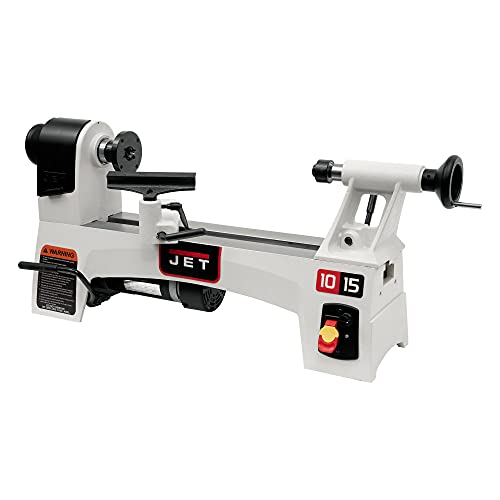
The JET JWL-1015VS is a compact benchtop lathe for users who want a trusted shop machine in a small footprint. Its 10 x 15-inch size works well for pens, small bowls, cups, ornaments, and short spindles. The 1/2 HP, 115-volt motor fits a normal household outlet. Variable speed control lets you adjust the cut without moving a belt by hand.
JET has long focused on woodworking tools, and this model shows that practical approach in a small format. The compact body is easier to place in a garage, craft room, or shared workshop. Its smaller swing does limit the size of bowls and platters you can turn. I recommend this machine for careful beginners who prefer a manageable learning platform over maximum capacity.
Pros:
- Compact body saves valuable shop space
- Variable speed makes setup easier
- 1/2 HP motor suits small and light projects
- 115-volt power works in many home shops
- JET brand offers a familiar woodworking-tool platform
- Good size for pens, ornaments, and small bowls
Cons:
- 10-inch swing limits bowl diameter
- 15-inch distance limits long spindle work
- Motor power may feel limited during deep cuts
My Recommendation
This is best for a space-limited beginner, classroom, or hobby shop that focuses on small work. It offers a smoother learning path than a basic fixed-speed machine because you can change speed as the wood changes. I would not choose it for large bowls or furniture legs. For compact projects and brand familiarity, it remains a strong candidate for the best lathe machine for wood.
12 x 20-Inch 3/4 HP Five-Speed Wood Lathe

This 12 x 20-inch benchtop lathe offers a useful middle ground for home woodturning. It lists a 3/4 HP motor and five speed settings from 680 to 2,770 RPM. That range covers slow starting cuts, general shaping, and many sanding tasks. The 20-inch bed also gives more room than compact 12 x 18 and 10 x 15 machines.
The thickened tool rest should give your turning tools a steadier support point, which matters when you learn to control bevel contact. Stainless steel live centers and a steel faceplate add useful working parts for spindle and face work. This is not an infinitely variable machine, so you must select one of five speeds rather than dial in an exact RPM. It can still serve a broad set of projects if you accept that simple limit.
Pros:
- 3/4 HP motor offers balanced home-shop power
- 12-inch swing handles many medium projects
- 20-inch bed supports longer spindles
- Five speeds cover common turning tasks
- Thick tool rest supports better tool control
- Steel faceplate and live centers add value
Cons:
- Speed is not infinitely adjustable
- Benchtop use requires a sturdy mounting surface
- Large, heavy blanks may challenge the motor
My Recommendation
I recommend this model for a home woodworker who wants more capacity than a mini lathe but does not need a full industrial machine. It can handle bowls, cups, spindles, and craft pieces with sensible cutting depth. The included steel parts are helpful for a new user building a tool set. It offers strong practical value when its current price stays below premium 1 HP models.
JET 12 x 21-Inch 1 HP Variable-Speed Lathe

The JET JWL-1221VS is the most capable all-around option in this group. Its 12 x 21-inch capacity suits bowls, hollow forms, cups, handles, and medium spindle work. The 1 HP motor gives it the reserve power that helps when a tool meets changing grain or a wider blank. Variable speed control also makes it easier to choose a calm start and a clean finish.
I see this lathe as a bridge between a beginner machine and a serious home-shop tool. It has enough room for skill growth, yet it does not demand the space of a long-floor lathe. A 12-inch swing still places a limit on very large platters, so measure your planned work before buying. Use a heavy stand or bench, because motor power alone cannot prevent vibration on a weak surface.
Pros:
- 1 HP motor gives strong general-purpose performance
- 12 x 21-inch capacity fits many turning projects
- Variable speed improves control and workflow
- Good balance of size for a home workshop
- Suitable for beginners who want room to advance
- Works well for both bowls and spindle projects
Cons:
- Higher cost than many entry-level lathes
- 12-inch swing limits very large bowl work
- Stand or bench may require a separate purchase
My Recommendation
For most serious hobbyists, I would choose the JET JWL-1221VS. It has the power, capacity, and variable control that make turning feel less like a fight with the machine. It is my leading pick for the best lathe machine for wood in this comparison, especially for a user who plans to turn for years. Its value is strongest when you want one dependable lathe instead of upgrading soon.
WM101A-Plus Mini Wood Lathe

The WM101A-Plus is made for very small turning projects and tight work areas. Its 24VDC, 96W power system keeps the machine light and compact. Infinitely variable speed gives a beginner direct control over the pace of a pen, small spindle, bead, or craft blank. The included tool kit can also help a new maker try basic turning without collecting every accessory at once.
This mini lathe makes sense for a desk-height craft area, apartment workshop, or classroom with limited room. Its small motor cannot match the force of a 1 HP wood lathe, so sharp tools and light cuts are essential. It is also not the right choice for large bowls, thick stock, or long furniture parts. Think of it as a gentle practice wheel rather than a full-size production machine.
Pros:
- Very small footprint suits tight spaces
- Infinitely variable speed is easy to adjust
- Low-voltage 24VDC design supports compact use
- Tool kit helps beginners start quickly
- Good for pens, beads, and small craft work
- Light weight makes storage easier
Cons:
- 96W motor limits stock size and cutting depth
- Not suitable for large bowls or long spindles
- Small machines need careful clamping to stay steady
My Recommendation
Choose this mini lathe if your projects are small and your shop space is smaller still. It is a friendly way to learn tool angle, grain direction, and basic spindle technique. I would not call it the best lathe machine for wood overall, but it may be the best starter machine for a student or craft maker. Its value comes from convenience, not heavy cutting power.
WEN 34035 14 x 20-Inch Variable-Speed Lathe
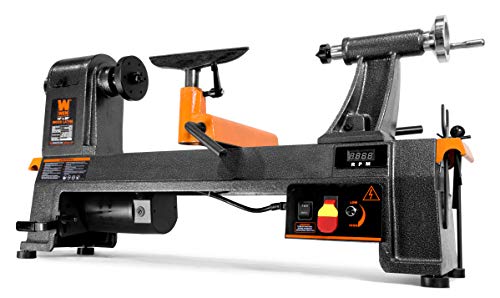
The WEN 34035 gives home woodworkers a generous 14-inch swing and a 20-inch distance between centers. That size works well for wider bowls and medium-length spindle projects. Its 6-amp motor supports variable speed, which helps you respond to blank size, wood type, and the stage of your cut. The larger capacity is useful when a 10- or 12-inch lathe feels too tight.
WEN often appeals to buyers who want practical tools at a reasonable price, and this model follows that pattern. It can be a sensible choice for a garage shop, especially when you plan to build a dedicated stand. A machine with this much swing needs careful balancing of blanks and a firm base. I also suggest checking the included accessories and current warranty terms before purchase, since package details can change.
Pros:
- 14-inch swing gives extra room for bowls
- 20-inch bed supports many spindle projects
- 6-amp motor offers useful home-shop output
- Variable speed supports safer project setup
- Good capacity for the price in many markets
- Suitable for advancing beginners and hobbyists
Cons:
- Large blanks require careful balancing
- May need a separate stand for best stability
- Not as compact as smaller benchtop models
My Recommendation
The WEN 34035 fits a woodworker who wants more bowl capacity but still needs a reasonably sized machine. It is a strong option for a garage or basement shop with room for a solid stand. I would rank it as a value-focused choice rather than a premium precision lathe. If 14-inch swing matters more than brand prestige, it deserves a close look as the best lathe machine for wood for larger home projects.
12 x 18-Inch Digital Display Wood Lathe

This 12 x 18-inch lathe focuses on electronic speed control and clear speed reading. Its listed 3/4 HP, 110-volt motor gives it enough output for many small and medium wood projects. The speed range of 650 to 3,800 RPM suits shaping, sanding, and polishing work. A digital display can help you repeat a setting instead of guessing from a belt position.
The machine may appeal to makers who enjoy a modern control panel and want a compact bench setup. Its 18-inch length works for bowls, cups, handles, and short spindles. The lower speed is not as slow as some 1 HP models, so take extra care with rough or uneven blanks. As with any electronic lathe, keep dust away from controls and inspect the power cord before use.
Pros:
- Digital display makes speed easier to monitor
- 3/4 HP motor suits many home projects
- 650 to 3,800 RPM range covers common tasks
- 12-inch swing handles useful medium-size work
- 110-volt setup fits many household workshops
- High speed helps with sanding and polishing
Cons:
- 650 RPM may be fast for some rough blanks
- 18-inch bed limits long spindle work
- Long-term electronic durability deserves attention
My Recommendation
I recommend this lathe for a DIY woodworker who likes visible speed data and electronic control. It is a practical fit for repeat work, where using a similar RPM each time helps build consistent habits. It is not ideal for very large or badly unbalanced stock. For digital control at a compact size, it can be the best lathe machine for wood for tech-minded beginners.
Garvee 14 x 40-Inch Variable-Speed Wood Lathe

The Garvee 14 x 40-inch lathe is aimed at woodworkers who need both swing and length. Its listed 0.5 HP motor and 1,040 to 2,980 RPM variable speed range fit a range of spindle and craft jobs. The 14-inch swing offers more bowl clearance than many compact machines. The 40-inch bed gives room for long legs, rails, dowels, and decorative turning.
This design can help a beginner explore full-length work without jumping straight to a heavy professional floor lathe. The included wrench and two chisels provide a basic starting point, though experienced users may want better turning tools. Since the motor is only 0.5 HP, take light passes in hard wood and avoid forcing the tool. A long machine also needs a level setup so the headstock and tailstock remain aligned.
Pros:
- 40-inch bed suits long spindle projects
- 14-inch swing provides useful bowl clearance
- Infinitely variable speed improves adjustment
- Simple accessory kit helps new users begin
- Useful choice for furniture parts and rails
- More project range than a short mini lathe
Cons:
- 0.5 HP motor is not ideal for heavy cuts
- Long bed takes more shop space
- Included chisels may not satisfy advanced turners
My Recommendation
This Garvee model is best for a user who values a long work area and plans to turn spindles. It can also suit a hobbyist who wants to make table legs or long decorative parts. I would choose a stronger 1 HP machine for frequent bowl work in dense wood. Still, its capacity makes it a useful alternative when length is the main need.
8 x 12-Inch Variable-Speed Wood Lathe
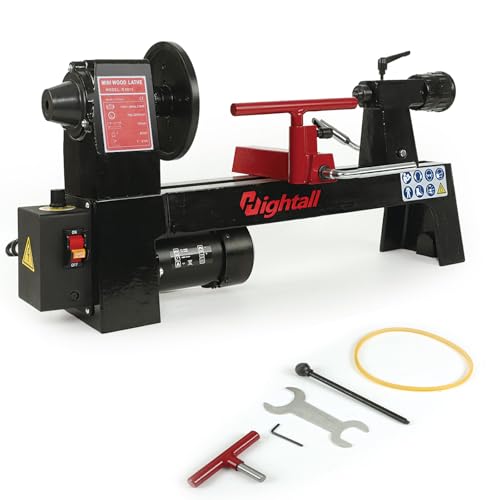
This 8 x 12-inch benchtop lathe is built for small work and limited spaces. Its 1/3 HP motor uses infinitely variable speed from 750 to 3,200 RPM. That control helps users slow down for shaping and increase speed for light sanding. The compact size makes it easy to place on a workbench, store after use, or share with another craft tool.
The small swing is a clear limit, but it can be a benefit for a new turner who wants less machine to manage. It suits pens, small handles, ornaments, beads, and short spindles. I would use light cuts and keep the tool rest close to the work because the motor is not designed for aggressive stock removal. Secure mounting matters, even with a small lathe, since vibration can spoil detail and increase risk.
Pros:
- Very compact for small home workshops
- Infinitely variable speed is beginner friendly
- Good for pens, ornaments, and small spindles
- 1/3 HP is suitable for light craft work
- Easy to store between projects
- Often costs less than larger variable-speed models
Cons:
- 8-inch swing limits project diameter
- 12-inch capacity does not suit long work
- 1/3 HP motor cannot handle deep heavy cuts well
My Recommendation
I would recommend this model to a beginner who wants to test woodturning before making a larger investment. It is also a good fit for a craft maker who works only on small pieces. It is not the best lathe machine for wood if you want bowls or furniture parts. Its main strength is a low-space, low-demand setup that helps new users learn the basics.
How I Compare a Wood Lathe
When I compare the best lathe machine for wood, I start with capacity. Swing over the bed tells you the largest theoretical diameter, while distance between centers shows the maximum length for spindle work. Real projects often need extra clearance, so I never plan to turn a blank at the exact limit. A little unused space makes the work safer and less stressful.
Motor power matters, but horsepower alone does not tell the whole story. A 1 HP motor can help with wider blanks and deeper cuts, while a small motor can perform well on pens and light spindles. I also look at low-speed control, because rough wood needs a calm start. Variable speed is convenient, but a well-made pulley system can still work well when the chosen speeds fit your projects.
Build quality affects both comfort and results. Cast iron tends to add weight and can help reduce vibration, but the machine still needs a firm stand. A rigid tool rest, smooth tailstock travel, and good headstock alignment make learning easier. I also check whether replacement parts, manuals, and warranty support appear easy to find.
What Size Wood Lathe Should You Buy?
A mini lathe with an 8- to 10-inch swing works for pens, small bowls, ornaments, and short handles. A 12-inch lathe gives a better balance for most home woodworkers. It can handle many bowls, cups, hollow forms, and medium spindles. A 14-inch machine makes sense when you often turn wide bowls or larger face-grain pieces.
For long spindles, bed length matters more than swing. A 14 x 40-inch lathe can support furniture parts that a 12 x 18-inch machine cannot. Measure the space around the lathe, not only the footprint under it. You need room to stand, move the tool, remove long stock, and access the power switch.
Important Features for Safe Woodturning
Speed control is one of the most useful features on a wood lathe. Start a rough blank at a low speed, stand to the side, and raise the speed only after the piece runs true. A forward and reverse function can help with sanding, but it does not replace good technique. Always follow the manual for the machine you buy.
The tool rest should lock firmly and sit close to the wood. A loose rest can let a tool catch, while a large gap can reduce control. Keep the tailstock aligned and use the right center for the work. Inspect the blank for cracks, knots, nails, and loose bark before you turn it.
Eye protection is the minimum. I also advise a face shield, hearing protection, a dust mask or respirator suited to fine wood dust, and shoes with a firm sole. Tie back long hair and avoid loose sleeves. Never wear gloves near a spinning lathe, and disconnect power before changing belts, centers, or accessories.
Best Uses for These Wood Lathes
| Best for | Why |
|---|---|
| Best overall home shop | The JET JWL-1221VS combines 1 HP, variable speed, and useful 12 x 21-inch capacity. |
| Best for long spindles | The VEVOR and Garvee 14 x 40-inch models provide extra bed length for legs and rails. |
| Best for small spaces | The WM101A-Plus and 8 x 12-inch lathe fit compact work areas and small craft projects. |
Buying Tips for 2026
Before you click Buy, confirm the current dimensions, voltage, speed range, and included accessories. Product pages can change, and sellers may update bundles over time. Look for a clear manual and a return policy that fits your comfort level. A low price means less if a missing part stops your first project.
Think about the wood you will turn most often. Soft pine and small craft blanks need less power than dense maple, large oak, or wet bowl blanks. If you expect your skills to grow, buying a little more capacity now may cost less than replacing a starter lathe later. This is why the JET 12 x 21 model stands out as a long-term pick.
Do not forget the hidden costs. You may need a stand, chuck, better chisels, sharpening gear, calipers, face protection, and dust control. A lathe is the heart of the shop, but the surrounding setup shapes your results. Save room in your budget for safe support and sharp tools.
FAQs Of best lathe machine for wood
What is the best lathe machine for wood for beginners?
The JET JWL-1015VS is a strong compact choice, while the JET JWL-1221VS is better for beginners who want more capacity. The best pick depends on your space, budget, and project size.
How much horsepower does a wood lathe need?
A 1/3 HP motor works for pens and light craft work. A 1/2 to 3/4 HP motor suits many small home projects. Choose 1 HP when you want stronger performance for bowls, larger blanks, and long-term growth.
Is variable speed important on a wood lathe?
Yes. Variable speed makes it easier to start rough blanks slowly and adjust the pace during shaping and sanding. Fixed pulley speeds can work, but they require more setup time.
Can a benchtop lathe turn large bowls?
Only within its rated swing and motor limits. A 12- or 14-inch lathe can handle medium bowls, but you must balance the blank and mount the machine firmly. Never exceed the stated capacity.
What safety gear do I need for woodturning?
Use eye protection and a face shield. Add hearing protection, suitable dust protection, and secure clothing. Keep the tool rest close, stand out of the spin path, and unplug the lathe before making adjustments.
Final Verdict: Which Should You Buy?
The JET JWL-1221VS is my top choice for the best lathe machine for wood. Its 1 HP motor, 12 x 21-inch capacity, and variable speed suit both new and skilled home turners.
Choose a compact JET or mini model for small work, or a VEVOR, WEN, or Garvee for longer pieces. Compare current price, capacity, safety, and support before ordering.