
The best random orbital sander for woodworking delivers smooth finishes, strong dust control, and low vibration.
You know that moment when a project looks great… until the light hits and you see swirl marks? Or your shop fills with dust after five minutes of sanding? I’ve been there too. The right tool changes everything. The best random orbital sander for woodworking should glide, collect dust well, and leave wood ready for stain or paint—without tingling hands. In this guide, I’ll help you zero in on the sander that fits your budget, your skills, and your shop setup. Whether you’re finishing a maple tabletop or knocking down pine edges, I’ll show you what really matters in daily use.

SKIL 5” Random Orbital Sander…
POWERFUL – With a 2.8 amp motor and 13,000 orbits per minute, it’s able to deliver a smooth performance over a variety of sanding applications. EASY TO CLEAN DUST CONTAINER…

DEWALT Random Orbit Sander, Variable…
3-Amp motor spins the pad at 8,000 – 12,000 OPM Separate counterweight design reduces vibration for improved comfort Improved dust-sealed switch protects against dust ingestion for longer switch life Dust…

DEWALT Orbital Sander Kit, 5…
3.0 amp motor that spins the pad at 12,000 OPM Shorter height allows the user to get closer to work piece Separate counterweight design reduces vibration for improved comfort Rubber…
SKIL 5-Inch Random Orbital Sander (SR211601)

The SKIL SR211601 is a budget-friendly palm sander that still feels refined in hand. Its cyclonic dust box stands out at this price, snapping on tight and staying put. The tool is compact, easy to grip, and light enough for long sessions without strain. It delivers quick stock removal and a surprisingly smooth finish for the class.
As a starter pick, it’s one of the best random orbital sander for woodworking when cost matters most. I like it for small home projects, trim work, and quick refinishing. The hook-and-loop pad makes grit changes simple and fast. Pair it with high-quality discs and you’ll get better finish and longer pad life.
Pros:
- Great price-to-performance for DIY and light pro work
- Cyclonic dust box captures a lot of fine dust
- Compact body reduces hand fatigue on vertical sanding
- Hook-and-loop pad speeds up paper swaps
- Stable, low-vibration feel for the price tier
Cons:
- Not as durable as pro-grade models for daily site use
- Dust box fills fast; a vac adapter is a better long-term plan
- Less power than premium 3.0A+ units
My Recommendation
If you want the best random orbital sander for woodworking on a tight budget, start here. It’s ideal for first-time buyers, weekend DIYers, and anyone refurbishing furniture in a small shop. Expect reliable dust capture for light work and an easy learning curve.
| Best for | Why |
| First-time woodworkers | Low cost and easy control build skills fast |
| Furniture touch-ups | Good finish quality without heavy weight |
| Small home projects | Cyclonic dust box keeps cleanup simple |
DEWALT 5-Inch Variable-Speed Sander (DWE6423)

The DEWALT DWE6423 is a shop favorite for a reason. Its 3.0-amp motor and variable speed dial give you control across tasks, from aggressive leveling to final finish. The short height improves balance and reduces tipping at edges. Paired with a vacuum, it traps most dust and keeps your lines of sight clear.
If you ask me which model feels closest to a “buy once, cry once” pick, this is it. It’s the best random orbital sander for woodworking pros who need reliability all week long. The pad braking system cuts down on gouges at startup. Ergonomics are dialed in, with rubber overmold where you need it most.
Pros:
- Strong 3.0A motor with variable speed for nuanced control
- Excellent dust collection with a vacuum hookup
- Low profile and well-balanced for edge control
- Pad brake reduces swirl risks and gouging
- Durable build stands up to jobsite use
Cons:
- Corded tether may limit mobility in large spaces
- Heavier than ultra-budget palm sanders
- Price sits above entry-level picks
My Recommendation
For many, this is the best random orbital sander for woodworking in a corded format. It shines on cabinetry, hardwood tabletops, and consistent shop output. Choose it if you value speed control, low vibration, and proven longevity.
| Best for | Why |
| Pro shops | Durable 3.0A motor handles daily workloads |
| Fine finishing | Variable speed reduces swirl and burn-through |
| Dust-sensitive spaces | Great performance with vac extraction |
DEWALT 5-Inch Orbital Sander Kit (DWE6421K)
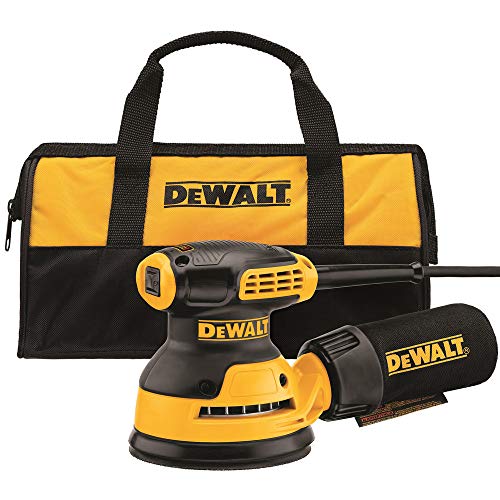
The DWE6421K is the single-speed sibling to the DWE6423. It runs at a steady 12,000 OPM, which is a sweet spot for general sanding. You give up the speed dial, but you get the same sturdy form factor and reliable pad braking. It comes in a kit with a bag, so it’s easy to store and carry.
For users who mainly sand pine, poplar, or prepped hardwood, this is a simple, tough tool. It can be the best random orbital sander for woodworking when you want fewer settings and reliable output. Hook it to a shop vac for clean results on trim, doors, and shelves. It’s well-priced for a DEWALT kit.
Pros:
- Set-it-and-forget-it single speed at 12,000 OPM
- Same rugged body and low profile as the DWE6423
- Includes a carrying bag for jobsite moves
- Pad brake limits swirl and scuffing
- Strong dust performance with vac connection
Cons:
- No variable speed for delicate veneers or soft finishes
- Cord limits range without an extension
- Slightly heavier than small DIY sanders
My Recommendation
Pick this if you want DEWALT’s build without the extra cost of a speed dial. It’s the best random orbital sander for woodworking users who stick to typical furniture woods and want predictable results. It’s also a smart choice for jobsite crews who need a simple, tough sander.
| Best for | Why |
| General carpentry | 12,000 OPM suits broad tasks |
| Budget-conscious pros | Pro durability with a lower price than variable-speed |
| On-the-go work | Kit bag simplifies transport and storage |
DEWALT 20V MAX Random Orbit Sander (DCW210B)

The DCW210B brings cordless freedom to a proven DEWALT platform. The brushless motor delivers strong runtime and consistent power, especially on the 20V Max batteries many woodworkers already own. With variable speed and a comfortable top grip, it adapts well from rough sanding to finish work. Dust collection is solid, and a vac adapter helps even more.
If you need to move around a big shop or jobsite, this is gold. It can be the best random orbital sander for woodworking when cords get in your way. The tool-only option is perfect when you already have batteries. Add a 5Ah or 6Ah pack for longer sessions on tabletops and doors.
Pros:
- Cordless freedom with strong brushless power
- Speed control supports both stock removal and finish sanding
- Great ergonomics and low vibration for a cordless tool
- Compatible with DEWALT 20V Max batteries
- Solid dust capture with a vacuum hooked up
Cons:
- Heavier with a large battery installed
- Tool-only purchase means higher total cost if you lack batteries
- Corded options may still outlast it in all-day sessions
My Recommendation
Choose this if you value mobility. For built-ins, stairs, and room-to-room work, it’s the best random orbital sander for woodworking when outlets are scarce. If you already run DEWALT 20V Max, it’s a no-brainer addition to your kit.
| Best for | Why |
| Jobsite mobility | No cord to snag on ladders or trim |
| Existing DEWALT users | Battery cross-compatibility saves money |
| On-site finishing | Variable speed suits touch-ups and installs |
BOSCH ROS20VSC 5-Inch Palm Sander Kit
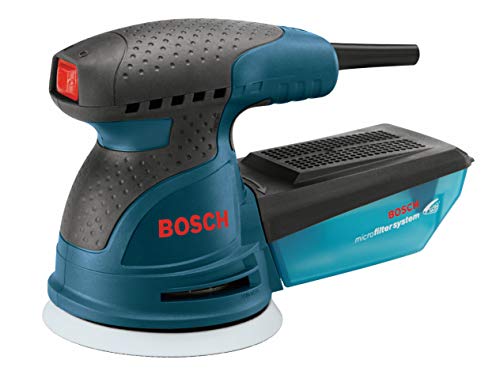
The BOSCH ROS20VSC is famous for finish quality. Its pad-dampening system reduces swirl marks, which matters when you plan to stain. Variable speed makes it versatile, while the microfilter canister grabs fine dust well. The kit usually includes a bag and vacuum adapter for quick setup.
This is a great option for detail-minded finishers and furniture makers. It’s often the best random orbital sander for woodworking when stain-grade results are your standard. The compact profile hugs your hand, and the on-tool dust canister locks with a positive feel. It’s a time-tested pick in many small shops.
Pros:
- Pad-dampening tech helps cut swirl marks
- Variable speed for delicate or aggressive passes
- Excellent microfilter canister performance
- Includes vac adapter and soft bag in most kits
- Comfortable and well-balanced for long sessions
Cons:
- 2.5A motor is less powerful than 3.0A+ rivals
- Canister fills quickly on large stock removal jobs
- Not ideal for heavy-duty, all-day leveling
My Recommendation
If your main goal is a flawless finish, pick this. It could be the best random orbital sander for woodworking when you chase stain-ready surfaces on walnut or cherry. Connect a vac and use quality discs; you’ll see the difference right away.
| Best for | Why |
| Finish-focused work | Pad dampening tames swirls on stain-grade wood |
| Small shops | Strong dust canister without a full dust system |
| Cabinetry | Speed control suits veneers and edge work |
DongCheng 5-Inch Random Orbital Sander, 3.2A
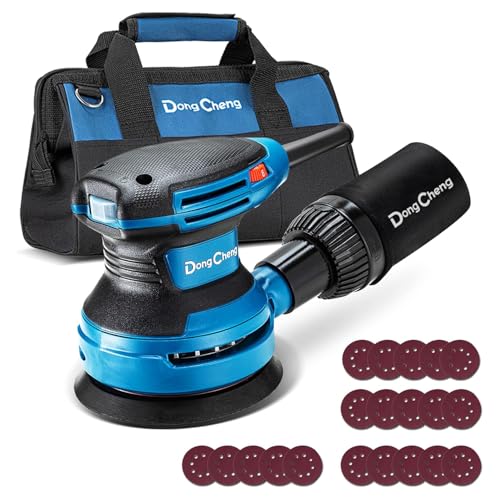
This DongCheng model packs a 3.2-amp motor and six speeds, making it punch above its price. It includes 20 sanding discs, which is handy for starting out. The detachable dust bag performs decently, and the overall build feels stable. For a lesser-known brand, it brings serious value and power.
I like it for users who need more muscle without breaking the bank. It can be the best random orbital sander for woodworking if you tackle rough stock and then shift to finish grits. The higher max speed helps on coarse passes, while lower speeds protect edges and soft woods. Expect a strong value-to-performance ratio.
Pros:
- 3.2A motor offers strong stock removal
- Six speeds for flexible sanding control
- Comes with 20 sanding discs to get started
- Stable feel reduces chatter at high OPM
- Good price for the power and kit content
Cons:
- Dust bag is basic; vac hookup recommended for best results
- Brand support may be more limited than big names
- Finish quality depends heavily on disc choice
My Recommendation
If you want a workhorse on a budget, this is compelling. It’s the best random orbital sander for woodworking users who do both rough leveling and final passes on the same tool. Add a vacuum and quality discs for best finish and pad life.
| Best for | Why |
| Budget power seekers | 3.2A motor with six speeds gives range |
| Mixed sanding tasks | High OPM for removal, low OPM for finish |
| Starter kits | Includes 20 discs to begin right away |
DEKOPRO 5-Inch Random Orbital Sander

The DEKOPRO random orbital sander targets entry-level users with a full starter kit. You get a dust box, six speed options, and 16 sandpapers. The tool fits well in the hand, and the controls are easy. For quick home fixes and hobby builds, it’s more than enough.
If you’re dipping your toes into woodworking, this might be the best random orbital sander for woodworking to learn on. It’s light, simple, and cheap to own. Pair it with 120–220 grits and you’ll see a smooth, paint-ready surface. For heavy leveling, you may want to step up in power later.
Pros:
- Very affordable starter kit with 16 discs
- Six speeds support a range of tasks
- Compact design is easy to control
- Dust box helps keep small areas cleaner
- Great for hobby and light work
Cons:
- Not built for daily pro use
- Lower power can slow heavy stock removal
- Dust box lacks the efficiency of a vac hookup
My Recommendation
Grab this if you want to test the waters without overspending. It can be the best random orbital sander for woodworking beginners, art students, or renters doing quick touch-ups. Keep the expectations modest, and it’ll serve you well.
| Best for | Why |
| New DIYers | Low cost, starter discs, and easy controls |
| Craft projects | Lightweight and simple for short sessions |
| Apartment work | Dust box helps limit mess in small spaces |
HYCHIKA 5-Inch Random Orbital Sander

The HYCHIKA 5-inch sander offers six variable speeds and up to 13,000 RPM for quick work. It includes 12 sandpapers and a dust bag that clips on securely. The handle design feels steady on flat panels and door faces. It’s a reasonable mid-budget option for small shops and DIY users.
If you sand a mix of pine, poplar, and plywood, this can be the best random orbital sander for woodworking at a friendly price. It has decent dust control for light use. Match the speed to the grit and wood to cut down swirls. It’s also simple to pack and store when space is tight.
Pros:
- Good power for light to moderate stock removal
- Six speeds help tailor the finish
- 12 included discs add starter value
- Stable grip improves control on wider boards
- Affordable for home workshops
Cons:
- Dust bag capacity is small for large jobs
- Not designed for heavy commercial use
- Finish results vary with disc quality
My Recommendation
Pick this if you need a value sander that still feels capable on furniture and trim. It’s often the best random orbital sander for woodworking when you want more speed options than basic DIY picks, without paying pro-tier prices.
| Best for | Why |
| Budget-conscious makers | Variable speed at a fair price |
| Small furniture | Stable feel helps control the finish |
| Occasional use | Includes discs and a simple dust bag |
DCK 5-Inch Random Orbital Sander (KSA125)

The DCK KSA125 brings a 3.0-amp motor with six speeds up to 12,000 OPM. It includes 10 sandpapers and a dust bag, so you can get to work fast. Low vibration makes it comfortable, even at higher speeds. The sander feels planted on flat workpieces, which improves consistency.
For value-focused buyers, it hits a sweet spot. It may be the best random orbital sander for woodworking when you want 3.0A power without the pro-brand price. It’s capable of both material removal and careful finishing. Add a vacuum hose to keep your air cleaner and your lines visible.
Pros:
- 3.0A motor with six speeds for range
- Low vibration for longer sessions
- Includes 10 discs for quick setup
- Good flat-surface stability
- Strong value for the features
Cons:
- Dust bag is basic; vac connection preferred
- Support and parts may not match big-brand ecosystems
- Pad and finish quality depend on disc choice
My Recommendation
Consider this if you want near-pro power at a modest price. It’s often the best random orbital sander for woodworking across mixed tasks, from rough sanding to pre-finish smoothing. Use quality discs and a vac hookup for the cleanest, most consistent results.
| Best for | Why |
| Value hunters | 3.0A motor and six speeds at a budget price |
| Panel work | Stable, low-vibe feel helps control |
| Home shops | Includes discs for fast start-up |
Choosing the Best Random Orbital Sander for Woodworking: Buyer’s Notes
Before the FAQs, here’s a quick guide to help you pick with confidence. These are the traits I test every time I review a sander. Keep them in mind as you choose the best random orbital sander for woodworking for your projects.
- Power and speed: 3.0A corded motors offer quick removal. Variable speed helps on edges and veneers.
- Dust control: A tight-sealing canister is good; a vac hookup is better. Clean air equals cleaner finishes.
- Vibration: Low vibration protects your hands and improves control. Try to test the grip if you can.
- Pad quality: A good brake limits swirls. Hook-and-loop pads should hold discs tight and release fast.
- Ergonomics: A lower profile and rubber overmold help on long sessions and vertical work.
One final tip: always step through grits. Don’t jump from 80 to 220. Move 80 → 120 → 150/180 → 220 for best results. This is how the best random orbital sander for woodworking delivers that glassy, even surface.
FAQs Of best random orbital sander for woodworking
What size sander pad should I choose?
Five-inch sanders are the sweet spot for most users. They balance control, speed, and disc availability. If you sand big panels often, a 6-inch can be faster but heavier.
Do I need variable speed?
It helps a lot. High speed for removal, lower speed for edges, soft woods, and finish passes. If you work on veneers or stain-grade surfaces, variable speed is worth it.
How do I avoid swirl marks?
Use fresh discs, keep the sander flat, and move slowly. Let the tool do the work. Step through grits and finish with vacuum extraction for a cleaner surface.
Is corded or cordless better?
Corded wins for long runtime and value. Cordless wins for mobility and convenience. If you already own batteries, cordless can be a great upgrade.
Which grit should I start with?
For bare wood: start at 80 or 100 for rough boards. Then 120, 150/180, and 220. For light touch-ups, start at 150 or 180 and go to 220.
Final Verdict: Which Should You Buy?
If you want one do-it-all pick, the DEWALT DWE6423 is hard to beat. It blends power, control, and dust capture. For stain-ready finishing, the BOSCH ROS20VSC shines.
Crave freedom from cords? The DEWALT DCW210B is the best random orbital sander for woodworking in mobile setups. On a tight budget, the SKIL SR211601 is a smart start.