
If you’ve ever wondered how much power a table saw really needs, you’re not alone. Many people—whether they’re hobby woodworkers or professional carpenters—ask themselves, “How many watts does a table saw use? ” Knowing the answer is more than just a technical detail.
It affects your workshop setup, your electric bills, and even the safety of your workspace. This article will give you a detailed, clear guide about table saw wattage, what affects it, and how to make smart choices for your needs.
Whether you’re buying your first table saw or trying to upgrade your shop, you’ll find real-world examples, practical tips, and crucial data throughout this guide.
What Does “wattage” Really Mean For Table Saws?
Before diving into numbers, let’s get clear on what wattage means. Watts are a measurement of power. For table saws, it’s the amount of electrical energy the motor uses while running. In simple terms, higher wattage means more power, but also more electricity used.
- Watts (W) measure how much energy the saw needs per second.
- Amps (A) are about the flow of electricity.
- Volts (V) are the pressure pushing the electricity.
You can always find the wattage by multiplying volts by amps:
Watts = Volts × Amps
For example, if a table saw is rated at 15 amps and 120 volts, the wattage is 1,800 watts (15 × 120).
Knowing wattage helps you:
- Choose the right extension cord and circuit
- Estimate electricity costs
- Avoid overloading your shop’s wiring
Typical Wattage Range Of Table Saws
Table saws are not all the same. Their wattage depends on their size, power, and intended use. Here’s a look at the common ranges:
- Benchtop Table Saws: 1,000–1,800 watts
- Contractor Table Saws: 1,200–2,000 watts
- Cabinet Table Saws: 2,000–3,500+ watts
- Hybrid Table Saws: 1,500–2,200 watts
- Jobsite Table Saws: 1,200–2,000 watts
Benchtop and jobsite saws are often used for lighter or portable work. Cabinet saws are the most powerful and used for heavy-duty, all-day cutting.
Let’s compare some popular models and their wattage:
| Table Saw Model | Type | Motor Amps | Voltage | Watts |
|---|---|---|---|---|
| DeWalt DWE7491RS | Jobsite | 15A | 120V | 1,800W |
| Bosch 4100XC-10 | Benchtop | 15A | 120V | 1,800W |
| SawStop PCS31230 | Cabinet | 13A | 220V | 2,860W |
| Grizzly G0690 | Cabinet | 12.8A | 220V | 2,816W |
| RIDGID R4512 | Hybrid | 13A | 120V | 1,560W |
Notice that more powerful, stationary saws use more watts. Portable saws stay in the 1,200–1,800 watt range.

Credit: www.walmart.com
Factors That Affect Table Saw Wattage
Wattage is not just about the label on the box. Several factors change how much power your table saw actually uses.
1. Motor Size And Efficiency
A larger motor can cut thicker, harder wood—but it uses more watts. More efficient motors can sometimes do the same work using less power. Older table saws are often less efficient, so they draw more watts for the same job.
2. Type Of Work
Cutting thin plywood takes less power than ripping a thick hardwood board. If you regularly cut dense woods like oak or maple, your saw will use more energy under heavy load.
3. Blade Sharpness
A dull blade forces the motor to work harder, increasing wattage. Keeping your blade sharp means using less electricity and making smoother cuts.
4. Startup Surge
When you first turn on the saw, there’s a brief surge in power. This can be 2–3 times the running wattage, but it only lasts a second. For example, a 1,800W saw might spike to 3,600–4,500W at startup.
5. Voltage Supply
Running a saw on lower voltage can increase amp draw and stress the motor. Some large saws switch between 120V and 240V; on 240V, they draw fewer amps for the same watts.
6. Accessories
If you run lights, vacuums, or other tools on the same circuit, total wattage goes up. Always check the combined load before plugging in.
How To Find Your Table Saw’s Wattage
You don’t need to guess. Here’s how to check the wattage for your specific saw:
1. Read The Motor Plate
Most table saws have a label or plate near the motor. It lists amps, volts, and sometimes HP (horsepower). If wattage is not listed, multiply amps by volts.
2. Check The Owner’s Manual
Manufacturers usually list the rated wattage for your saw in the manual. This is the typical running power, not the peak startup.
3. Use A Power Meter
For exact measurements, plug the saw into a kill-a-watt meter or similar device. This shows real-time watt usage, including any extra draw from dull blades or tough cuts.
4. Online Resources
Some manufacturers and tool review sites publish full specs. If you’ve lost your manual, you can often find the numbers online.
Table Saw Wattage: Real-world Examples
To make this more concrete, here’s how much power some common table saws use in daily work.
- Small Benchtop Saw
- Example: Skil 3410-02 (10-inch)
- Motor: 15A, 120V
- Running Watts: 1,800W
- Startup Surge: 3,600–4,000W
- Use: Plywood, pine boards
- Jobsite Table Saw
- Example: DeWalt DWE7485
- Motor: 15A, 120V
- Running Watts: 1,800W
- Startup Surge: 3,600–4,200W
- Use: Framing, trim work
- Cabinet Table Saw
- Example: SawStop PCS31230
- Motor: 13A, 220V
- Running Watts: 2,860W
- Startup Surge: 5,000–6,000W
- Use: Furniture, hardwoods
- Hybrid Table Saw
- Example: RIDGID R4512
- Motor: 13A, 120V
- Running Watts: 1,560W
- Startup Surge: 3,000–3,600W
- Use: Cabinet making
These examples show how wattage grows with saw size and job difficulty. Cabinet saws need dedicated, higher-capacity circuits.
Wattage Needs For Different Users
Not everyone needs a high-wattage table saw. Here’s how to decide what’s right for you:
Hobbyist/diy User
If you’re making small projects or doing home repairs, a benchtop or jobsite saw (1,200–1,800W) is usually enough. These plug into standard outlets and are easy to move.
Serious Woodworker
If you work with hardwoods or build furniture, a hybrid or small cabinet saw (1,500–2,500W) gives more power and stability. You may need a 20-amp circuit.
Professional/heavy-duty
For daily use, thick lumber, or commercial shops, a cabinet saw (2,500–3,500+W) is best. These require 220V wiring and a dedicated line.
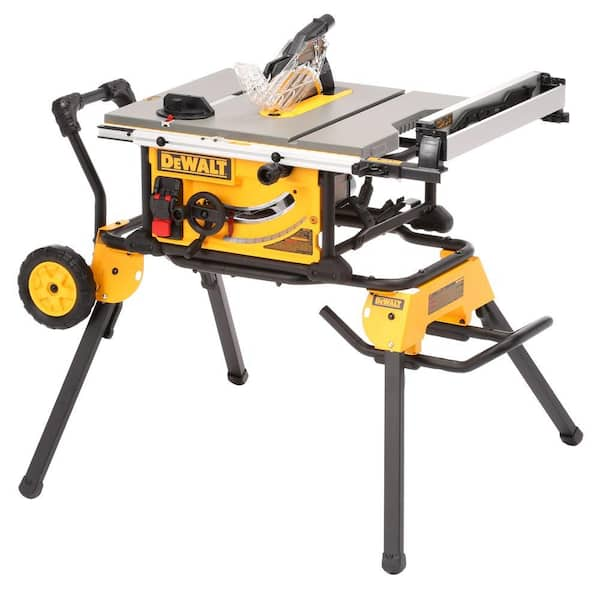
Credit: www.homedepot.com
Electricity Cost Of Running A Table Saw
How much does it cost to run your saw? Here’s a quick way to estimate:
- Find the wattage (e.g., 1,800W)
- Convert to kilowatts: 1,800W ÷ 1,000 = 1.8 kW
- Multiply by hours used: If you use your saw for 2 hours, that’s 1.8 × 2 = 3.6 kWh
- Multiply by your electricity rate: If power costs 15¢ per kWh, then 3.6 × $0.15 = $0.54
So, running a 1,800W saw for 2 hours costs about 54 cents. Most users don’t run their saw constantly, so the actual monthly cost is low.
Power Supply And Circuit Requirements
Choosing the right power supply is not just about plugging in. Using too small a circuit can trip breakers or overheat wires. Here’s what you need to know:
1. Circuit Size
Most benchtop and jobsite saws (up to 1,800W) run on a 15-amp, 120V household circuit. Hybrid and small cabinet saws may require a 20-amp circuit. Large cabinet saws need 220V, 20–30 amp circuits.
2. Dedicated Circuit
For high-wattage saws, use a dedicated circuit—no other tools or outlets on the same line. This prevents overloads.
3. Extension Cords
Use a heavy-duty cord (12-gauge or thicker) for saws over 1,500W. Thin cords cause voltage drops, make motors run hot, and can even be unsafe.
4. Surge Protection
Because startup surges are high, consider a surge protector or a slow-blow breaker for your saw’s circuit.
How Table Saw Wattage Compares To Other Tools
You might wonder how a table saw’s wattage stacks up against other common shop tools. Here’s a comparison:
| Tool | Typical Amps | Volts | Watts |
|---|---|---|---|
| Table Saw | 10–15A | 120V | 1,200–1,800W |
| Miter Saw | 10–15A | 120V | 1,200–1,800W |
| Jointer | 6–10A | 120V | 720–1,200W |
| Planer | 12–15A | 120V | 1,440–1,800W |
| Shop Vacuum | 8–12A | 120V | 960–1,440W |
| Drill Press | 3–7A | 120V | 360–840W |
Table saws are among the highest wattage tools in a typical shop. Always add up the total if you run several tools at once.
Common Mistakes When Figuring Table Saw Wattage
Many users make errors when estimating how much power they need for a table saw. Here are some common mistakes and how to avoid them:
1. Ignoring Startup Surge
People often look only at running watts, forgetting the startup surge. This can trip a breaker if your circuit is too small.
2. Using Thin Extension Cords
A thin cord causes voltage drop, overheating, and reduced motor life. Always use a heavy-duty cord (12-gauge or better).
3. Overloading Circuits
Plugging multiple high-wattage tools into one circuit can trip breakers or even start a fire. Use a dedicated line for your main saw.
4. Not Checking Actual Usage
Some saws use more power than the label says, especially with tough cuts or dull blades. Use a power meter for accurate numbers.
5. Underestimating Future Needs
If you plan to upgrade your saw or add more tools, build in extra capacity now. It’s easier than rewiring later.
Saving Energy With Your Table Saw
You can reduce energy use and keep your saw running well with a few simple habits:
- Keep the blade sharp: A sharp blade reduces the load on the motor.
- Clean the saw regularly: Dust and buildup force the motor to work harder.
- Use the right blade: For thick hardwood, use a rip blade. For plywood, use a fine-tooth blade.
- Make steady cuts: Forcing wood too fast increases wattage and risks kickback.
- Upgrade to an efficient motor: Newer motors can cut the same wood with less electricity.
Wattage And Safety: What You Need To Know
High-wattage tools need careful handling for safety:
- Circuit breakers: Don’t bypass them or use bigger fuses than recommended.
- Proper wiring: Old or undersized wiring can overheat and cause fires.
- Grounding: Always plug into a grounded outlet for shock protection.
- Ventilation: High-wattage motors get hot; keep air flowing around your saw.
One common mistake is running a powerful saw on an old, worn outlet or extension cord. This can lead to overheating and even electrical fires. Always check your setup before starting a big project.
)
Credit: www.energysage.com
How Horsepower Relates To Wattage
You might see table saws rated by horsepower (HP) instead of just amps or watts. Here’s how it connects:
- 1 HP = 746 watts
But remember, motor efficiency means the actual wattage drawn is usually higher than the “output” rating. For example, a 2 HP motor might use 1,800–2,200 watts, depending on how efficient it is.
Some manufacturers list “peak horsepower,” which is the maximum for a split second. Focus on continuous horsepower for real comparison.
The Role Of Induction Vs. Universal Motors
Table saw motors come in two main types:
- Universal motors: Lighter, noisier, and common in portable saws. They often have higher wattage for their size but wear out faster.
- Induction motors: Quieter and more efficient, found in cabinet and hybrid saws. They use power more steadily.
Induction motors often need 240V wiring for high-wattage models.
Wattage Needs For Off-grid Or Portable Power
If you want to run your table saw with a generator or battery system, wattage is crucial:
- Choose a generator with at least 25% more watts than your saw’s running wattage.
- For a 1,800W saw, pick a generator rated at 2,400–2,500W or higher.
- Remember the startup surge—some generators can’t handle the spike.
For battery-powered table saws (rare, but growing), check both the amp-hour rating and the maximum watt output. Most battery saws are lower wattage and best for light-duty work.
Matching Table Saw Wattage To Your Needs
It’s tempting to buy the most powerful saw you can afford. But more isn’t always better. Here’s what matters most:
- Type of work: Thin plywood vs. thick hardwood
- Frequency: Occasional DIY vs. daily commercial use
- Power supply: Do you have 220V available?
- Portability: Heavier, high-wattage saws are harder to move
If you only use your saw a few times a year, a 1,500–1,800W model is usually plenty. For serious woodworking, invest in a 2,200–3,000W saw, but plan your shop wiring first.
Practical Examples: Workshop Scenarios
Let’s look at a few real-life workshop setups and the wattage needed.
Example 1: Home Garage Workshop
- Saw: DeWalt 10” jobsite saw (1,800W)
- Other tools: Shop vacuum (1,200W), drill (500W)
- Total running watts: 3,500W
A standard 15-amp circuit can only handle about 1,800W. Running both saw and vacuum on the same line will trip the breaker. Solution: Use separate circuits.
Example 2: Cabinet Shop
- Saw: SawStop 3HP cabinet saw (2,800W)
- Other tools: Dust collector (1,400W), jointer (1,000W)
- Total running watts: 5,200W
This setup needs at least two 20-amp, 220V circuits. A single circuit is not enough.
Example 3: Off-grid Construction
- Saw: Bosch benchtop saw (1,800W)
- Power: Portable generator (2,200W rated, 3,000W peak)
This generator is enough for the saw’s running watts and startup surge. If you add more tools, you’ll need a larger generator.
Table Saw Wattage: Key Takeaways
- Most table saws use between 1,200 and 3,500 watts, depending on size and type.
- Always check both running watts and startup surge.
- Match your saw to your circuit and power supply for safety.
- Don’t forget the total wattage if you use other tools at the same time.
- Proper wiring, sharp blades, and regular cleaning keep wattage needs lower.
For more in-depth technical details about electric motors and power use, visit the Wikipedia page on electric motors.
Frequently Asked Questions
How Do I Know If My Circuit Is Big Enough For My Table Saw?
Check your saw’s running watts and the breaker size. A typical 15-amp, 120V circuit can handle up to 1,800W. If your saw uses more, or if you run extra tools, use a 20-amp circuit or add a dedicated line.
Why Does My Table Saw Trip The Breaker When I Turn It On?
The startup surge can be 2–3 times the running wattage. If your circuit is too small, or if you have other tools plugged in, the breaker may trip. Use a dedicated, properly sized circuit for your saw.
Can I Use A Table Saw With A Portable Generator?
Yes, but the generator must handle both the running watts and the startup surge. Choose a generator rated at least 25% higher than your saw’s running wattage.
What’s The Difference Between Amps And Watts On A Table Saw?
Amps measure the flow of electricity; watts measure total power. You can find watts by multiplying amps by volts. For example, 15A × 120V = 1,800W.
Does A More Powerful (higher Wattage) Saw Always Cut Better?
Not always. A higher wattage saw can cut thicker wood, but blade sharpness, motor efficiency, and cut quality also matter. For most home users, 1,500–1,800W is plenty.
Choosing the right table saw wattage keeps your shop safe, efficient, and ready for any project. With this knowledge, you’ll avoid common mistakes and get the best performance from your tools.