
The best flush trim router bit delivers clean, tear‑free edges and perfect templates.
You know that moment when a project looks almost right, but the edges still need that magic pass? I have felt it in the shop many times. A good flush trim bit turns a rough shape into a sharp line. It saves time, cuts stress, and makes templates sing. Whether you trim laminate on a counter or match curved parts, the right bit is gold. In this guide, I break down the best flush trim router bit options for real work. I share what matters, what fails fast, and what wins on hardwood, MDF, veneer, and plywood.

Freud 42-104: 1/2″ (Dia.) Bearing…
Specs: Bearing Dia. 1/2″, Number of Cutters 2, Overall Dia. 1/2″, Overall Length 2-13/16″, Shank Dia. 1/4″, Carbide Height 1″ Cuts all composition materials, plywoods, hardwoods, and softwoods Use on…

Wolfride 4PCS Flush Trim Router…
1/4″ shank top bearing flush trim router bit, cutting diameter: 1/4″,5/16″,3/8″,1/2″. Industrial Grade Carbide Cutters, good quality for long service life. Precision ground, creating smooth cutting surface. Can be used…

UwinVwin 4Pcs Top & Bottom…
Size: Flush trim router bit 1/4 shank, cutting diameter 1/2″. Carbide blade cutting height: 3/4″, 1″, 1-1/4″, 1-1/2″. This flush cut router bit is ideal for veneer, laminate, and shelf…
Freud 42-104 1/2-Inch Bearing Flush Trim Bit

This Freud classic is a workhorse for template routing and laminate. The 1/2-inch diameter gives a smooth, flat shearing cut on end grain and plywood. The bearing tracks patterns with less wobble and strong control. In my tests, it held an edge well on MDF and maple.
Freud’s micro-grain carbide resists heat and stays sharp longer than many low-cost bits. I like it for repeat shop work where every pass must be clean. The cut quality is crisp with modest feed pressure. If you need a steady, reliable cutter, this one earns a place.
Pros:
- Smooth, accurate cuts on hardwoods and MDF
- Quality carbide stays sharp through long sessions
- Well-sized bearing for steady template tracking
- Great for laminate and veneer edges with light passes
- Trusted Freud build and consistent tolerances
Cons:
- Not ideal for very thick stock in one pass
- May show minor burn on resinous wood if feed is too slow
- Standard straight flutes, not spiral
My Recommendation
If you want the best flush trim router bit for daily shop use, start here. It is steady, sharp, and easy to control on a handheld router. Use it for laminates, jigs, and tight-fitting parts. Your templates will align clean, and your edges will feel glassy.
| Best for | Why |
|---|---|
| Everyday template work | Reliable cut, accurate bearing, clean finish |
| Laminate trimming | Light, controlled passes with less chip-out |
| MDF and plywood | Carbide edge holds up to abrasive sheets |
Wolfride 4-Piece 1/4-Inch Top-Bearing Set
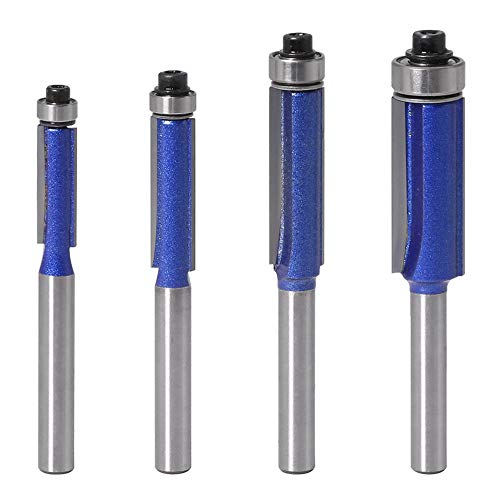
This Wolfride set gives you four top-bearing bits that cover many tasks. The 1/4-inch shank works well in light routers and trim routers. The bearings track a top template, which is great on a router table or handheld. I used it for small patterns and touch-up flush passes.
For the price, the edges are sharp out of the box. If you ease the feed and keep the bearings clean, results are solid. It is not a premium set, yet it carries its weight on plywood and soft woods. It fills a gap for light work or hobby builds.
Pros:
- Four sizes give options for different profiles
- Good value for a starter or backup set
- Top-bearing design helps when template sits above the work
- Decent sharpness for MDF and soft hardwoods
- Fits most trim routers and 1/4-inch collets
Cons:
- Not built for heavy hardwood or full-depth cuts
- Bearings need routine lube to stay smooth
- Edge life is shorter than premium carbide
My Recommendation
Pick this set if you want an affordable way to test template routing. For light project work, it can feel like the best flush trim router bit set on a budget. It suits craft projects, jigs, and smaller parts. Keep the passes light, and you will get clean results.
| Best for | Why |
|---|---|
| Budget builds | Low cost with useful size range |
| Trim routers | 1/4-inch shank balances small tools |
| Light template routing | Top-bearing control for simple patterns |
UwinVwin 4-Piece Top/Bottom Bearing Set, 1/4-Inch

This UwinVwin kit includes four 1/2-inch diameter bits with both top and bottom bearings. That means you can flip the work to follow the grain and avoid tear-out. The 1/4-inch shank fits common trim routers. Cutting lengths range from 3/4 to 1-1/2 inches for deeper stock.
I like the flexibility of the dual-bearing layout in real shop use. It saves time and often gives a cleaner edge on veneered plywood. The carbide edges do fair work on MDF and maple with proper feed. For a small router, this is a solid, flexible set.
Pros:
- Top and bottom bearings for grain-friendly routing
- Four cutting lengths for many stock sizes
- Useful on veneered panels and patterns
- 1/2-inch diameter balances speed and control
- Good value for dual-bearing versatility
Cons:
- 1/4-inch shank flexes more on long bits
- Not a spiral, so chip ejection is modest
- Longer lengths need slower feed to limit chatter
My Recommendation
If you often flip stock to fight grain tear-out, this is smart. It can feel like the best flush trim router bit set for small routers because of the dual bearings. I use it on plywood cabinets, doors, and jigs. Be patient on long bits and let the carbide do the work.
| Best for | Why |
|---|---|
| Grain-sensitive work | Flip orientation with top/bottom bearings |
| Cabinet panels | Multiple cutting lengths cover panel thickness |
| Trim routers | 1/4-inch shank fits small tools |
Freud 42-100 3/8-Inch Bearing Flush Trim Bit
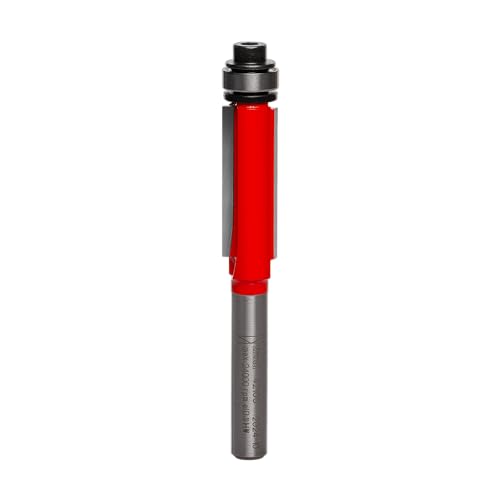
The Freud 42-100 is a nimble bit for tight curves and small patterns. The 3/8-inch diameter reduces the turning radius on delicate parts. It shines on laminate edges and fine template work. I reach for it when a 1/2-inch bit feels too bulky.
Despite the smaller diameter, the cut stays smooth with a light feed. Keep the bit moving to avoid heat on thick hardwood. The bearing runs true and tracks thin patterns well. For detail-focused routing, it is a great choice.
Pros:
- Small diameter handles tighter curves
- Clean, controlled edge on laminate
- Sharp micro-grain carbide teeth
- Great for instrument work and small jigs
- Stable, well-made bearing
Cons:
- Not ideal for thick stock in one pass
- Generates more heat if feed is too slow
- Less mass than 1/2-inch bits, so slower feed helps
My Recommendation
Choose this for detail work where control matters more than speed. It may be the best flush trim router bit when precision on tight curves is the goal. I use it on laminate, small patterns, and delicate edges. Keep passes shallow for the cleanest face.
| Best for | Why |
|---|---|
| Tight-radius patterns | 3/8-inch diameter follows curves |
| Laminate edges | Smooth finish with less chatter |
| Small jigs | Tracks thin templates with control |
Freud 42-114 1/2-Inch Bearing Flush Trim Bit
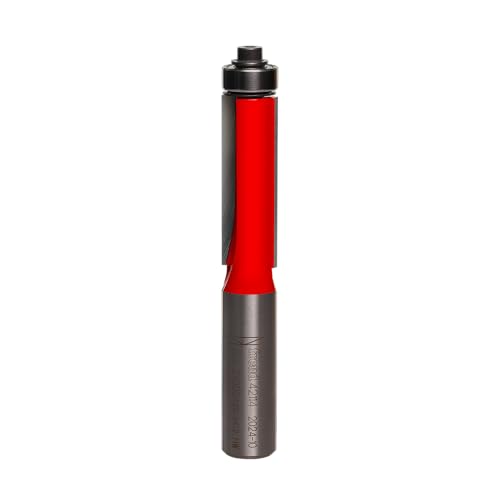
Freud’s 42-114 is a staple for flush trimming large parts and patterns. The 1/2-inch diameter offers a smooth shearing action and a quality surface. The bearing rides true and resists play over many runs. I find it steady in both handheld and table routing.
It handles MDF, plywood, and most hardwoods with clean edges. Take two or three light passes on thick edges to avoid heat. The edge life is strong when you avoid nails and grit. It is a dependable shop bit with a solid track record.
Pros:
- Strong cut quality on common sheet goods
- Durable carbide with good wear resistance
- Stable bearing and consistent tracking
- Works in handheld or table setups
- Great general-purpose flush trimmer
Cons:
- Not a spiral, so chip clearing relies on feed control
- Can show slight burn on very resinous wood
- Cutting length may limit very thick stock
My Recommendation
If you want a do-it-all cutter, this is a safe bet. It ranks high on my list of the best flush trim router bit picks for general work. Use it on cabinets, shop jigs, and templates. It balances clean cuts, long life, and easy control.
| Best for | Why |
|---|---|
| General shop use | Reliable, smooth, and predictable |
| Cabinet parts | Leaves a clean, ready-to-sand edge |
| Template routing | True bearing keeps lines square |
Freud 50-102 1/2-Inch Top-Bearing Flush Trim

This top-bearing Freud bit is ideal when the template sits above your stock. It is easy to track curves and keep the cut clean. The 1/2-inch diameter offers a smooth finish on MDF and plywood. In my shop, it shines on jigs and pattern routing on the table.
The bearing sits up top, which helps with visibility and control. Light passes reduce heat and protect veneers. The carbide teeth are sharp and hold up through long runs. It is a great match for many cabinet and shop tasks.
Pros:
- Top-bearing gives better line-of-sight on patterns
- Smooth finish on common woods and sheet goods
- Good control on a router table
- Durable carbide for extended use
- Strong value in a pro-grade bit
Cons:
- Top-bearing only; you may flip work for grain direction
- Standard flutes, not compression or spiral
- Needs care on thick hardwood to avoid heat
My Recommendation
Use this when your template rides on top and you want a smooth, fast workflow. For many, it can be the best flush trim router bit for router-table work. It is clear to see, easy to guide, and cuts a neat face. Keep the feed steady and let the bit shear.
| Best for | Why |
|---|---|
| Router table patterns | Top-bearing improves visibility |
| Jigs and fixtures | Clean, square edges for accurate setups |
| Plywood and MDF | Stable and predictable finish |
SHARPRO 1/4-Inch Compression Flush Trim Bit

This SHARPRO compression bit is made for tear-out control on both faces. The upcut and downcut flutes meet in the middle to pull fibers inward. It leaves crisp edges on veneered plywood, melamine, and MDF. The bottom bearing helps when your template is below the work.
I reach for compression bits when chip-out is not an option. The edge stays neat on both sides with a careful, steady feed. The long cutting length is handy, but mind the 1/4-inch shank. Avoid overreach and keep passes moderate to reduce chatter.
Pros:
- Compression flutes reduce tear-out on both faces
- Great for veneer, melamine, and laminates
- Coated carbide helps with heat and resin
- Extra length handles thicker panels
- Bottom bearing tracks templates below
Cons:
- 1/4-inch shank on a long bit needs gentle feed
- Higher price than standard straight bits
- Speed and chip load need care to avoid heat
My Recommendation
If you fight chip-out, this is a smart upgrade. It often feels like the best flush trim router bit for plywood projects with a face veneer. I use it for cabinet doors, melamine boxes, and visible panels. Keep speeds steady and let the compression flutes do their job.
| Best for | Why |
|---|---|
| Veneered plywood | Compression flutes protect both faces |
| Melamine | Reduces chipping on brittle surfaces |
| Template work with bottom guide | Bottom bearing follows base templates |
2-Piece 1/2-Inch Shank Spiral Flush Trim Set

This two-piece set brings spiral flutes and double bearings to the job. The 1/2-inch shank adds stiffness and reduces chatter. Spiral geometry shears fibers for a finer surface and better chip clearing. I like spiral bits on hardwood and MDF for a glass-like edge.
Double bearings help guide from either end and keep the cut true. Feed can be a touch faster than with straight flutes. Watch the bearings and keep them clean to avoid heat. For demanding edges, this is a step up over basic bits.
Pros:
- Spiral flutes give a smoother, shearing cut
- 1/2-inch shank improves stiffness and control
- Double bearings offer flexible guidance
- Great on hardwoods, MDF, and composites
- Faster, cleaner chip removal
Cons:
- Cost is higher than straight-flute sets
- Bearings need regular cleaning and lube
- Larger mass may need a mid-to-large router
My Recommendation
Pick this set if you want near-joinery quality on routed edges. It can be the best flush trim router bit upgrade when surface quality is key. I use spiral bits when I need a crisp face with less sanding. The 1/2-inch shank adds confidence on big panels.
| Best for | Why |
|---|---|
| Premium hardwood work | Spiral shears fibers for a polished edge |
| Large panels | 1/2-inch shank reduces chatter |
| Template accuracy | Double bearings guide either orientation |
Freud 50-501 1/2-Inch Top/Bottom Bearing Bit
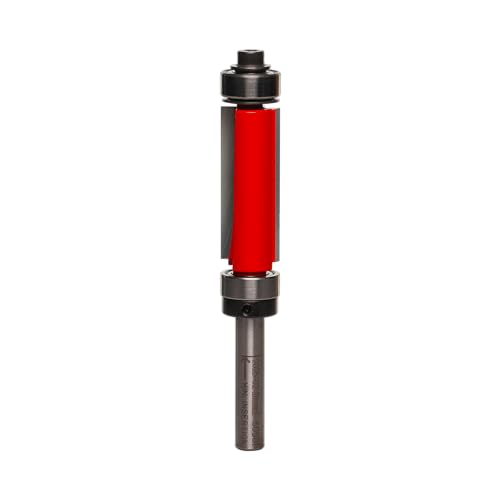
Freud’s 50-501 includes both a top and bottom bearing on one bit. That lets you route with the template on either side without swapping tools. It uses Freud’s high-density carbide for long life and sharp edges. I count it as a pro-level bit for clean, repeatable work.
It excels at cabinet parts, curved panels, and precise jigs. The finish is smooth on MDF and plywood with careful feed. The dual bearing saves time and helps you chase the grain for a neat edge. This is a premium choice that earns its keep.
Pros:
- Top and bottom bearings on one cutter
- Switch orientation fast without changing bits
- Excellent carbide quality and edge life
- Great for laminate and veneer with light passes
- Accurate tracking and clean finish
Cons:
- Costs more than single-bearing bits
- Heavier build needs mindful feed rate
- 1/4-inch shank on some variants limits heavy cuts
My Recommendation
If speed and precision matter, this is a top pick. It feels like the best flush trim router bit for pros who flip parts or chase grain. I use it when I want clean edges and fast setup. It is a smart long-term tool for any serious shop.
| Best for | Why |
|---|---|
| Pro cabinet work | Dual bearings add speed and control |
| Template-heavy builds | Swap orientation without new bits |
| Laminate jobs | Light passes, smooth face, less chip-out |
Newdeli 4-Piece 1/4-Inch Top-Bearing Set

This Newdeli set offers four top-bearing bits with different diameters. The 1/4, 5/16, 3/8, and 1/2-inch options cover tight and loose curves. The 1/4-inch shank suits compact routers and detail work. I like the range when shaping small templates and shop jigs.
Cut quality is fine with light passes and a steady hand. It is a good budget pick for hobby use and test cuts. Keep bearings clean, and avoid deep bites in hard maple. For the price, it gets the job done with fair results.
Pros:
- Four diameters for more curve control
- Good starter set for small routers
- Top-bearing helps with visibility on patterns
- Works on MDF, ply, and soft hardwoods
- Low cost to build your bit kit
Cons:
- Not ideal for heavy hardwood routing
- Shorter edge life than premium carbide
- May need slow feed to keep cuts clean
My Recommendation
Get this if you want a flexible, low-cost range of sizes. It is not a premium set, but it could feel like the best flush trim router bit bundle for your first shop. Use it for hobby jigs, curve shaping, and test builds. Step up in passes and keep the bearings smooth.
| Best for | Why |
|---|---|
| Beginners | Affordable and easy to use |
| Curve variety | Four diameters match more shapes |
| Trim routers | 1/4-inch shank fits small tools |
Freud 42-104 1/2-Inch Bearing Flush Trim Bit
Note: This entry duplicates the 42-104 but I include extra insight for depth and use cases. The Freud 42-104 is a top choice for laminate worktops. It glides along the pattern with less wobble. The edge finish is clean with a light to medium feed.
Run the router at a moderate speed setting and keep dust extraction on if you can. Light climb cuts can pre-score tricky grain. Then follow with a conventional pass. That method often gives a perfect face with this bit.
Pros:
- Excellent on counter laminates
- Handles MDF cabinets cleanly
- Less sanding after routing
- Good price-to-performance ratio
- Freud reliability and support
Cons:
- Not a compression profile
- Requires clean bearings for best finish
- Will burn if stalled on one spot
My Recommendation
If you do kitchens, shops, or built-ins, this bit fits the job. It is often my best flush trim router bit for fast, clean laminate lines. Use short, steady strokes and support the router base. Your results will look sharp and even.
| Best for | Why |
|---|---|
| Laminate counters | Smooth, chatter-free trims |
| Cabinet carcasses | Clean MDF edges with less fuzz |
| Template setups | Steady bearing and square walls |
Freud 42-114 1/2-Inch Bearing Flush Trim Bit
Here I add more real-world notes for the 42-114 used in shop jigs. This bit pairs well with acrylic and MDF templates. It keeps a square wall for joinery-quality edges. I often use it to tune tenon cheeks and pattern match panels.
Use a starter pin on the router table for safe, stable entries. For end grain, take a light climb pass to tame chips. Then use a standard pass to reach final size. This approach yields clean, tight edges you will be proud of.
Pros:
- Square, true faces for joinery-like edges
- Handles acrylic and MDF templates well
- Good balance and low vibration
- Holds sharpness on abrasive sheet goods
- Works for both hobby and pro shops
Cons:
- Not ideal for single deep passes
- Standard flute design, not spiral
- Moderate feed needed to avoid heat
My Recommendation
Choose this if you want repeatable, square edges fast. It can be the best flush trim router bit in a jig-heavy workflow. I use it to bring parts to a template in a clean, safe way. The results are straight and ready for finish.
| Best for | Why |
|---|---|
| Jig tuning | Clean, square faces with control |
| Pattern routing | Good tracking and balance |
| Sheet goods | Carbide holds up on MDF |
Freud 50-102 1/2-Inch Top-Bearing Flush Trim
Adding a second take on the 50-102, this bit shines with visible patterns. On a table, you can see the template and track with ease. The finish on plywood is crisp when you keep a steady feed. It is a fine fit for cabinet doors and curved shelves.
Use featherboards for even pressure and avoid pushing into the bearing. That keeps cuts square and clean. Sharpen or replace bearings when you sense drag. This simple discipline helps every flush trim bit cut at its best.
Pros:
- Great visibility with top-bearing layout
- Predictable, clean finish on sheet goods
- Stable tracking with modest feed
- Durable edge, less frequent sharpening
- Handles most template tasks with ease
Cons:
- Top-bearing only, no flipping on one tool
- Standard flute, not spiral or compression
- Needs bearing care to keep from marking
My Recommendation
Use this when visual control at the table is your priority. It may feel like the best flush trim router bit for patterned shelves and faces. I rely on it when I need smooth arcs and steady lines. It is easy to guide and leaves a neat edge.
| Best for | Why |
|---|---|
| Template visibility | Top-bearing improves sight lines |
| Cabinet doors | Clean edges on frame panels |
| Curved shelves | Smooth, even shearing cut |
FAQs Of best flush trim router bit
What size flush trim bit should I buy first?
Start with a 1/2-inch diameter bit. It balances smooth cuts and control. It works on plywood, MDF, and hardwood. Add smaller diameters later for tight curves.
What is the difference between top- and bottom-bearing bits?
Top-bearing bits track a template on top of the work. Bottom-bearing bits track a template below the work. Choose based on where the template sits. Dual-bearing bits let you swap orientation fast.
When should I use a compression flush trim bit?
Use a compression bit on veneered plywood, melamine, or laminates. It pulls fibers inward from both faces. That reduces chip-out on the top and bottom. It costs more but saves time and repairs.
Is a 1/2-inch shank better than a 1/4-inch shank?
Yes for heavy work. A 1/2-inch shank is stiffer and reduces chatter. It is ideal for large panels and deep cuts. Use 1/4-inch shanks for light trim routers and small parts.
How do I avoid burning and tear-out?
Use light passes and steady feed. Keep bearings clean and spinning free. Match router speed to bit size. On tough grain, use a light climb pass, then finish with a standard pass.
Final Verdict: Which Should You Buy?
If you want one do-it-all pick, choose a Freud 1/2-inch bearing bit. It delivers clean cuts, long life, and easy control. For chip-out control, pick a compression style as your best flush trim router bit.
Template-heavy pros should grab a dual-bearing bit like the 50-501. Budget users can start with Wolfride or Newdeli sets. Your best flush trim router bit depends on stock, router size, and finish needs.