
The best pinless scroll saw blades combine clean cuts, control, and long life.
You fire up the scroll saw to cut a tight inside curve, but the blade wanders, the back tears out, and your patience runs thin. I’ve been there. The right blade feels like a quiet guide for your hands. It tracks straight, cleans the bottom fibers, and holds an edge through hardwood knots and layered plywood. Whether you cut fretwork, inlays, or names for gifts, the best pinless scroll saw blades turn struggle into flow. In this guide, I break down the standouts and help you pick a set that matches your saw, your projects, and your pace.

Ultra Reverse 60 pc Variety…
Flying Dutchman scroll saw blades are 5″ long and pinless. Milled blades, which makes a sharper cutting edge. Manufactured in Germany with top-grade high-quality hardened steel. Ultra Reverse pinless blades…

FOXBC 5 Inch Plain End…
5 Inch Plain End Scroll Saw Blade Set Includes: (12 Pack) with 28 teeth per inch, (12 Pack) with 12 teeth per inch, (12 Pack) 10 teeth per inch FOXBC…

Heavy Duty 60 pc Variety…
Flying Dutchman scroll saw blades are 5″ long and pinless. Milled blades, which makes a sharper cutting edge. Manufactured in Germany with top-grade high-quality hardened steel. The Flying Dutchman Heavy…
Flying Dutchman Ultra Reverse, 60-Pack
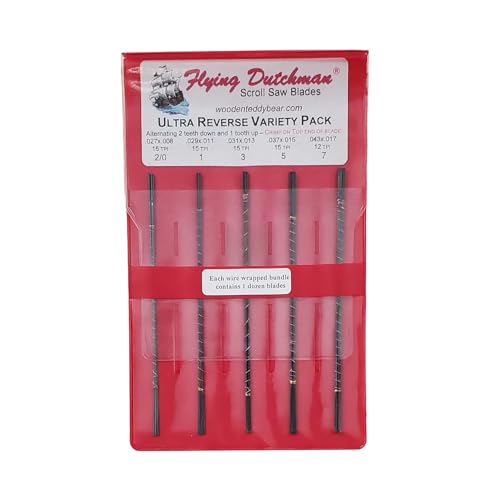
The Ultra Reverse 60-pack from Flying Dutchman is a trusted pick for clean backs and smooth curves. These are pinless, plain-end blades with reverse-tooth geometry that lifts fibers on the upstroke, cutting down on bottom tear-out. If you often cut thin veneers, Baltic birch, or tight fretwork, the control on inside turns is a joy. The set includes a variety of sizes so you can match blade to material and detail.
I like how these blades track straight under light tension. The steel feels consistent, and breakage is low if you let the teeth do the work. On scroll saw puzzles and ornaments, the edges look crisp with less sanding. If you’re hunting the best pinless scroll saw blades for smooth results across a range of woods, this mix is an easy win.
Pros:
- Reverse teeth reduce bottom tear-out on plywood and veneers
- Variety pack covers delicate cuts and thicker stock
- Straight tracking helps with tight inside curves
- Durable steel holds an edge across long sessions
- Low chatter in hardwood when tensioned right
Cons:
- Reverse-tooth learning curve for some users
- Labeling can rub off; sort sizes before storage
- Not ideal for very thick exotic hardwoods
My Recommendation
This 60-pack is great for hobbyists and pros who want clean backs and fewer burn marks. The reverse-tooth layout shines on thin to medium stock, craft plywood, and fine fretwork. If you want the best pinless scroll saw blades for all-around use with less sanding, start here. It gives you range, control, and value in one box.
| Best for | Why |
|---|---|
| Fretwork and ornaments | Reverse teeth clean the bottom surface |
| Baltic birch plywood | Smooth edges, less fuzz, less sanding |
| Mixed material projects | Variety pack suits many thicknesses |
FOXBC Plain-End Set, 36-Pack (10–28 TPI)
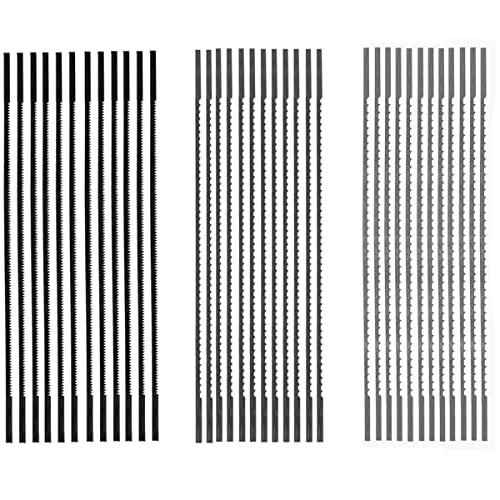
This FOXBC 36-pack gives you three tooth counts for common jobs. The 10 TPI works for thicker softwoods and rough cuts, while 12 TPI and 28 TPI handle finer detail and thinner stock. The plain-end design fits most clamp-style scroll saws that accept pinless blades. For the price, it’s a solid starter or backup set to keep on the bench.
I like this mix for learners who are building skill on curves and inside cuts. The blades load fast and tension without drama. Edge life is fair for high carbon steel, and you can swap sizes quickly as your cuts change. For those seeking the best pinless scroll saw blades on a budget, FOXBC offers good value.
Pros:
- Good mix of TPI for common cuts
- Budget-friendly for practice and production
- Decent edge life in softwoods and plywood
- Simple, consistent tensioning in plain-end clamps
- Clear size options reduce guesswork
Cons:
- Not reverse-tooth; more sanding on the back
- Edge dulls faster in dense hardwoods
- Limited ultra-fine detail options
My Recommendation
Pick this if you want an affordable, reliable set to learn on or to fill gaps. It suits craft plywood, pine, and MDF templates with clean, even cuts. While not the absolute best pinless scroll saw blades for high-end hardwood detail, it holds its own for many shop tasks and hobby projects with a light touch.
| Best for | Why |
|---|---|
| Beginners on a budget | Affordable mix of TPI to learn techniques |
| Softwood and plywood | Cuts fast with fair control |
| Shop backups | Handy set to keep projects moving |
Flying Dutchman Heavy Duty, 60-Pack
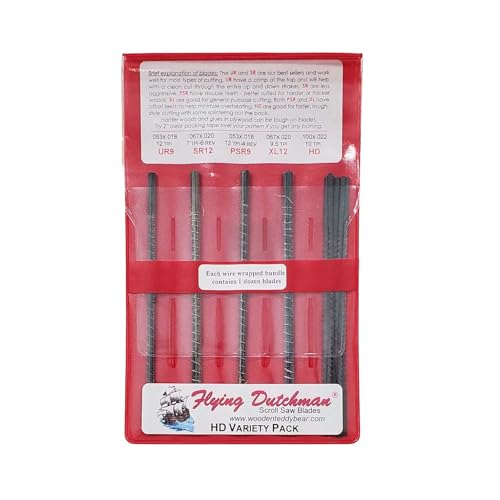
The Heavy Duty 60-pack from Flying Dutchman targets thicker stock and tougher woods. The tooth set and gauge give you bite without wild wandering. I reach for these when I cut hardwood plaques, 3D patterns, and thicker laminations. They hold tension well and keep a straight line through grain changes.
These are some of the best pinless scroll saw blades if you want strength first. They resist snapping when you pivot or backtrack in tight areas. Expect less fuzz on top surfaces and good control on outside profiles. If you often cut over 3/4-inch material, this set earns its place.
Pros:
- Robust gauge for thicker hardwoods
- Confident tracking through knots and grain
- Lower breakage under pivoting stress
- Good life with steady feed rate
- Variety of sizes for common heavy cuts
Cons:
- Not ideal for ultra-fine fretwork
- May leave more sanding on bottom without reverse teeth
- Feels stiff for thin veneers
My Recommendation
Choose this 60-pack if your work leans thick, hard, and bold. It’s great for plaques, puzzles in hardwood, and stacked cuts where stiffness matters. If you want some of the best pinless scroll saw blades for heavy work without babying the blade, this set brings calm power.
| Best for | Why |
|---|---|
| Hardwoods and thicker stock | Stiff blade body and tooth set |
| Stack cutting | Holds a straight line under load |
| Bold outside profiles | Fast, confident feed without chatter |
WEN Spiral Pinless #2, 12-Pack (41 TPI)

Spiral blades cut in any direction thanks to teeth that wrap the blade. This WEN #2 size at 41 TPI is tuned for tight scroll work where you can’t keep turning the workpiece. It excels at inside cuts, letters, and narrow bridges where a standard blade binds. The pinless, plain-end design fits most clamp-type saws.
Cut quality is crisp in thin hardwoods and ply when the feed is light. Expect fine kerfs and smooth arcs with fewer pilot holes. If you’re after the best pinless scroll saw blades for freehand detail and delicate curves, a good spiral like this belongs in your drawer.
Pros:
- Cuts in any direction—great for intricate shapes
- Fine kerf for delicate patterns and letters
- Reduces need to rotate the workpiece
- Good control in thin hardwoods and plywood
- Pinless design fits common scroll saws
Cons:
- Learning curve on feed pressure and pace
- Back surface can fuzz if pushed too hard
- Not the fastest in thick stock
My Recommendation
Buy these if you love detailed, flowing designs where standard blades slow you down. They are some of the best pinless scroll saw blades for script fonts, spirals, and tiny inside cuts. Keep your touch light and let the wrap-around teeth glide the shape.
| Best for | Why |
|---|---|
| Letters and filigree | Any-direction cutting without binding |
| Thin hardwood patterns | Fine kerf with tight control |
| Inside cuts | Fewer turns, cleaner arcs |
FOXBC Pin-End 5″ Replacements, 48-Pack

This 48-pack is a pin-end set made for models like the WEN 3921/3923, Dremel, Craftsman, Delta, and more. While this article focuses on the best pinless scroll saw blades, many saws still use pin-end blades. If you own a pin-end saw or adapters, this is a handy bulk pack. The high carbon steel cuts well in softwoods and common craft stock.
They load fast thanks to the pins and keep alignment for quick jobs. For patterns with fewer inside cuts, they get you moving quickly. If you later switch to pinless clamps, you can still keep these for your pin-end machine. It’s a simple, reliable set for everyday craft cutting.
Pros:
- Compatible with many common pin-end saws
- Quick loading with secure pin alignment
- Good for softwoods, MDF, and craft ply
- Large pack size for steady use
- Budget-friendly replacement option
Cons:
- Not pinless—won’t fit plain-end clamps without adapters
- Less ideal for very fine fretwork
- More tear-out than reverse-tooth pinless blades
My Recommendation
Choose this only if your saw needs pin-end blades or you have adapters on hand. For pure performance, the best pinless scroll saw blades offer more finesse, but these are solid for quick craft cuts and templates. Keep a pack in the shop if you run a pin-end machine often.
| Best for | Why |
|---|---|
| Pin-end scroll saws | Direct fit with fast loading |
| Craft plywood and MDF | Clean enough cuts at low cost |
| Quick templates | Simple, no-fuss blade swaps |
Flying Dutchman Ultra Reverse #5, 72-Pack

The Ultra Reverse #5 is a sweet spot size for many scroll saw tasks. This 72-pack focuses on one size that many woodworkers use daily. Reverse-tooth geometry cleans the bottom and leaves a smooth edge in 1/4 to 3/4-inch stock. If you burn through #5 blades often, buying in bulk saves time and cash.
I reach for #5 when I need a balance of speed and detail. It works in hardwoods, ply, and softwoods with the right feed. The control is steady in curves and tight arcs. If you want the best pinless scroll saw blades in a single, all-purpose size, this is a workhorse pack.
Pros:
- All-purpose #5 size suits many jobs
- Reverse teeth reduce bottom fuzz
- Bulk 72-pack is efficient for frequent use
- Good control on curves and tight turns
- Consistent quality and low break rate
Cons:
- Single size—less flexible for ultra-thin or very thick stock
- May still need sanding on end grain
- Not ideal for micro fretwork
My Recommendation
If your projects live in the mid-range of material thickness, this is a go-to blade. It’s one of the best pinless scroll saw blades for general shop and craft work. Keep a tube in reach, and you’ll cover 80% of your day-to-day cuts.
| Best for | Why |
|---|---|
| General-purpose cutting | #5 hits the sweet spot of speed and control |
| Plywood up to 3/4 inch | Reverse teeth clean the back |
| Batch production | Bulk pack reduces downtime |
5″ Pinless HCS Set, 50-Pack (10 & 28 TPI)

This 50-pack pinless set blends coarse 10 TPI and fine 28 TPI blades. That gives you speed for thicker work and detail for thin sheets. The high carbon steel is straightforward and easy to tension. For makers who need a lot of blades fast, this set fills the drawer without draining the wallet.
I suggest using 10 TPI for pine and layered stock, and 28 TPI for acrylics and thin ply. Keep your feed light on plastics to avoid melting. If you need the best pinless scroll saw blades for mixed shop tasks and light metals, this set offers range and value.
Pros:
- Two TPI choices for thick and thin materials
- Works on wood, plastics, and non-ferrous metals
- Affordable bulk pack for high-use shops
- Easy to load and tension
- Good starter kit for new users
Cons:
- No reverse-tooth option in the mix
- Dulls quicker in dense hardwoods
- Finish may need sanding on bottom face
My Recommendation
Go with this set if you split your time between wood, plastic, and thin metals. The 10 and 28 TPI sizes cover most test cuts and jigs. While not top-tier in every way, these are some of the best pinless scroll saw blades for budget-minded versatility.
| Best for | Why |
|---|---|
| Mixed materials | Two TPI options handle wood and plastics |
| Budget builds | Large count at a fair price |
| Prototyping | Quick changes to dial in cut quality |
Spiral Pinless #7, 5″ Plain-End

This #7 spiral blade is a step up in size for faster cutting and more open kerfs. It’s great when you want spiral freedom but need more speed than a fine #2. The teeth wrap the blade, so you can pull lines in any direction. That makes it useful for marquetry, inlay borders, and complex inside curves.
Use light, even feed pressure and let the blade float the design. In medium stock, it holds a neat edge and reduces burning with steady pace. If you are building a kit of the best pinless scroll saw blades, a #7 spiral earns a spot next to your fine spirals.
Pros:
- Any-direction cutting for complex shapes
- Faster feed than finer spiral sizes
- Good control in medium stock
- Plain-end compatibility
- Useful kerf for inlay and marquetry borders
Cons:
- Wider kerf than fine spirals
- Back fuzz if pushed too hard
- Less ideal for micro-detail
My Recommendation
Pick this if you love spiral freedom but want more pace. It sits between delicate and bold, which is handy for many designs. For artists who collect the best pinless scroll saw blades for specific roles, a #7 spiral is a great mid-range tool.
| Best for | Why |
|---|---|
| Curvy borders and inlay | Any-direction cutting, steady kerf |
| Medium stock detail | Balanced speed and control |
| Inside cuts | Less rotation, cleaner flow |
Flying Dutchman Spiral Variety, 60-Pack
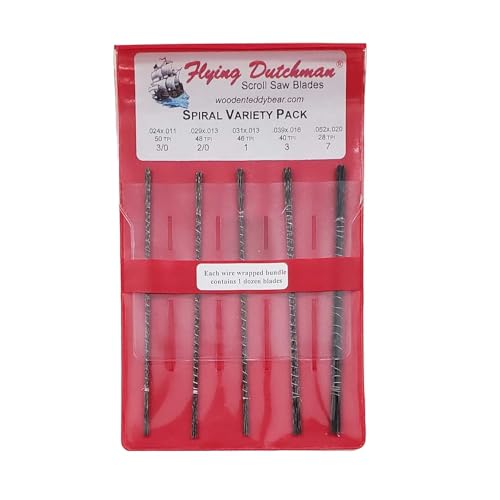
When I want spiral blades for many tasks, this Flying Dutchman variety pack is my pick. You get several sizes to match stock and detail needs. Spirals cut in every direction, so you spend less time turning the work or drilling extra pilot holes. For complex fretwork, this speeds up the flow.
The steel quality is consistent, with good edge life when you avoid forcing the feed. Expect cleaner curves with practice and a gentle touch. If you want the best pinless scroll saw blades in spiral form, this 60-pack covers your bases from fine to fast.
Pros:
- Complete size range for spiral cutting
- Smooth, predictable feel with light feed
- Great for letters, scrolls, and complex shapes
- Reduces workpiece rotation
- Stable performance across the set
Cons:
- Spiral learning curve can be steep
- Back fuzz if you rush the cut
- Not as clean as reverse-tooth on bottom faces
My Recommendation
Get this if you cut a lot of intricate work and want options at hand. It’s one of the best pinless scroll saw blades sets for spiral lovers. Master the feed, and you’ll unlock new designs that are hard with standard blades alone.
| Best for | Why |
|---|---|
| Intricate fretwork | Any-direction cut saves time and effort |
| Script and curves | Fine control in tight shapes |
| Mixed thickness | Multiple sizes match the job |
5″ Pinless Plain-End Mix, 45-Pack

This 45-pack blends 10, 12, and 28 TPI plain-end blades for wood, plastics, and non-ferrous metals. It’s a flexible box for shops that jump across materials. The pinless design fits clamp-style saws and keeps setup simple. It’s a good all-rounder for craft shows, gifts, and weekend builds.
With light feed, the 28 TPI works well in acrylic and thin aluminum. Use 10–12 TPI for wood and stacked cuts where speed matters. If you’re building a bench kit of the best pinless scroll saw blades, this set fills many everyday roles at a fair price.
Pros:
- Useful TPI spread for many materials
- Pinless, easy to tension and align
- Decent life with steady, cool feed
- Good value for mixed-use shops
- Clear sizing for quick swaps
Cons:
- No reverse-tooth options
- Dull faster in very dense hardwood
- Edges may need cleanup on plastics if rushed
My Recommendation
Choose this 45-pack if you like one kit that can do a lot. It’s not a specialist, but it covers wood, plastic, and light metal well. Among the best pinless scroll saw blades for day-to-day variety, it’s a reliable choice for the home shop.
| Best for | Why |
|---|---|
| General shop work | Three TPI options fit many tasks |
| Plastics and thin metal | 28 TPI helps avoid chip-out and melt |
| Stack cutting wood | 10–12 TPI speed with control |
Ultra Reverse 60-Pack Variety (Recap)
Note: This entry highlights the same Ultra Reverse family for clarity in variety packs. The reverse-tooth design keeps the back of your work neat. This wins time when you cut ornaments, signs, and puzzles. I like how the sizes move from delicate to sturdy without losing feel.
When I test blades, I look for clean lines and low fuzz with gentle feed. This set passes that test and stays sharp for long sessions. If you plan to buy only one variety pack, these are among the best pinless scroll saw blades for consistent results.
Pros:
- Reverse teeth help with clean backs
- Wide size range for many tasks
- Steady tracking and low chatter
- Good life on hardwoods and ply
- Great for show-ready edges
Cons:
- Reverse-tooth learning curve
- Not ideal for ultra-thick exotic woods
- Labels can fade in shop dust
My Recommendation
Use this if you value finish quality as much as speed. It’s a versatile set that earns trust cut after cut. For many makers, these are the best pinless scroll saw blades to keep as a daily driver.
| Best for | Why |
|---|---|
| Showpiece edges | Reverse teeth fight tear-out |
| Fretwork variety | Sizes for both fine and bold cuts |
| Plywood projects | Clean backs reduce sanding time |
FOXBC Plain-End Set, 36-Pack (Recap)
This recap entry underlines the value play of the FOXBC 36-pack. Three TPIs make it easy to match stock and detail without guesswork. In day-to-day cutting, the blades tension well and cut clean lines. It’s a useful basis for a small shop kit.
Finer blades keep edges smooth in ply and thin hardwoods, while 10 TPI brings speed to thicker parts. If you want the best pinless scroll saw blades for learning, prototyping, or backup use, this set is a safe bet. It fills the gaps when a premium blade runs low.
Pros:
- Simple, practical TPI mix
- Plain-end fits many saws
- Good starter kit for skill-building
- Budget-friendly for volume work
- Easy blade swaps
Cons:
- No reverse teeth
- Edge life is average in dense stock
- Limited ultra-fine options
My Recommendation
Keep this set on hand if you move between workstations or classes. It’s not fancy, but it’s dependable. As part of a larger blade plan, these remain among the best pinless scroll saw blades for the price.
| Best for | Why |
|---|---|
| Classrooms and clubs | Affordable, consistent results |
| Practice runs | Good for skill drills and tests |
| General backup | Fills in when premium blades run out |
Buying Tips: Choose the Right Pinless Blade
Here’s how I match blades to projects for clean, calm cuts. Keep these points in mind as you pick from the list above. The best pinless scroll saw blades shine when you match teeth and thickness to the job.
Material thickness: For 1/8 to 1/4-inch stock, fine blades like #2/0 to #3 keep detail sharp. For 1/4 to 3/4 inch, a #5 or #7 balances speed and control. Over 3/4 inch, heavy-duty or coarser teeth prevent stalling.
Tooth style: Reverse-teeth reduce bottom tear-out in ply and veneers. Standard-tooth runs fast but leaves more fuzz. Spiral blades cut any direction and help with letters, inside curves, and tight bridges.
Material type: For hardwoods, pick a blade with sturdy gauge and sharp set. For plastics, use higher TPI and light feed to avoid melt. For thin metals, use fine TPI and go slow with lube if allowed.
Feed and tension: Let the teeth cut—don’t force. Keep tension firm, with minimal deflection when you pluck the blade. A calm feed gives the best line and the best life from the best pinless scroll saw blades.
FAQs Of best pinless scroll saw blades
How do I stop tear-out on the bottom of my cuts?
Use reverse-tooth pinless blades and support the work with clean backing. Keep feed steady and avoid forcing the cut.
Which blade size covers most projects?
A #5 reverse-tooth plain-end blade handles many jobs from 1/4 to 3/4 inch with clean results.
Are spiral blades better than standard blades?
They’re better for complex inside cuts and letters. Standard blades cut faster and leave cleaner bottoms with reverse teeth.
What TPI should I use for plastics?
Use higher TPI, like 28 or more, with a light, cool feed. This reduces melt and chipping.
Why do my blades break often?
Likely from too much feed, low tension, or twisting. Slow down, increase tension, and pivot smoothly.
Final Verdict: Which Should You Buy?
If I had to pick one, I’d choose the Flying Dutchman Ultra Reverse 60-Pack. It delivers clean backs, smooth curves, and great control across many materials.
For most users seeking the best pinless scroll saw blades, that variety pack hits the sweet spot. It balances finish, speed, and value in a way few sets match.